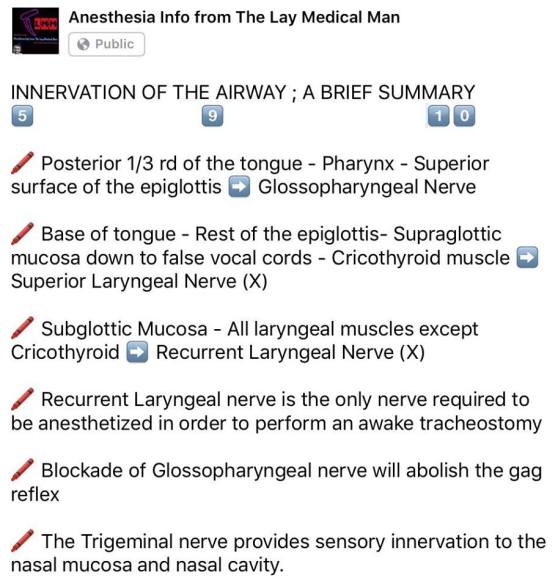
VIVA SCENE: NERVE SUPPLY OF AIRWAY / LARYNX

17424819_1290023894366762_819631840420383430_n

Morphine and Hydromorphone

  • Morphine is metabolised via hepatic system and excreted by renal system
  • It can get accumulated in hepatic/renal dysfunction and obesity
  • Morphine has 2 metabolites:
  • Morphine 6 glucoronide- Active metabolite: responsible for analgesia and sedation
  • Morphine 3 glucoronide: Can cause seizures
  • Morphine has histamine releasing property
  • Hydromorphone is more potent than morphine
  • Hydromorphone doesnt have active metabolites
  • Hydromorphone lacks histamine release

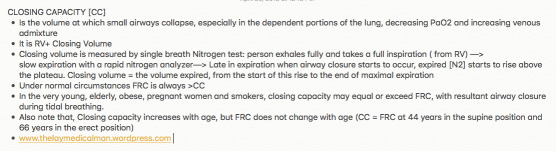
CLOSING CAPACITY

Screen Shot 2018-04-25 at 12.15.05 PM

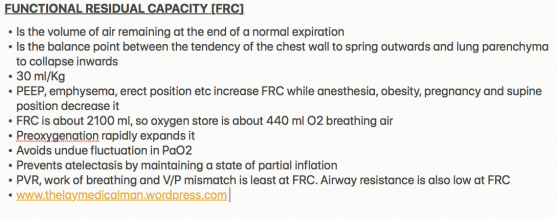
FUNCTIONAL RESIDUAL CAPACITY [FRC]

Screen Shot 2018-04-23 at 5.18.47 PM

The functional residual capacity of the infant’s lungs is only one half that of an adult in relation to body weight. This difference causes excessive cyclical increases and decreases in the newborn baby’s blood gas concentrations if the respiratory rate becomes slowed because it is the residual air in the lungs that smooths out the blood gas variations.

The functional residual capacity  equals the expiratory reserve volume  plus the residual volume.  This is the amount of air that remains in the lungs at the end of normal expiration (about 2300 milliliters).
INTRA-PLEURAL PRESSURE

  • The resting position of the lungs and chest wall occurs at FRC.
  • If isolated, the lungs, being elastic, would collapse to a volume <FRC.
  • The isolated thoracic cage would normally have a volume >FRC.
  • Since the chest wall is coupled to the lung surface by the thin layer of intrapleural fluid between parietal and visceral pleura, opposing lung and chest wall recoil forces are in equilibrium at FRC.
  • This produces a pressure of about −0.3 kPa [−2 mmHg ] in the pleural space.
  • Normal inspiration reduces intrapleural pressure further to −1.0 kPa [−6 mmHg] but with forced inspiration it can reach negative pressures of −4.0 kPa or more.
  • Intrapleural pressure may be measured by an intrapleural catheter or from a balloon catheter placed in the mid-oesophagus [Oesophageal pressures
    tend to reflect intrapleural pressures]
  • In the upright adult the intrapleural pressure at the base of the lung is approximately 0.7 kPa greater than the pressure at the apex
  • It will increase during coughing
  • -1.0 kPa intrapleural pressure is equivalent to a distending transpulmonary pressure of +1.0 kPa

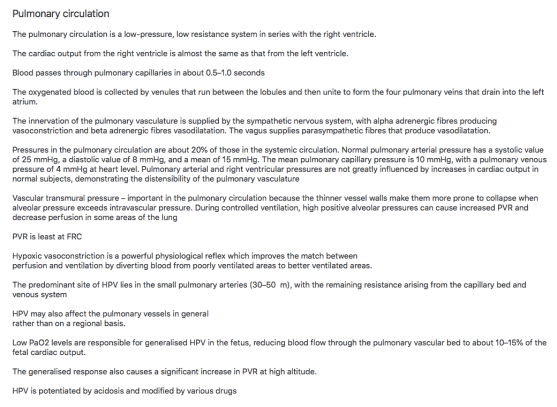
PULMONARY CIRCULATION

Pulm vasc

DOXAPRAM

Management options in hypercalcemia

  • Administration of normal saline
  • Loop diuretics like Frusemide ( Thiazides will increase the tubular absorption of calcium)
  • Calcitonin
  • Bisphosphonates
  • Mithramycin
  • Hydrocortisone
  • Hemodialysis
  • Hypercalcemia per se doesn’t contraindicate any specific anesthetic drug or technique