Rewriting the Rules for Brain Bleeds: What INTERACT3 Taught Us

Spontaneous intracerebral haemorrhage has long carried an air of clinical resignation, the diagnosis that quietly lowered everyone’s expectations before treatment had even begun. INTERACT3, published in The Lancet in May 2023, unsettled that fatalism. It changed not a drug but a way of thinking, and it has since become impossible to discuss acute haemorrhagic stroke without reference to it.

The Trial in Brief

INTERACT3 was a pragmatic, international stepped-wedge cluster-randomised trial enrolling 7,036 patients across 121 hospitals, most of them in low- and middle-income countries. Instead of testing a single molecule, it asked whether a coordinated care bundle, begun within hours of the bleed, could alter the course of the illness. The bundle drew together four physiologically targeted actions: intensive systolic blood pressure lowering to a target below 140 mmHg; strict glucose control (6.1–7.8 mmol/L in patients without diabetes, 7.8–10.0 mmol/L in those with it); fever control holding temperature at or below 37.5°C; and rapid reversal of anticoagulation to an INR below 1.5.

What the Numbers Showed

The primary outcome was functional recovery, measured by a modified Rankin Scale shift analysis at six months. The bundle came out ahead, with a common odds ratio of 0.86 (95% CI 0.76–0.97; p=0.015). The advantage extended beyond function. Mortality fell from 17.0% to 14.1%, and serious adverse events dropped from 20.1% to 16.0%. In a disease so often treated with a shrug, these are shifts of real consequence.

The Story of Secondary Injury

The physiology explains why. Outcome after an intracerebral haemorrhage is shaped less by the original bleed than by the secondary injury that follows, and each element of the bundle disarms a different, time-sensitive part of that cascade.

The first threat is early haematoma expansion, which occurs in roughly a third of patients within the opening hours and responds to blood pressure. That is the rationale for rapid, controlled lowering of systolic pressure. The trial’s smooth, protocol-guided titration also mattered: it likely spared patients the falls in renal and cerebral perfusion that may have blunted the effect in earlier blood-pressure trials such as ATACH-2.

Alongside pressure sit hyperglycaemia and fever, each an independent driver of perihaematomal oedema, oxidative stress, and a faltering penumbral metabolism. Anticoagulation-associated bleeds carry the highest expansion risk of all, which places rapid reversal among the most valuable components of the bundle.

The deeper lesson runs beneath the individual parts. None of these interventions had previously shown a convincing functional benefit on its own. Delivered together, early and in concert, they moved patients measurably towards independence. The whole outperformed the sum of its parts.

From Nihilism to a Protocol Worth Running

This reframes the disease. Intracerebral haemorrhage moves from a condition met with therapeutic nihilism to an actionable, protocol-driven emergency, one that sits naturally beside the bundled approaches already familiar from sepsis and STEMI care. For the neuroanaesthesiologist and neurointensivist, the implication is concrete: systems-level implementation — standing order sets, rapid-reversal pathways, and pre-specified physiological targets switched on in the emergency department and carried through into the operating room — achieves what isolated pharmacological effort has not.

Reading the Evidence Honestly

Two caveats temper the enthusiasm. The stepped-wedge design is vulnerable to temporal confounding and cannot, by its structure, isolate which single element carried the benefit, which means the bundle should be adopted as a complete package rather than dismantled into favoured parts. And because most patients were recruited in lower-resource settings, questions of external validity and generalisability deserve open acknowledgement rather than quiet assumption.

These limits notwithstanding, INTERACT3 is well positioned to shape forthcoming AHA/ASA and European Stroke Organisation guidance. It establishes early, multimodal physiological control as the emerging standard of care in acute intracerebral haemorrhage.


Sources: INTERACT3, The Lancet (2023) · INTERACT3 full text, PMC

Reading the Pupil Anew: Automated Pupillometry in Neurological Monitoring

For over a century, the pupillary examination has rested on a simple ritual: a clinician, a penlight, and a judgement rendered in an instant — is the pupil brisk, sluggish, or unresponsive? It is among the most venerable of bedside assessments, and also among the least dependable. When clinicians examine the same patient, their agreement on whether the pupils are unequal falls below fifty percent, and the unaided eye is wholly incapable of detecting the subtle, incremental changes that so often precede deterioration.

Automated pupillometry offers a more rigorous alternative. A calibrated flash of light is delivered, the pupil’s response recorded in fine detail, and the result distilled into a single value — the Neurological Pupil index (NPi), scaled from 0 to 5, with anything below 3 flagged as abnormal. In shining light and measuring the constriction that follows, the device tests the full pupillary light reflex — the afferent limb carried by the optic nerve (cranial nerve II) that senses the light, and the efferent limb carried by the parasympathetic fibres of the oculomotor nerve (cranial nerve III) that drives constriction. Its warning power rests chiefly on the efferent (CN III) pathway, which is exquisitely sensitive to rising intracranial pressure and is compressed early as the brain begins to herniate. A gradually falling NPi can therefore signal catastrophe hours before the dreaded “blown pupil” appears. Measured every four to six hours, it now helps anticipate dangerous swelling after stroke, head injury, and surgery, and — via the 2025 NPi-Connect system — feeds straight into the medical record as a trackable vital sign independent of who holds the light.

The supporting evidence continues to accumulate. Automated pupillometry is now employed to anticipate dangerous brain swelling in stroke, with measurements taken every four to six hours to follow the trajectory rather than a single isolated reading. The same principle has proven valuable following traumatic brain injury and neurosurgery, where a falling NPi identifies patients on the verge of decline. In early 2025, a system known as NPi-Connect began transmitting these readings directly into the electronic medical record, establishing the NPi as a properly documented, trackable vital sign that no longer depends upon the individual performing the examination.

The limitations, however, deserve candid acknowledgement. Commonly used sedatives and analgesics — opioids and dexmedetomidine among them — blunt the pupillary response, and recent work demonstrates that the depth of sedation can meaningfully distort the reading. Iris pigmentation, prior ocular surgery, direct orbital trauma, and certain neuromuscular conditions may all degrade its accuracy, and the measurement interrogates only a single nerve pathway, offering no insight into the wider brain. The four-to-six-hour intervals between readings likewise leave unmonitored windows.

The most compelling horizon lies in estimating the pressure within the skull without breaching it at all. Emerging systems infer that pressure from the faint pulsatile expansion of the skull, from gentle microwave or near-infrared signals, or from ultrasound of the sheath surrounding the optic nerve. One such approach now falls within roughly 3 mmHg of the true value, achieving accuracy to within a few points in approximately 72 percent of cases. Combining these signals — the pupillary index, a non-invasive pressure estimate, and the optic nerve measurement — offers a credible route toward sparing many patients an invasive monitor placed through the skull. For the present, the invasive monitor retains its primacy, and the prudent posture is to regard pupillometry as a valuable early-warning companion rather than the sole arbiter of a swelling brain.

How Much Blood Does an Injured Brain Need? What do HEMOTION and TRAIN tell?

The messages

For years, ICUs treated anemia in brain-injured patients like anemia in anyone else: transfuse only when hemoglobin falls to about 70 g/L. Two large 2024 randomized trials HEMOTION (NEJM) and TRAIN (JAMA) have overturned that habit, marking the biggest shift in neurocritical-care transfusion practice in a decade.

Why the injured brain is different

Injured brain tissue has almost no reserve to pull extra oxygen from blood or raise blood flow in the vulnerable “penumbra” around the injury. So anemia isn’t just a lab number here it becomes a direct driver of secondary ischemic injury at hemoglobin levels the rest of the body tolerates. Both trials tested whether keeping hemoglobin higher protects the brain.

HEMOTION: a strong signal, just short of significance

Adults with moderate-to-severe traumatic brain injury and anemia were randomized to a liberal strategy (transfuse at Hb <100 g/L) or restrictive (<70 g/L), with unfavorable Glasgow Outcome Scale “Extended (GOS-E) at six months as the primary outcome. Unfavorable outcomes: 68.4% liberal vs 73.5% restrictive  a ~5-point improvement favoring liberal, but not statistically significant. A “negative” trial that still leans one way.

TRAIN: larger, broader, clearly positive

Bigger and wider  850 patients, 72 ICUs, 22 countries, including traumatic brain injury plus subarachnoid and intracerebral hemorrhage. Liberal trigger <9 g/dL vs restrictive <7 g/dL, GOS-E at 180 days. Liberal was clearly better: 62.6% vs 72.6% unfavorable, an absolute risk difference of 10.0%, with no excess clotting or lung injury.

Do they really disagree? No.

The trials are concordant in direction, differing only in power and breadth. HEMOTION’s confidence interval includes TRAIN’s result, and both favor transfusing sooner. The likely mechanism is better cerebral oxygen delivery at the microvascular level supported by benefit appearing in functional neurologic recovery rather than survival.

What this means at the bedside

Shift toward a liberal threshold of ~90-100 g/L, individualized by evidence of brain-tissue compromise (brain-tissue oxygen tension, an evolving infarct, vasospasm risk) rather than a rigid number. A 70 g/L default is now hard to defend in structural brain injury. Two caveats: neither trial showed a mortality benefit (the case rests on function), and both were underpowered for disease subgroups. The open frontier is titrating transfusion to real-time cerebral oximetry or brain-tissue oxygen monitoring rather than a single systemic haemoglobin value.

Bedside Weaning Assessment for Myasthenia Gravis

Bedside Test Procedure Normal / Reassuring Value Clinical Significance (Red Flag)
Clinical Assessment Observe for signs of respiratory distress and bulbar weakness (speech, swallowing). No accessory muscle use, effortless breathing, strong cough, clear voice. Tachypnea, accessory muscle use, paradoxical breathing, weak “boggy” cough, slurred/fading voice.
Vital Capacity (VC) Patient takes a maximal inhalation and exhales fully into a bedside spirometer. > 20 mL/kg (ideal body weight) < 15-20 mL/kg, or a declining trend during the breathing trial.
Negative Inspiratory Force (NIF) / MIP Patient makes a maximal inspiratory effort against an occluded airway for ~20 seconds. More negative than -30 cm H₂O Less negative than -30 cm H₂O (e.g., -25, -20), or a worsening trend.
Single Breath Count Patient takes a deep breath and counts aloud steadily (e.g., “1-one-thousand, 2-one-thousand…”). > 25 < 15-20. Indicates severely reduced vital capacity.
Head Lift Test Patient lies supine and lifts their head off the bed, holding the position as long as possible. > 30 seconds < 20 seconds. Correlates with significant diaphragmatic weakness.
Breath-Holding Time After a maximal inhalation, the patient holds their breath for as long as possible. > 30 seconds < 20 seconds. Suggests poor respiratory reserve.

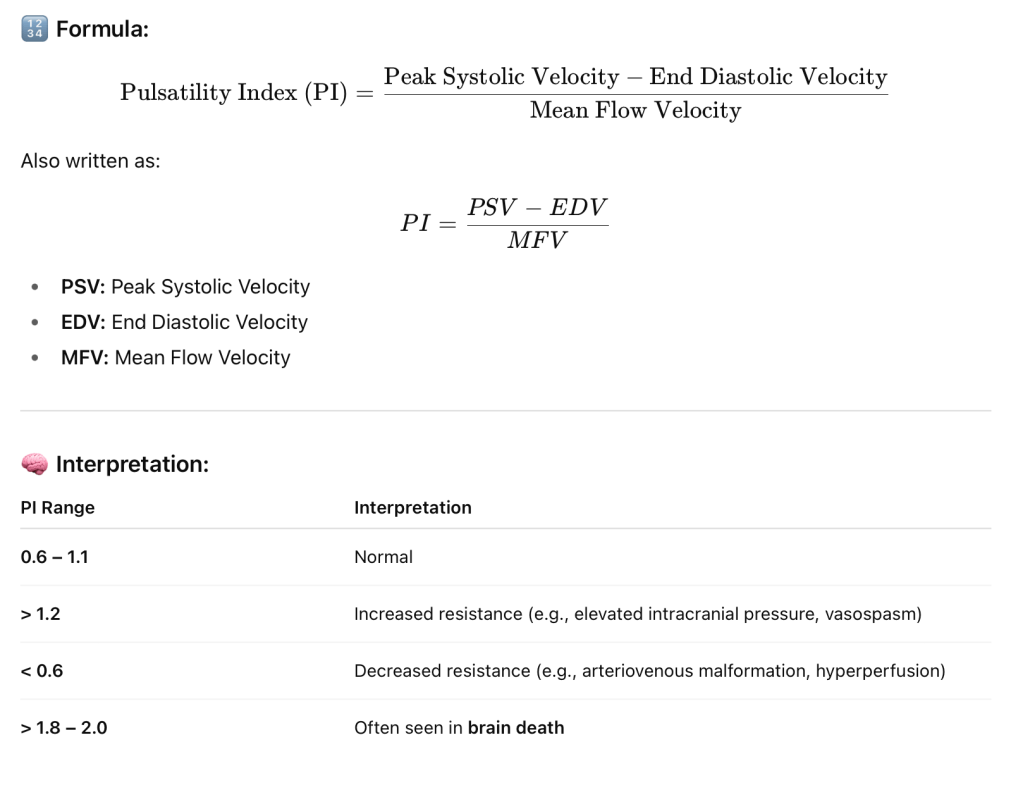
Pulsatility Index (PI)

The TCD Pulsatility Index (PI) is a parameter used in Transcranial Doppler (TCD) ultrasonography to evaluate the resistance to blood flow in cerebral vessels. It’s commonly used to assess cerebral hemodynamics, especially in patients with conditions like stroke, traumatic brain injury, hydrocephalus, and brain death.

📌 Clinical Uses of PI in TCD:

  • Elevated ICP (Intracranial Pressure): Higher PI suggests rising ICP.
  • Vasospasm detection in subarachnoid hemorrhage.
  • Brain death evaluation: Very high PI or absent diastolic flow.
  • Monitoring cerebral autoregulation.
  • Hydrocephalus assessment.

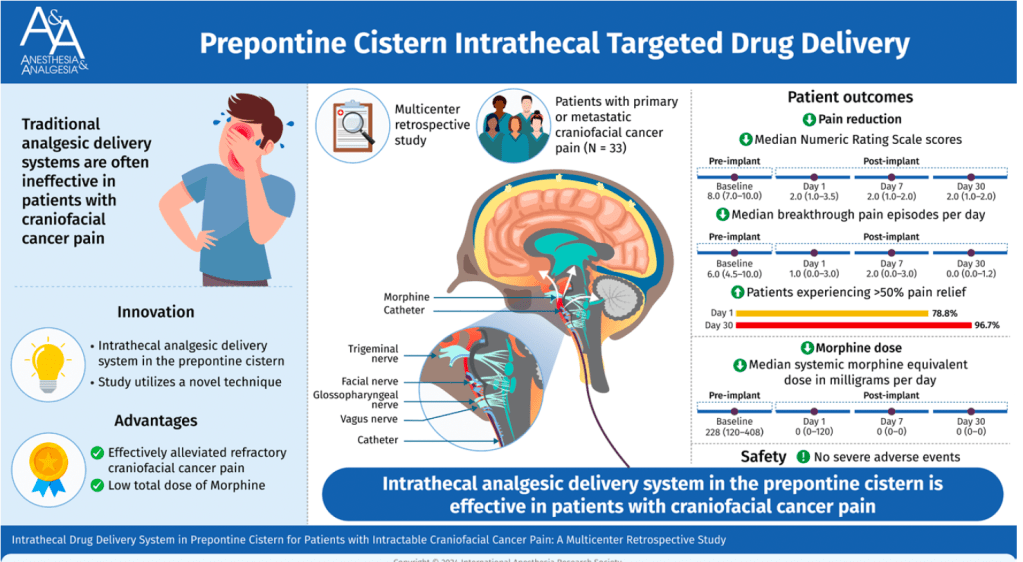
Intrathecal Drug Delivery System in Prepontine Cistern for Craniofacial Cancer Pain

Placing the catheter tip of an intrathecal morphine pump into the prepontine cistern could effectively relieve refractory craniofacial cancer pain with an extremely low total morphine dose requirement and few adverse events. This procedure could be considered in patients with severe refractory craniofacial cancer pain. (Anesth Analg 2025;141:255–63)

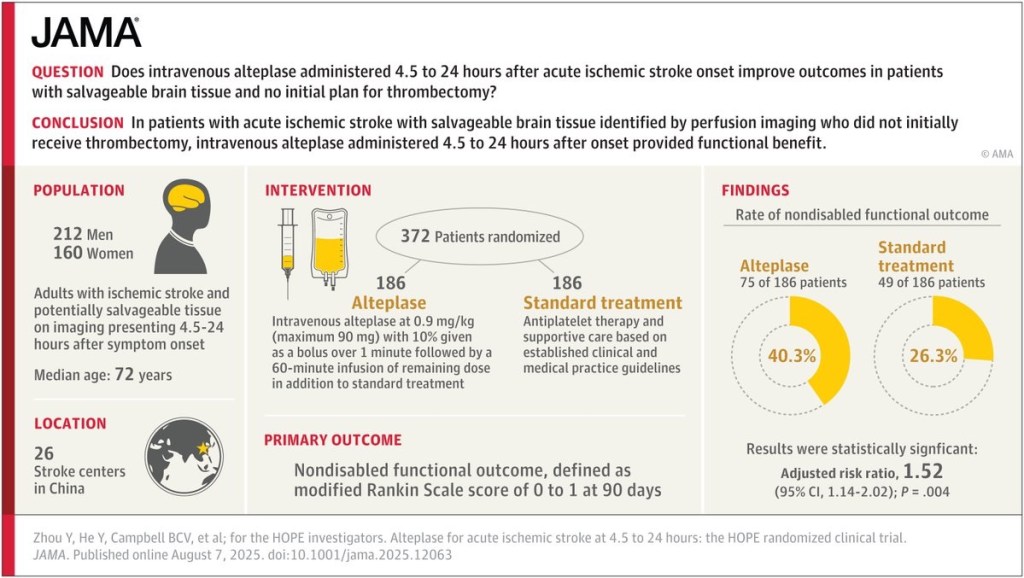
Does intravenous alteplase administered 4.5 to 24 hours after acute ischemic stroke onset improve outcomes?

Anaesthesia Machine Checklist

✅ ASA Summary of Anesthesia Machine Checkout Recommendations

🔄 To Be Completed Daily

1. Verify that auxiliary oxygen cylinder and self-inflating manual ventilation device are available and functioning

👥 Provider and Technician

2. Verify that patient suction is adequate to clear the airway

👥 Provider and Technician

3. Turn on anesthesia delivery system and confirm that AC power is available

👤 Provider or Technician

4. Verify availability of required monitors, including alarms

👤 Provider or Technician

5. Verify that pressure is adequate on the spare oxygen cylinder mounted on the anesthesia machine

👥 Provider and Technician

6. Verify that the piped gas pressures are ≥ 50 psig

👥 Provider and Technician

7. Verify that vaporizers are filled and, if applicable, filler ports are tightly closed

👤 Provider or Technician

8. Verify that there are no leaks in gas supply lines between flowmeters and common gas outlet

👤 Provider or Technician

9. Test scavenging system function

👤 Provider or Technician

10. Calibrate or verify calibration of the oxygen monitor, and check the low oxygen alarm

👤 Provider or Technician

11. Verify that carbon dioxide absorbent is not exhausted

👤 Provider or Technician

12. Perform breathing system pressure and leak testing

👥 Provider and Technician

13. Verify that gas flows properly through the breathing circuit during both inspiration and exhalation

👥 Provider and Technician

14. Document completion of checkout procedures

👥 Provider and Technician

15. Confirm ventilator settings and evaluate readiness to deliver anesthesia care (anesthesia time out)

👤 Provider

🕒 To Be Completed Prior to Each Procedure

2. Verify that patient suction is adequate to clear the airway

👥 Provider and Technician

4. Verify availability of required monitors, including alarms

👤 Provider or Technician

7. Verify that vaporizers are filled and filler ports are closed

👤 Provider

11. Verify that carbon dioxide absorbent is not exhausted

👤 Provider or Technician

12. Perform breathing system pressure and leak testing

👥 Provider and Technician

13. Verify gas flows properly through breathing circuit (inspiration and exhalation)

👥 Provider and Technician

14. Document completion of checkout procedures

👥 Provider and Technician

15. Confirm ventilator settings and evaluate readiness to deliver anesthesia care (anesthesia time out)

👤 Provider

Legend:

👥 = Provider and Technician

👤 = Provider or Technician / Provider only

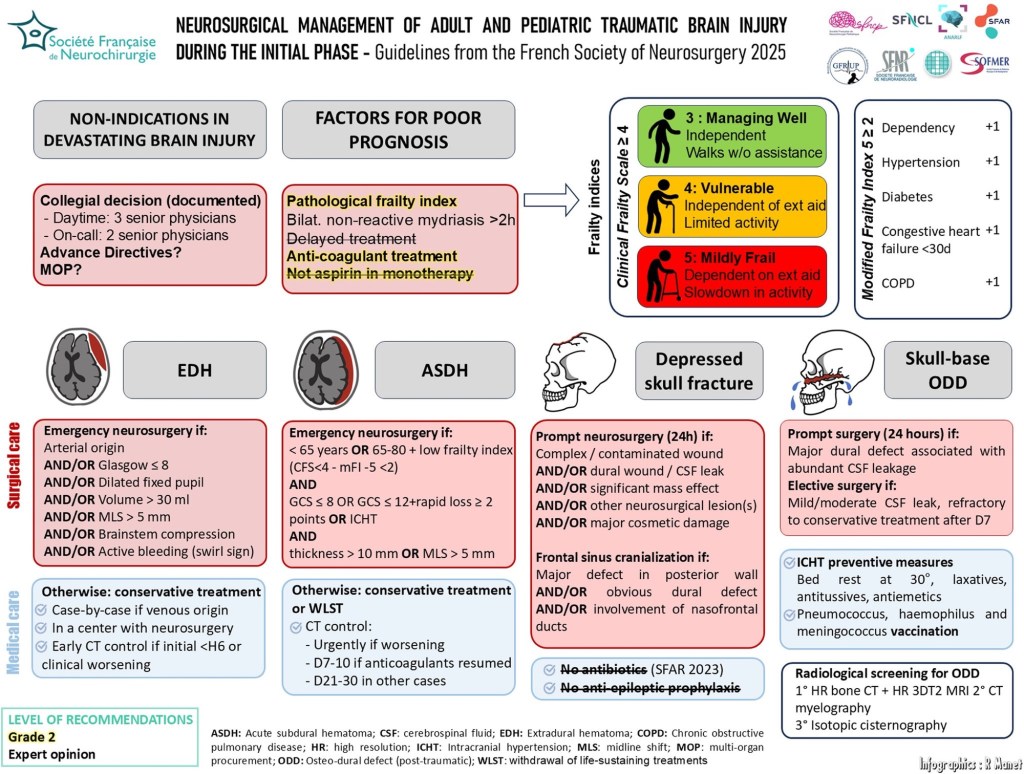
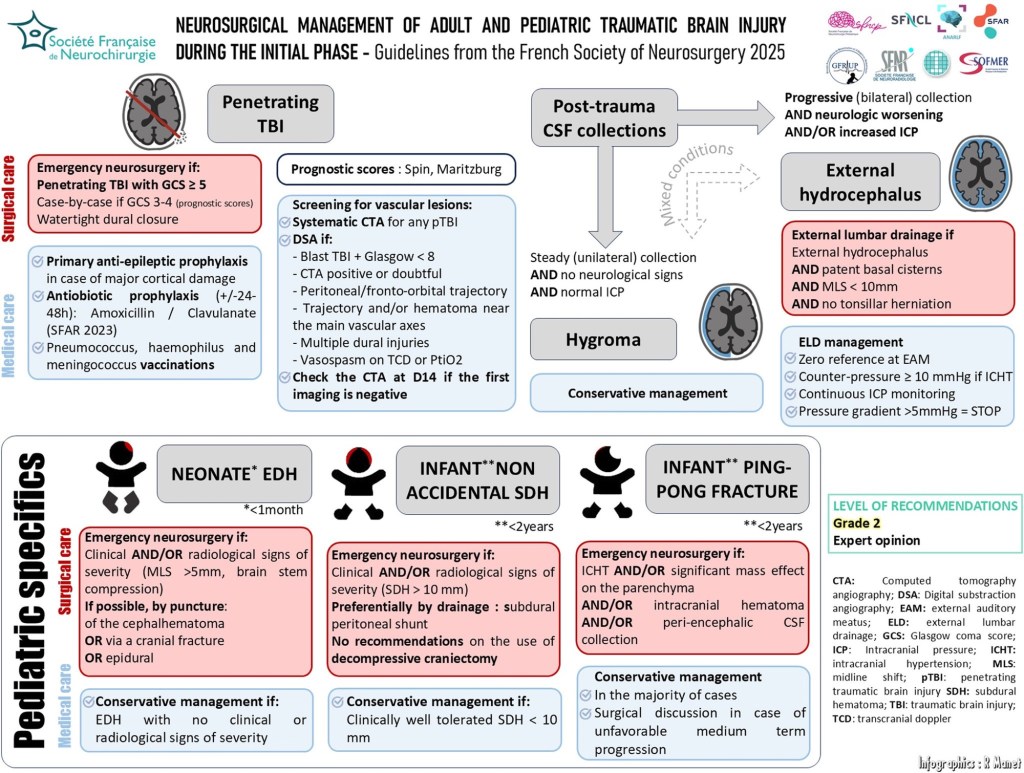
Neurosurgical management of the acute phase of adult and pediatric traumatic brain injury: 2025 guidelines of the French Society of Neurosurgery

Blood Transfusion in Pediatric Neurosurgeries: A Practical Guide


Introduction

Blood transfusion in pediatric neurosurgery, particularly for procedures like craniosynostosis repair, requires a careful and calculated approach. The unique physiological characteristics of children—especially infants—demand precise blood volume estimationloss assessment, and transfusion decision-making to ensure safety and optimal outcomes.

Below are key calculations and considerations when planning for blood transfusion in pediatric neurosurgical settings:


1. Estimated Blood Volume (EBV)

Understanding the Estimated Blood Volume (EBV) is essential for predicting transfusion needs.

Age GroupEstimated Blood Volume (ml/kg)
Preterm neonates90–100
Full-term neonates85–90
Infants (<12 months)80
Children (>12 months)75

For example, in craniosynostosis surgeries, which often involve infants, use 80 ml/kg; for children like a 5-year-old patient, use 75 ml/kg.


2. Maximum Allowable Blood Loss (MABL)

To guide intraoperative transfusion decisions, MABL is calculated as:

MABL = EBV × (Starting Hct – Target Hct) / Starting Hct

This helps determine the volume of blood a child can safely lose before transfusion becomes necessary.


3. Packed Red Blood Cell (PRBC) Transfusion Volume

To avoid over-transfusion:

PRBC Volume (mL) = Weight (kg) × Desired Hb rise (gm/dL) × Transfusion Factor

Where:

  • Transfusion Factor = 3 / PRBC Hct
    (Typical PRBC Hct = 0.60–0.65)

Example: 10 mL/kg of PRBC with Hct 60% gives ~2 gm/dL rise in Hb.


4. Methods of Estimating Blood Loss

Estimating intraoperative blood loss in neurosurgery can be difficult due to hidden bleeding. Use a combination of the following:

  • Visual assessment of the field
  • Calibrated suction canister readings
  • Weighing surgical sponges
  • Serial haematocrit levels from ABG
  • Thromboelastography (TEG) or ROTEM for coagulation monitoring

Note: Blood may be concealed under drapes or on instruments—constant vigilance is critical.


5. Factors Influencing Transfusion Decisions

There is no universal transfusion trigger; decisions must be individualized based on:

  • Preoperative haematocrit and baseline haemoglobin
  • Child’s weight and age
  • Surgical pathology (e.g., craniosynostosis often involves blood loss >20–500% of EBV)
  • Comorbidities affecting oxygen delivery (e.g., cyanotic heart disease)

Transfusion Thresholds and Recommendations

ScenarioTransfusion Recommendation
Hb ≥ 7 gm/dL and stableNo transfusion needed
Hb < 5 gm/dL or critically illTransfusion indicated
Hb 5–7 gm/dLIndividualized decision
Target Hb after transfusion7.0 – 9.5 gm/dL
Minimum Hct for craniotomy25%
Optimum cerebral oxygen deliveryHct ~30%
Acute brain injury (e.g., trauma)Transfuse if Hb 7–10 gm/dL
Massive transfusion (>50% EBV in 3 hrs or 100% in 24 hrs)Use PRBC : FFP : Platelet = 2 : 1 : 1

Summary

In pediatric neurosurgery, particularly in high-risk procedures like craniosynostosis repair, blood transfusion must be:

✅ Carefully calculated using weight-based formulas
✅ Guided by clinical condition, not just haemoglobin numbers
✅ Continuously reassessed using haematocrit, ABG, and coagulation studies
✅ Supported by a multidisciplinary team for timely intervention

By integrating these evidence-based parameters into your intraoperative workflow, you can significantly improve transfusion safety and patient outcomes.


Stay updated. Stay meticulous. Pediatric neurosurgery demands nothing less.