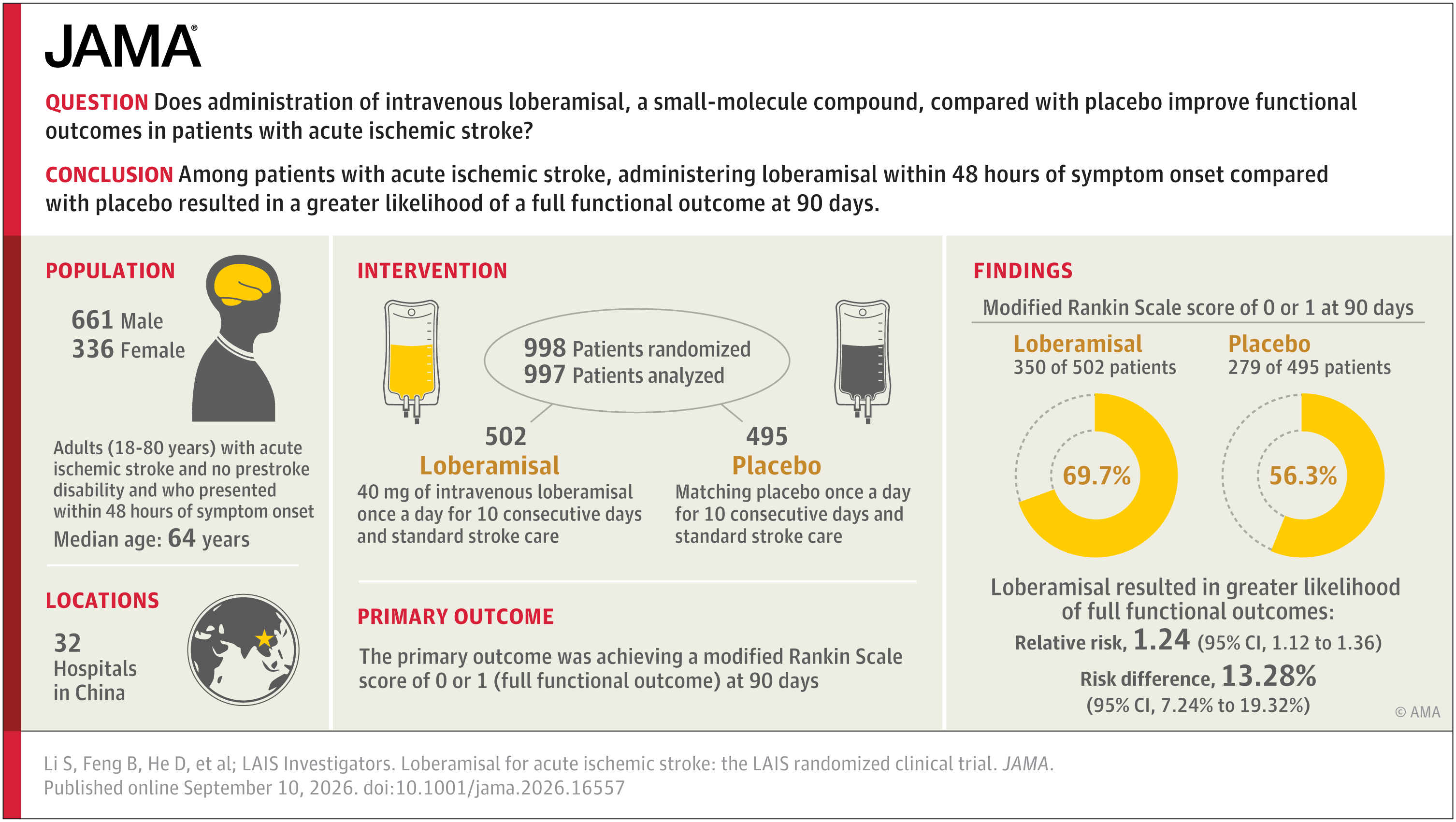
Visual abstract above: Li S, Feng B, He D, et al. JAMA. 2026;336(18):1612-1620. © American Medical Association. Open full-size image.
Neuroprotection is the graveyard of stroke research. Over a thousand agents have protected neurons in the laboratory, and almost none have survived a large human trial. Even nerinetide, the PSD-95 inhibitor that looked so promising, stumbled in ESCAPE-NA1 (cancelled out by alteplase) and then failed outright in ESCAPE-NEXT.
So when a phase 3 trial in JAMA reports that a neuroprotective drug improved functional outcome, and that it did so even when given more than a day after stroke onset, it deserves attention. It also deserves a careful look at the numbers. That trial is LAIS, testing a new molecule called loberamisal.
📌 Bottom line: In moderate ischaemic stroke treated within 48 hours (median 25 hours), a 10-day course of intravenous loberamisal raised the rate of mRS 0–1 at 90 days from 56.3% to 69.7% (NNT about 8), with no safety signal. But mRS 0–2, NIHSS improvement and Barthel Index were the same in both groups. The benefit sits almost entirely at the boundary between “slight disability” and “no significant disability”. Promising, not yet practice-changing.
💊 What is loberamisal?
Loberamisal is a small molecule with two targets, chosen to hit excitotoxicity from both sides:
- Turning down excitation: ischaemia over-activates NMDA receptors, which pulls neuronal nitric oxide synthase (nNOS) onto the scaffolding protein PSD-95. That coupling drives nitric oxide–mediated injury. Loberamisal uncouples PSD-95 from nNOS, the same target as nerinetide, but by a different molecule.
- Turning up inhibition: it is a positive allosteric modulator of the α2 subunit-containing GABAA receptor, restoring the inhibitory tone that ischaemia erodes.
- Beyond the acute hit: in preclinical work it also suppresses myeloperoxidase-driven neuroinflammation, and sustained PSD-95–nNOS uncoupling appears to favour neurogenesis and synaptic remodelling. The authors call it “neuroprotective and neuroreparative”, which matters for the late treatment window.
👥 Who was studied
- 998 patients randomised at 32 hospitals in China (July to December 2024); 997 analysed
- Age 18 to 80 years, NIHSS 7 to 20, no prestroke disability (mRS 0–1), within 48 hours of onset
- Median age 64; two thirds men; median NIHSS 8, so mostly moderate strokes
- Median time from onset to first dose about 25 hours; more than half were treated after 24 hours
- Thrombolysis allowed (about 17% received it); thrombectomy patients were excluded
- Double-blind, placebo-controlled phase 3
💉 What was compared
- Loberamisal: 40 mg IV over 60 minutes, once daily for 10 days, plus standard stroke care
- Placebo: matching infusion for 10 days, plus standard stroke care
The primary outcome was a “full functional outcome”, mRS 0–1 at 90 days. Edaravone and edaravone-dexborneol were not permitted.
📊 What they found
| Outcome | Loberamisal (n = 502) | Placebo (n = 495) |
|---|---|---|
| mRS 0–1 at 90 days (primary) | 350 (69.7%) | 279 (56.3%) |
| Sliding dichotomy mRS at 90 days | 49.0% | 39.8% |
| NIHSS improvement ≥4 at day 10 | 44.7% | 49.0% |
| NIHSS improvement ≥4 at day 30 | 73.5% | 72.7% |
| Barthel Index ≥95 at 90 days | 70.7% | 70.4% |
| Serious adverse events | 8.6% | 10.7% |
| Death | 1.2% | 2.0% |
The safety profile was clean. Adverse event rates were nearly identical, there was no excess haemorrhagic transformation in thrombolysed patients, and no unexpected serious reactions were reported.
🔎 Now look at where the benefit sits
This is the part worth slowing down for. Here is the full 90-day mRS distribution:
| mRS at 90 days | Loberamisal | Placebo |
|---|---|---|
| 0 | 24.5% | 22.7% |
| 1 | 46.1% | 35.1% |
| 2 | 7.8% | 21.1% |
| 3 | 14.1% | 12.6% |
| 4 | 5.7% | 5.7% |
| 5 | 0.4% | 0.4% |
| 6 (death) | 1.3% | 2.5% |
| mRS 0–2 (adds up) | 78.4% | 78.9% |
Almost the entire treatment effect is a shift of about 13% of patients from mRS 2 to mRS 1. The proportion who were independent (mRS 0–2) is the same in both arms, and the proportion left with moderate-to-severe disability (mRS 3–5) is also the same. The usual ordinal shift analysis could not even be run, because the proportional odds assumption failed. That is exactly what you expect when an effect lives at one cut-point and nowhere else.
Why does this matter? The difference between mRS 1 (“no significant disability, able to carry out usual activities”) and mRS 2 (“slight disability, cannot do everything as before”) is the softest boundary on the scale. It rests on how the patient describes their own life, and here it was assessed with a simplified questionnaire, often by telephone. Inter-rater agreement is weakest exactly at this boundary. Meanwhile, the more objective measures (NIHSS change at 10 and 30 days, Barthel Index ≥95) did not move at all.
To be fair, the trial was blinded, so a measurement artefact should affect both arms equally. A real effect on fatigue, mood, cognition or confidence, which mRS 1 versus 2 can capture and NIHSS cannot, is possible. The exploratory depression and anxiety numbers leaned the right way (severe depression 4.9% vs 7.8%), though not significantly, and that fits an α2-GABAA mechanism. But a single-boundary shift with no support from other scales needs replication before it is believed.
⚠️ Other things to keep in mind
- Late treatment window: at a median of 25 hours, there is little penumbra left to “protect”. If the drug works, it is probably working on inflammation and recovery rather than classical neuroprotection.
- Narrow population: moderate strokes (median NIHSS 8), no thrombectomy, few thrombolysed patients, China only. Large-vessel occlusions treated with thrombectomy, the group that sees anaesthetists, were excluded.
- Effect larger than planned: the trial was powered for a 10.8-point difference and found 13.4. Big early effects in single-country trials often shrink with replication.
- Funding: supported by a national science grant and by the drug’s manufacturer, NeuroDawn Pharmaceutical. The academic team analysed the locked data independently, which is reassuring.
- No imaging or biomarker data: nothing tells us how, or in whom, the drug worked.
🏥 What it means for the neuro-OR and neuro-ICU team
For now, very little changes at the bedside. Loberamisal is not available outside trials, and the patients we meet most, thrombectomy cases under GA or sedation, were not studied. The questions for us are the next ones: will it help after successful recanalisation, as a true “reperfusion plus protection” strategy? And does a GABAA modulator given daily for 10 days interact with our sedatives in the neuro-ICU? The trial does not tell us.
The bigger lesson is conceptual. LAIS adds to a growing idea that the window for helping the injured brain may be days, not hours, if the target is inflammation and repair rather than the dying penumbra. That is a field neurocritical care should watch closely.
🧾 Take-home
LAIS is the most positive phase 3 neuroprotection result in years, with a clean safety profile and a striking headline number. But the benefit is concentrated in moving patients from mRS 2 to mRS 1, while independence, neurological recovery and daily-living scores were unchanged. Treat it as a strong signal that needs a second trial, ideally outside China and in thrombectomy patients, before it changes how we manage stroke.
Reference: Li S, Feng B, He D, et al; LAIS Investigators. Loberamisal for acute ischemic stroke: the LAIS randomized clinical trial. JAMA. 2026;336(18):1612-1620. doi:10.1001/jama.2026.16557. ClinicalTrials.gov NCT06517173. See also the accompanying editorial by Jeffrey L. Saver, “Neuroprotective Therapy for Acute Ischemic Stroke”, in the same issue.
For education only. Follow your local stroke and anaesthesia protocols.