
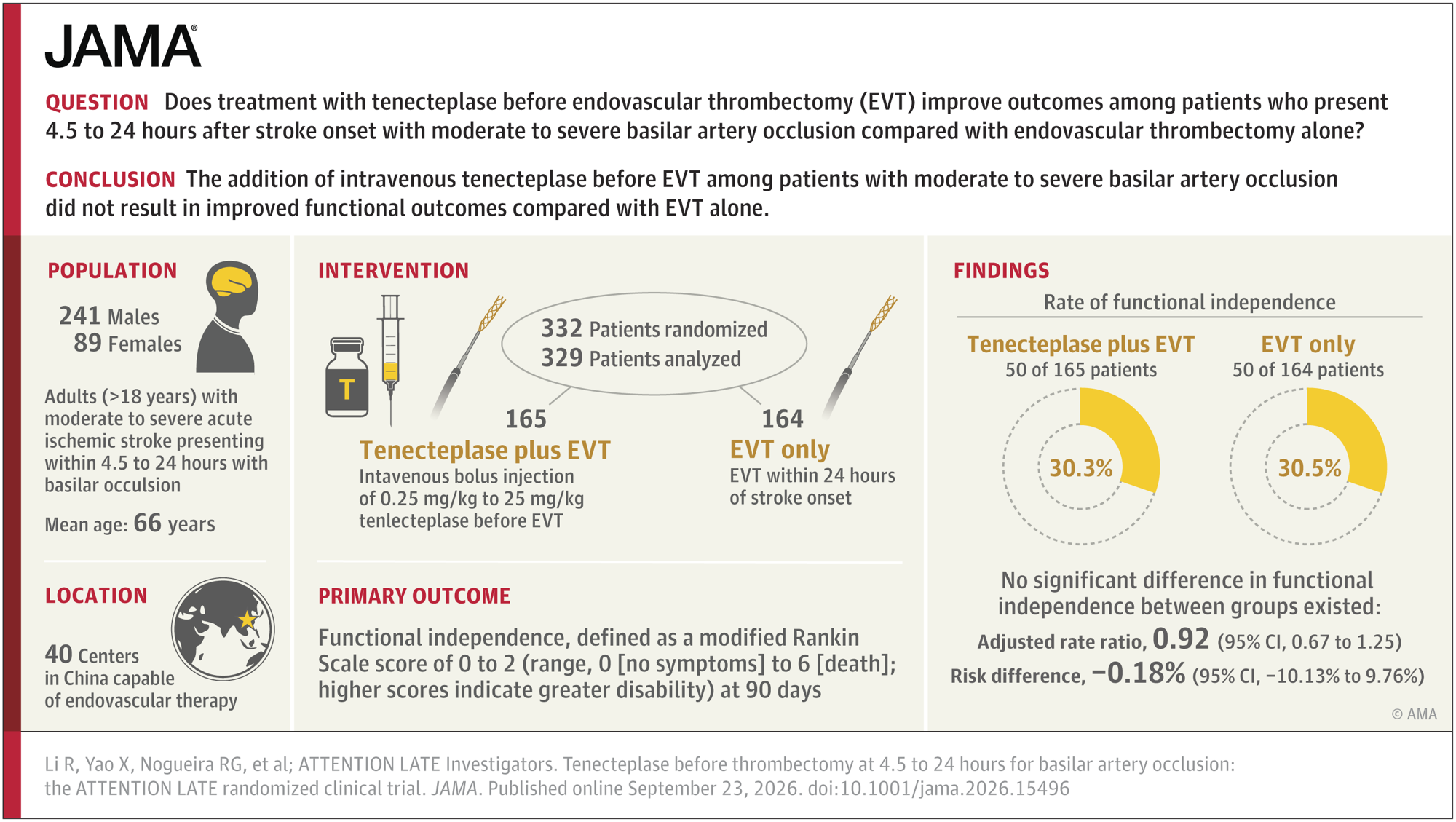
Visual abstract above: Li R, Yao X, Nogueira RG, et al. JAMA. 2026;336(17):1529-1538. © American Medical Association. Open full-size image.
The basilar artery is the most unforgiving territory in stroke medicine. Left untreated, a basilar artery occlusion kills or severely disables most patients. Thrombectomy changed that story: the ATTENTION trial showed that pulling the clot out nearly doubled the chance of a good outcome (46% vs 23%). Tenecteplase, meanwhile, has been pushing the clot-busting window towards 24 hours in some anterior circulation trials.
So the obvious next question: when a patient with a basilar occlusion reaches a thrombectomy centre late, should we give tenecteplase on the way to the angio suite? ATTENTION-LATE, published in JAMA on 23 September 2026, gives a clear answer.
📌 Bottom line: In basilar artery occlusion presenting 4.5 to 24 hours after onset directly to a thrombectomy-capable centre, adding tenecteplase before thrombectomy did not improve 90-day functional independence. About 30% of patients were independent at 90 days in both groups.
🔬 The question
Does intravenous tenecteplase before endovascular thrombectomy (EVT) improve outcomes in basilar artery occlusion when patients arrive between 4.5 and 24 hours after stroke onset, compared with thrombectomy alone?
👥 Who was studied
- 332 patients randomised at 40 thrombectomy-capable stroke centres in China (March 2023 to February 2025); 330 included and 329 completed follow-up
- Adults with moderate to severe basilar artery occlusion (NIHSS 10 or more) arriving 4.5 to 24 hours after onset
- Mean age 66 years; about three quarters were men
- Open-label design with blinded assessment of outcomes
💉 What was compared
- Tenecteplase + EVT: a single intravenous bolus of 0.25 mg/kg (maximum 25 mg), then thrombectomy
- EVT alone: thrombectomy within 24 hours of onset
The primary outcome was functional independence at 90 days, defined as a modified Rankin Scale score of 0 to 2.
📊 What they found
| Outcome | Tenecteplase + EVT | EVT alone |
|---|---|---|
| Functional independence (mRS 0–2) at 90 days | 50/165 (30.3%) | 50/164 (30.5%) |
| Symptomatic intracranial haemorrhage | 5% | 4% |
| Death at 90 days | 40% | 43% |
The drug was not clearly harmful: bleeding and death were similar in both groups. It simply added nothing.
🤔 Why didn’t the clot-buster help?
The trial does not answer this directly, but several explanations are plausible:
- Thrombectomy does the heavy lifting. When the catheter reaches the clot soon after arrival, the drug has little time to work first.
- Old clots resist lysis. Many hours after onset, a thrombus tends to be more organised and less responsive to a fibrinolytic.
- Atherosclerosis is common in basilar occlusion, particularly in Asian populations. A fibrinolytic cannot open a fixed stenosis.
- It fits earlier evidence. In TIMELESS, late-window tenecteplase also showed no benefit when most patients went on to thrombectomy.
⚠️ Read with caution
- Wide confidence interval: the result cannot rule out a modest benefit or harm of up to about 10 percentage points either way.
- Open-label: clinicians knew who received the drug, though outcomes were assessed blind.
- China only: the mix of stroke causes, especially intracranial atherosclerosis, may differ elsewhere.
- Direct arrivals only: patients came straight to thrombectomy centres. The trial does not tell us about “drip and ship” patients who face long transfer delays from a peripheral hospital.
- Severe strokes: 90-day mortality of about 40% reflects how sick these patients were.
🏥 What it means for the neuro-OR and neuro-ICU team
For a late-presenting basilar occlusion arriving at a thrombectomy centre, the priority is getting to the groin quickly, not waiting for lysis. Skipping the drug also removes a layer of complexity for the anaesthesia team, such as post-lytic caution around arterial and central line placement. The decisions where we can still make a difference remain the same: general anaesthesia versus conscious sedation, airway protection in a patient with brainstem signs, and blood pressure management before and after recanalisation.
🧾 Take-home
In late basilar artery occlusion at a thrombectomy-capable centre, go straight for the clot. Tenecteplase on the way in adds cost and complexity without measurable benefit.
Reference: Li R, Yao X, Nogueira RG, et al; ATTENTION LATE Investigators. Tenecteplase before thrombectomy at 4.5 to 24 hours for basilar artery occlusion: the ATTENTION LATE randomized clinical trial. JAMA. 2026;336(17):1529-1538. doi:10.1001/jama.2026.15496. ClinicalTrials.gov NCT05701956.
For education only. Follow your local stroke and anaesthesia protocols.