Wolff–Parkinson–White syndrome and the Anesthesiologist

WHAT ARE THE CAUSES OF PALPITATION

Exercise, Anxiety, Caffeine, alcohol, drugs: thyroxine, cocaine, beta 2 agonists, MI, arrthymias, hyperthyroidism, hypoglycaemia, phaeochromocytoma

MECHANISMS OF ARRHYTHMIAS

Reentry circuits, Enhanced automaticity, Triggered activity

EVALUATION AND MANAGEMENT

History and examination, ECG: 12-lead, 24-hour, ambulatory, cardiac electrophysiological study, blood investigations to rule out endocrine causes

ABC, oxygen, etc., Check electrolytes (including Mg2+), Carotid sinus massage, Adenosine – caution in asthma and if taking dipyridamole prolongs half-life

WHAT HAPPENS IN WPW SYNDROME?

Presence of faster accessory pathway (bundle of Kent) between atrium  and ventricle (accessory AV pathway) which conducts impulses faster than the normal AV node. Electrical signals traveling down this abnormal pathway may stimulate the ventricles to contract prematurely, resulting in a unique type of supraventricular tachycardia. The ECG may show sinus rhythm, normal axis, short PR interval and the presence of delta waves

DELTA WAVES

The accessory atrio-ventricular pathway conducts the atrial impulse to the ventricles much faster than the A–V node. This results in the start of ventricular depolarisation sooner than normal, hence the short P–R interval. That initial ventricular depolarisation
takes place in normal ventricular tissue (i.e. not specialised conducting tissue). The initial rate of depolarisation is therefore slower, hence the slurred, delta wave. When the rest of the impulse finally arrives the A–V node, the bundle of His and Purkinje carries out the ventricular depolarization as normal; hence, the rest of the QRS looks normal

IMPLICATIONS FOR ANESTHESIA

1.There is a tendency to paroxysmal supraventricular tachycardia in the perioperative period and there may be associated congenital cardiac abnormality.

2.Anaesthetic drugs tend to change the physiology of AV conduction.

3.If the patient is asymptomatic, then risk of perioperative arrhythmias is much less.

4.We should avoid light planes of anaesthesia and drugs that can precipitate tachycardia (like atropine, glycopyrrolate, ketamine) resulting in paroxysmal supraventricular tachycardia or atrial fibrillation

5.There are references showing disappearance of delta waves after propofol administration, making it the drug of choice for induction. For maintenance, Isoflurane and sevoflurane are preferred as they dont have effect on AV node conduction. Short acting nondepolarizing muscle relaxant would be an acceptable choice as reversal of neuromuscular blockade using neostigmine and glycopyrrolate is not required.

6. Regional anaesthesia has significant advantage over general anaesthesia as multidrug
administration, laryngoscopic stimulation, intubation, and light planes leading to sympathetic stimulation are avoided.

WHAT ARE THE COMMON ARRHYTHMIAS IN WPW?

Atrial fibrillation (AF): Patients with WPW who develop atrial fibrillation are at risk of very rapid ventricular responses as the accessory pathway does not provide any ‘protective delay’ like the A-V node. This may result in heart failure or may even deteriorate into ventricular fibrillation. In AF, most conducted impulses reach the ventricles via the accessory pathway, so delta waves are seen on the ECG.
Re-entrant tachycardia: A re-entry circuit is set up. After transmitting an atrial impulse, the A–V node usually recovers before the accessory pathway. If an atrial ectopic occurs at the right time, it will transmit through the A–V node while the accessory pathway is still refractory. By the time it has done this, the accessory pathway may have recovered and the impulse will then pass through it back into the atria. As the impulses are all reaching the ventricles via the A–V node and not the accessory pathway, there are no delta waves on the ECG

INTRAOPERATIVE ARRHYTHMIAS: MANAGEMENT

1. A,B,C and Treat possible triggers of rhythm disturbance such as hypoxia, hypercarbia, acidosis, electrolyte disturbance or any cause of sympathetic stimulation.

2.Assess the degree of cardiovascular compromise. If there is significant compromise, synchronised DC cardioversion starting at 25–50 J would be the treatment of choice. If the blood pressure was stable, then the management would depend on the rhythm.

3. Pharmacological therapy:

(a) For re-entrant tachycardia, adenosine would be the first choice. Class 1a drugs such as procainamide (5–10 mg/kg) and disopyramide prolong the refractory period, decrease conduction in the accessory pathway (by blocking fast sodium channel) and may terminate both re-entrant tachycardia and AF. More conventional drugs such as amiodarone, sotalol and other beta-blockers such as esmolol may also be useful.

(b)AF: The treatment principle is to prolong the anterograde refractory period of the accessory pathway relative to the AV node. This slows the rate of impulse transmission through the accessory pathway and, thus, the ventricular rate. This is in direct contradiction to the goal of treatment of non-WPW atrial fibrillation, which is to slow the refractory period of the AV node

DRUGS THAT SHOULD BE AVOIDED

Verapamil and digoxin are contra-indicated as they both preferentially block A–V conduction thereby increasing conduction through the accessory pathway. Although verapamil could, in theory, be used to terminate a re-entrant tachycardia, its use is not advisable, because these patients may then revert to AF or flutter. A further hazard with verapamil is that a tachyarrhythmia that looks like re-entrant tachycardia may actually be VT. Adenosine would preferentially block the A–V node and therefore should not be used in AF.
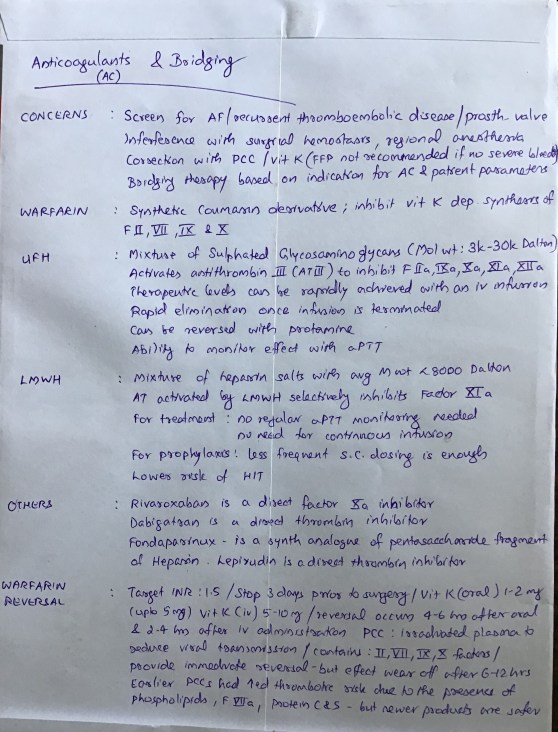
ANTICOAGULANTS AND BRIDGING

N.B. Corrections:

LMWH inhibits factor Xa (Not XIa)

TOTAL BODY WEIGHT [TBW] , LEAN BODY WEIGHT [LBW], IDEAL BODY WEIGHT [IBW] &ADJUSTED BODY WEIGHT ; THEIR IMPLICATIONS IN Anesthesia AND CriticalCare

Drug administration in obese patients is difficult because recommended doses are based on pharmacokinetic data obtained from individuals with normal weights

With increasing obesity, fat mass accounts for an increasing amount of TBW, and the LBW/TBW ratio decreases

TBW is defined as the actual weight

IBW is what the patient should weigh with a normal ratio of lean to fat mass

IBW can be estimated from the formula: IBW (kg) = Height(cm) − x ( where x = 100 for adult males and 105 for adult females).

LBW is the patient’s weight , excluding fat

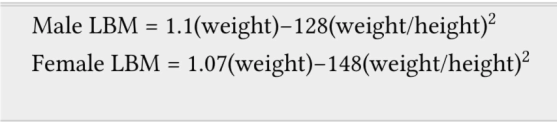
Male LBW = 1.1(weight)-128(weight/height)^2 (Weight in Kg and Height in cm)

Female LBW = 1.07 (weight) -148 (weight/height)^2

Regardless of total body weight, lean body weight rarely exceeds 100 kg in men and 70 kg in women

Below IBW, TBW and LBW are similar.

Adjusted body weight (ABW) Takes into account the fact that obese individuals have increased lean body mass and an increased volume of distribution for drugs.

It is calculated by adding 40% of the excess weight to the IBW : ABW (kg) = IBW (kg) + 0.4 [TBW (kg)]

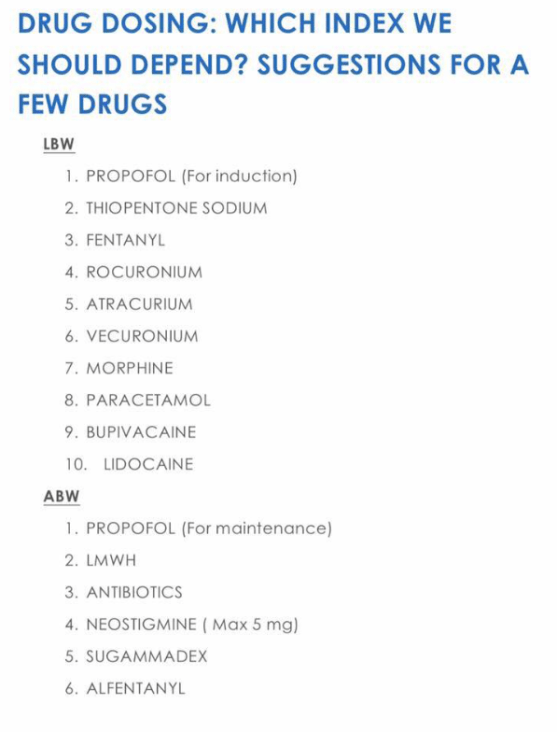
Drugs with weak or moderate lipophilicity can be dosed on the basis of IBW or more accurately on LBW. These values are not same in obese; because 20–40% of an obese patient’s increase in TBW can be attributed to an increase in LBW. Adding 20% to the ‘estimated IBW based dose’ of hydrophilic medication is sufficient to include the extra lean mass. Non-depolarizing neuromuscular blocking drugs can be dosed in this manner.

In morbidly obese patients, the induction dose of propofol can be calculated on IBW.

In case of midazolam, prolonged sedation can occur from the larger initial dose needed to achieve adequate serum concentrations. #TheLayMedicalMan

Remifentanil dosing regimens should be based on IBW or LBW and not on TBW.

When using succinylcholine in obese adults or adolescents, dosage should be calculated on TBW

The antagonism time of neostigmine has been shown to be independent of TBW and BMI. Therefore, TBW can be used to calculate the dose.

Ref:Association of Anaesthetists of Great Britain and Ireland. Peri-operative management of the obese surgical patient 2015. Anaesthesia 2015, 70, pages 859–876.

Screen Shot 2018-09-11 at 9.46.48 AMScreen Shot 2018-09-11 at 9.48.11 AM

A FEW CLUES IN INTERPRETING AN ISOLATED PROLONGATION OF ACTIVATED PARTIAL THROMBOPLASTIN TIME (aPTT)

aPTT tests the intrinsic and common pathways of coagulation

Though it is included commonly as a part of coagulation profile assessment, it’s primary uses are to detect coagulation factor deficiency and titration of heparin therapy

An isolated elevation of aPTT may indicate

deficiency of Factor VIII or IX or XI or XII

acquired clotting factor inhibitors

presence of Lupus anticoagulant

N.B.:- Factor VIII deficiency is Haemophilia A, Factor IX deficiency is Haemophilia B and Factor XI deficiency is Haemophilia C

If factor levels are >30% of normal, aPTT may remain normal, for e.g. in mild von Willebrand disease [raised aPTT + prolonged Bleeding Time (BT)], in mild hemophilia etc

Reference: Martlew V. Peri-operative management of patients with coagulation disorders. Br J Anaesth. 2000; 85(3): 446–455.

HOMOCYSTINURIA : Anesthesia IMPLICATIONS

There is increased levels of homocystine and methionine in blood and urine due to the deficiency of Cystathionine B synthetase which catalyses the conversion of homocystine and serine into cystathionine

Raised cystine levels reduce the resistance of endothelium against thrombosis, reduces the activity of the vasodilator nitric oxide (NO) and increase platelet aggregation. So there is high incidence of thromboembolism. We have to ensure good hydration, good cardiac output,early mobilisation and should provide mechanical +/- pharmacological thromboprophylaxis. Many patients will be on anticoagulation. If untreated 50% of patients will have thromboembolic complications and the mortality is about 20% before the age of 30 years. So both modification of the dosing of anticoagulants ( especially if regional anesthesia is planned) if patient is receiving them and providing prophylaxis against DVT are important elements of perioperative care. The incidence of thrombotic complications are more in pregnant patients.

Blood viscosity and platelet adhesiveness can be reduced by dextran, and the prior administration of pyridoxine

Reduced cystine results in weak collagen and fragmentation of elastic tissue of large arteries. There is high incidence of vascular diseases like Cerebrovascular diseases, Coronary Artery Disease, Peripheral Vascular Diseases

Patients may have increased insulin levels resulting in hypoglycemia. Dextrose infusion will prevent hypoglycaemia.

Acute psychiatritc symptoms, delirium etc have been reported and the altered availability of homocysteine, methionine and cystiene which are having glutamate agonist properties, has been postulated as a factor which promotes this.

Regional anaesthesia has certain theoretical disadvantages. Penetration of a large epidural blood vessel might initiate thrombosis, as may the accompanying venous stasis of the lower limbs.

Reference: ANAESTHESIA DATABOOK, A Perioperative and Peripartum Manual, 3RD EDITION
Rosemary Mason

FIBROMYALGIA- AN OVERVIEW

Is a common chronic pain condition, characterised by

Pain ( Spontaneous, widespread , diffuse, worse in the morning, hypersensitivity to all painful stimuli, >3 months duration, 11 out of 18 defined tender points produce tenderness on digital palpation)
Sleep disturbances
Fatigue

Pathophysiology may include

dysfunction of descending inhibitory pathways
abnormal neurotransmitter release
central sensitisation etc

Tricyclic antidepressants ( like Amitriptyline 5-10 mg ) may be effective in fibromyalgia as they reduce pain & fatigue and improve sleep

Other therapies used:

Pregabalin
Gabapentin
Newer MAO inhibitors like pirlindole
TENS
Acupuncture
Intravenous lignocaine
Injection of trigger points
Cognitive Behavioural Therapy
Warm bath
Complimentary therapies

#pain , #fibromyalgia , #PainManagement

Reference: Dedhia JT, Bone ME. Pain and fibromyalgia. Contin Educ Anaesth Crit Care Pain. 2009; 9(5): 162–166.

HOW Hb S BECOMES A VILLAIN IN SICKLE CELL DISEASE (SCD) ?

Inherited as Autosomal Recessive disease (MNEMO> Sickle Cell Disease causes Recession of RBC function)

A single DNA base change ( Beta chain) causes SCD

DNA base change is Adenine for Thymine & the resultant amino acid change is Valine for Glutamic Acid ( MNEMO> Adenine Added; Valine got a Welcome; Glutamine has to Go )

Thus Hb S is produced. As Valine is hydrophobic, the deoxygenated Hb is less water soluble and gets precipitated & polymerized inside the RBC

This polymerization slightly reduces the overall affinity for O2; otherwise the affinity for O2 is same for Hb A and Hb S

These changes also make the RBCs more rigid and contributes to sickling and microvascular occlusion

Regarding hypoxaemia, HbS will precipitate at a PO2 of 5–6 kPa (37-45 mm of Hg). As venous PO2 lies in this range, in case of homozygous individuals having only abnormal Hb will have continuous sickling

Patients with sickle cell trait experience sickling at much lower partial pressures (2.5–4 kPa / 19-30 mm of Hg )

Sickledex test produces a turbidity and becomes positive even with a very small amount of Hb S: so it CAN NOT differentiate between homo & heterozygous states

Reference: Smith T, Pinnock C, Lin T. Fundamentals of Anaesthesia, 3rd edn. Cambridge: Cambridge University Press, 2009; pp. 234–5

CARCINOID SYNDROME & THE ANESTHESIOLOGIST

Carcinoid tumours are neuroendocrine tumours originating from enterochromaffin cells [GIT(~90%), gonads and bronchus mainly]

Some patients develop Carcinoid Syndrome, where the tumour secretes neuropeptides into systemic circulation

Usually they undergo firstpass metabolism in liver

If the patient is becoming symptomatic, due to the neuropeptide secretion, it’s either due to their production in large amounts to overwhelm the metabolic capacity of the liver or that they are released without going through the portal circulation

They secrete bio-active compounds like serotonin, histamine, catecholamines, bradykinin, kallikrein, substance-P, motilin etc

This can cause symptoms like bronchospasm, hypotension, hypertension, flushing etc

Pharmacologic treatment of intraoperative/ acute/ hemodynamic crises are with i.v. Octreotide, whereas for treatment of chronic symptoms, Somatostatin analogues like Lanreotide are used. Octreotide can also be used for prophylaxis. Should be continued postoperatively.

Vasoactive drugs like catecholamines and histamine releasing drugs like morphine, atracurium, succinylcholine, thiopentone etc should be avoided. Use of a test dose may reduce adverse events.

Antihistamines are also given prophylactically in case of gastric tumours

Another concern for the anesthesiologist in such patients is the possibility of Carcinoid heart disease. Here, the patient develops thickened valves resulting in tricuspid and pulmonary regurgitation and pulmonary stenosis (mitral and aortic insufficiency can also occur; but are less frequent). Pericarditis or myocardial metastases can also occur.

AMNIOTIC FLUID EMBOLISM (AFE) : WHICH ARE THE CONSISTENT CLINICAL FEATURES @ PRESENTATION?

Hypotension , Hypoxemia and DIC are hallmarks (MNEMO> “AFE is Highly Dangerous”)

Hypotension & Fetal Distress occur in 100% of cases

DIC occur in 83% and indicate a bad prognosis

Cardiac arrest occur in around 87% of patients

Mortality is >60% ; it has been observed that only 15% survive with intact neurological function

Pulmonary Hypertension, CHF and DIC are key events in the pathogenesis

Pulmonary edema (occur in >90% of cases), Dyspnoea (occur in 49%) & Bronchospasm (occur in 15%) are the respiratory signs

Reference: Dedhia JD, Mushambi M. Amniotic fluid embolism. Contin Educ Anaesth Crit Care Pain. 2007; 7(5): 152–156. Gist RS, Stafford IP, Leibowitz AB et al. Amniotic fluid embolism. Anaesth Analg. 108(5): 1599–1602.

The Risk Factors as per EuroSCORE II System used for risk stratification of patients undergoing Cardiac Surgery

Patient factors

• Sex: Female
• Age: >60 years
• Co-morbidities including renal, neurological and extra-cardiac arterial disease

Disease factors

• Recent MI
• Left ventricular dysfunction
• Unstable angina

Operative factors

• Redo or emergency surgery
• Non-isolated coronary artery bypass grafting