ATROPINE ; A VERY FAMILIAR STRANGER!

Atropine produces complete vagal block at a dose of 3 mg;

Should be avoided in pyrexial children, as it inhibits sweating ;

Delirium is another side effect ;

Patients with Downs syndrome may show resistance to atropine;

Parenteral atropine wont cause significant pupillary dilatation and so is not contraindicated in glaucoma

NALOXONE DOSING

  • For reversal of post-operative respiratory depression and coma: 20-40mcg IV PRN
  • For opioid overdose: 40-400 mcg IV PRN
  • Infusion: If an infusion is required, commence the infusion with an hourly infusion rate calculated as 2/3rd of the total bolus dose given to achieve the desired opioid reversal effect
  • DOSAGE IN RENAL FAILURE AND RENAL REPLACEMENT THERAPY: Dose as in normal renal function
  • DOSAGE IN PAEDIATRICS: IV:
  • For post-operative respiratory depression or over-sedation, give 0.002mg/kg/dose (i.e. dilute 0.4mg to 20ml and then give 0.1ml/kg/dose). Repeat every 2 minutes x 4 if required, then commence infusion by adding 0.3mg/kg to 30ml 5% dextrose and running at 0-1ml/hr (0.01mg/kg/hr).
  • For opiate overdose, give 0.01mg/kg (max 0.4mg) (i.e. dilute 0.4mg to 10ml and give 0.25ml/kg/dose). Repeat every 2 minutes x4 if required, then commence infusion by adding 0.3mg/kg to 30ml 5% dextrose and running at 0-1ml/hr (0.01mg/kg/hr)

ACETAZOLAMIDE (Diamox)

INDICATIONS: 1. Diuretic (particularly in the presence of metabolic alkalosis) 2. Correction of severe metabolic alkalosis

DOSAGE: For diuresis, the dose is usually 250-375 mg stat. If, after an initial response, the patient fails to continue to diurese, do not increase the dose but allow for kidney recovery by skipping medication for a day. Acetazolamide yields best diuretic results when given on alternate days, or for 2 days alternating with a day of rest.Increasing the dose does not increase the diuresis and may increase the incidence of drowsiness and/or paraesthesia. Increasing the dose often results in a decrease in diuresis.

Evidence to support use in patients below the age of 12 years have not been established.

Acetazolamide is contraindicated in the presence of metabolic acidosis. This drug is not indicated in patients on renal replacement therapy.

Acetazolamide is an enzyme inhibitor that acts on carbonic anhydrase, the enzyme that catalyzes the reversible reaction involving the hydration of carbon dioxide and the dehydration of carbonic acid.

CONTRAINDICATIONS 1. Hypersensitivity to acetazolamide or other sulphonamides 2. Metabolic acidosis 3. Cirrhosis (risk of development of hepatic encephalopathy)

Acetazolamide and sodium bicarbonate used concurrently increases the risk of renal calculus formation.

METABOLIC SIDE EFFECTS
Metabolic acidosis, electrolyte imbalance, including hypokalaemia, hyponatraemia, loss of appetite, taste alteration, hyper/hypoglycaemia.

SJOGRENS SYNDROME-anesthesia implications

🏳️‍🌈Preoperative abnormalities

1. Symptoms of the sicca syndrome include dryness of the eyes and skin.

2. Check for associated RA, SLE, scleroderma, the polymyositis, polyarteritis nodosa, chronic active hepatitis, and Grave’s disease.

3.Lung / airway : desiccation of the nose and bronchial tree, obstructive airways disease, interstitial lung disease

4.sensory / motor neuropathy may occur and CNS lesions have been described.

5.The patient may be taking corticosteroids or occasionally immunosuppressive agents.

🏳️‍🌈Anaesthetist’s concerns

1. Sometimes gross swelling of the salivary glands may make mask anaesthesia difficult.

2.The problems of pulmonary disease, if present.

3.The dry eyes are susceptible to damage during anaesthesia.

4.Allergy to antimicrobial agents, particularly penicillin, cephalosporins and trimethoprim

Management

1. careful assessment of the primary disease, and of any pulmonary involvement.

2. Drying agents should be avoided if possible.

3. The eyes should be protected with pads.

4. Anaesthetic gases should be humidified.

5. Steroid supplements may be required.

6. Care should be taken when prescribing antimicrobial agents

ANTI #RHEUMATOID AGENTS PERIOPERATIVELY🎲

🏵  METHOTREXATE: caution in elderly,respiratory-renal-hepatic dysfunction. CONSIDER STOPPING 1 WEEK BEFORE

🏵  SULFASALAZINE: withhold atleast on day of surgery; as elimination is primarily renal and as reduction GFR is possible perioperatively

🏵  AZATHIOPRINE: withhold on day of surgery

🏵  HYDROXYCHLOROQUINE : can continue perioperatively

🏵  LEFLUNOMIDE : decreased wound healing; but stopping <2months prior to surgery unlikely to be beneficial

Amiodarone

AMIODARONE for arrhythmias
LD 150 mg over 10 mins.
INFUSION: 1mg/min x 6 hrs f/b 0.5mg/ min x 18 hrs
i.e. Load 900 mg in 50 cc syringe pump & give 3.33 ml/hr x 6 hrs f/b 1.66 ml/hr x 18 hrs

PAEDIATRIC CAUDAL / EPIDURAL ANAESTHESIA : DRUG DOSING

ARMITAGE : The dosage prescription scheme of Armitage :
With 0.5 mL/kg, all sacral dermatomes are blocked. •
With 1.0 mL/kg, all sacral and lumbar dermatomes are blocked. •
With 1.25 mL/kg, the upper limit of anesthesia is at least midthoracic.

However, when 1.25 mL/kg is injected there is a danger of excessive rostral spread (above T4); it is therefore preferable not to administer more than 1.0 mL/kg of local anesthetic.

EPIDURAL:
Bupivacaine, levobupivacaine- initial dose : Solution: 0.25% with 5 µg/mL (1/200,000) epinephrine

Dose:<20 kg: 0.75 mL/kg20-40 kg: 8-10 mL (or 0.1 mL/year/number of metameres)>40 kg: same as for adults
Continuous infusion- maximum doses: <4 mo: 0.2 mg/kg/hr (0.15 mL/kg/hr of a 0.125% solution or 0.3 mL/kg/hr of a 0.0625% solution)4-18 mo: 0.25 mg/kg/hr (0.2 mL/kg/hr of a 0.125% solution or 0.4 mL/kg/hr of a 0.0625% solution)>18 mo: 0.3-0.375 mg/kg/hr (0.3 mL/kg/hr of a 0.125% solution or 0.6 mL/kg/hr of a 0.0625% solution

Ropivacaine : initial dose: Ropivacaine : 0.2% Dose: same regimen in mL/kg as for bupivacaine (see above)
Infusion : Same age-related infusion rates in mg/kg/hr as for bupivacaine (usual concentration of ropivacaine: 0.1%, 0.15%, or 0.2%)Do not infuse for more than 36 hr in infants < 3 ms

DOSING ACCORDING TO SEGMENT :

The volume of local anesthetic necessary for analgesia/anesthesia depends on location of surgery and epidural catheter. In young children the estimated volume would be: 0.04 mL/kg/segment. In children older than 10 years of age simple formula can be used: V (in mL) = 1/10 x (age in years).

TEST DOSE: The recommended test dose is 0.1mL/kg of local anesthetic with 5mcg/mL of epinephrine to maximum volume of 3mL (or 2.5 mcg/mL in the child less than 18 month old )

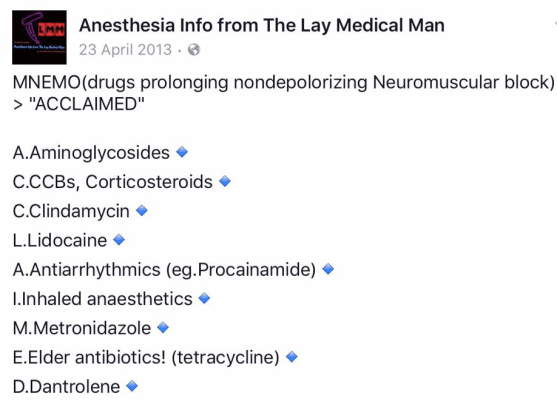
DRUGS PROLONGING NEUROMUSCULAR BLOCKADE

Screen Shot 2018-08-31 at 2.45.37 PM

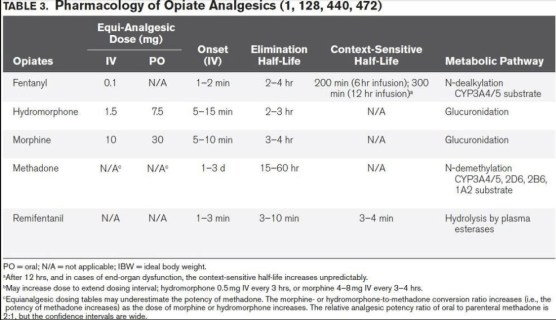
MNEMO> PENTAZOCINE “HOT DRUG”


H.Hallucination­ and psychotomimetic­ effects

O.Overt seizures rarely, with iv route

T.Typical Opioid side effects

D.Dose: 0.5 mg/kg i.v. or 30 mg i.v. Q4H. 30 mg iv= 10 mg morphine

R. Respiratory depression, Raised Pulmonary pressures (Pulmo­nary HTN), Raised BP, Raised ICP, Rare disease:Porphyri­a ….are CONTRAINDICATIO­NS

U. Upward CVP, LVEDP,PULMONARY­ PRESSURES

G.Give LESSER doses more FREQUENTLY to reduce side effects

#pharmacology , #opoid ,#pentazocine , #MuscleRelaxants , #mnemonic, #MedicalMnemonics ,#anaesthesia