Anesthesia Implications in ACHALASIA CARDIA

MNEMO> First 4 letters of ACHAsia.

A. Acute upper airway obstruction secondary to tracheal compression (by the dilated segment ) can be managed by Sublingual glyceryl nitrate,Passage of a naso-oesophageal tube,Transcutaneous needle puncture,Tracheal intubation etc

C Care against aspiration: The dilated oesophagus must be emptied and decompressed (needs a period of prolonged starvation) Rapid sequence induction ,Tracheal tube removal is performed in the awake patient, Patient should be nursed in the lateral position during recovery.

H History: Respiratory complications, which may be attributed to asthma or chronic bronchitis, are secondary to overspill of undigested material

A Acute problems that can be caused by the dilated segment : Acute thoracic inlet obstruction , difficulty in passing the tracheal tube past the dilated oesophagus, Upper airway obstruction , progressive dilatation of the upper oesophagus may occur in association with air swallowing or IPPV

Equipment check list for anaesthesia or sedation in a remote location away from the operating theatre

Remember the acronym SOAPME.

🔘S (suction) – Appropriate size suction catheters and functioning suction apparatus.

🔘O (oxygen) – Reliable oxygen sources with a functioning flow meter. At least one spare E-type oxygen cylinder.

🔘A (airway) – Size appropriate airway equipment: • Face mask • Nasopharyngeal and oropharyngeal airways • Laryngoscope blades • ETT • Stylets • Bag-valve-mask or equivalent device.

🔘P (pharmacy) – Basic drugs needed for life support during emergency: • Epinephrine (adrenaline) • Atropine • Glucose • Naloxone (reversal agent for opioid drugs) • Flumazenil (reversal agent for benzodiazepines).

🔘M (monitors): • Pulse oximeter • NIBP • End-tidal CO2 (capnography) • Temperature • ECG

🔘E (equipment): • Defibrillator with paddles • Gas scavenging • Safe electrical outlets (earthed) • Adequate lighting (torch with battery backup) • Means of reliable communication to main theatre site

#anaesthesia , #anesthesiacheck , #anesthesiatechnician ,#na , #nurseanaesthetist , #nurseanesthetist , #OperatingRoomSafety , #OR , #OperationTheatre , #AnaesthesiaTechnician ,#OT ,#nora ,#aoor

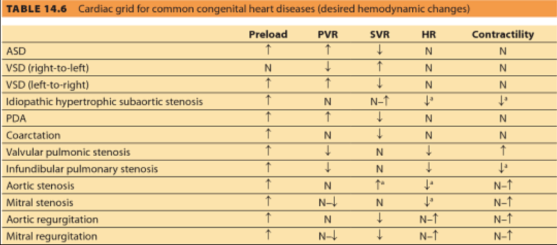
CARDIAC GRID FOR CONGENITAL HEART DISEASES

Screen Shot 2018-08-31 at 2.49.54 PM

NB:

MITRAL VALVE-AREA

Normal valve surface area 4 – 6 cm2

Symptom free until 1.5 – 2.5 cm2

Moderate stenosis 1 – 1.5 cm2

Critical stenosis <1 cm2

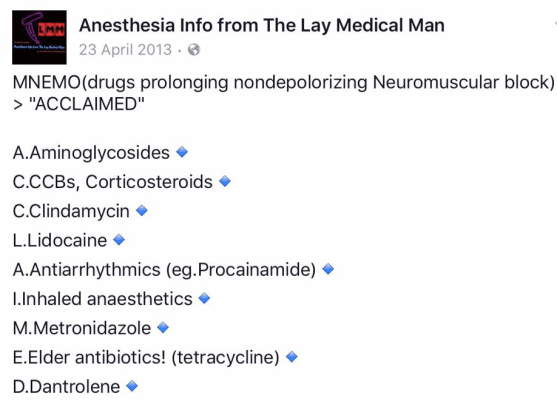
DRUGS PROLONGING NEUROMUSCULAR BLOCKADE

Screen Shot 2018-08-31 at 2.45.37 PM

DEFINITION OF SEDATION

The American Society of Anaesthesiologists uses the following definitions for levels of sedation:

# Minimal sedation (formerly known as anxiolysis) is a drug-induced state during which patients respond normally to verbal commands. Although cognitive function and coordination may be impaired, respiratory and cardiovascular stability is unimpaired.

# Moderate sedation (formerly known as conscious sedation) is a drug-induced depression of consciousness during which patients respond purposefully to verbal commands, either alone or accompanied by light tactile stimulation. It is important to remember that reflex response to a painful stimulus is not a purposeful response. No interventions are required to maintain a patent airway, and spontaneous ventilation is adequate. Cardiovascular stability is usually maintained.

# Deep sedation/analgesia is a drug-induced depression of consciousness during which patients cannot be easily roused but respond purposefully following repeated or painful stimulus. Patients may require assistance in maintaining a patent airway and spontaneous ventilation may be inadequate. Cardiovascular stability is usually maintained. In the UK deep sedation is considered to be a part of the spectrum of general anaesthesia.

MNEMO> PENTAZOCINE “HOT DRUG”


H.Hallucination­ and psychotomimetic­ effects

O.Overt seizures rarely, with iv route

T.Typical Opioid side effects

D.Dose: 0.5 mg/kg i.v. or 30 mg i.v. Q4H. 30 mg iv= 10 mg morphine

R. Respiratory depression, Raised Pulmonary pressures (Pulmo­nary HTN), Raised BP, Raised ICP, Rare disease:Porphyri­a ….are CONTRAINDICATIO­NS

U. Upward CVP, LVEDP,PULMONARY­ PRESSURES

G.Give LESSER doses more FREQUENTLY to reduce side effects

#pharmacology , #opoid ,#pentazocine , #MuscleRelaxants , #mnemonic, #MedicalMnemonics ,#anaesthesia

MNEMO🤓 (anaesthesia implications)>Systemic Lupus Erythematosus

” SLE – CARD”

1.Cardiac and Renal involvement🔻
2.Anemia🔻
3.Raynaud’s phenomenon: So avoid hypothermia🔻
4.Determine clotting status🔻

🤓Hint Question: “Have you brought your SLE CARD for surgery?”

#SLE, #MedicalMnemonics ,#lupus ,#anaesthesia

DESCRIPTION OF THE IMPORTANT EVENTS IN THE CARDIAC CYCLE SYNCHRONISED WITH THE EKG & VENOUS PRESSURE WAVE FORMS

1. Atrial Contraction (Phase 1): It is initiated by the P wave of the ECG which represents electrical depolarization of the atria. Atrial contraction does produce a small increase in venous pressure that can be noted as the “a-wave”. Atrial contraction normally accounts ONLY for about 10% of left ventricular filling when a person is at rest. At high heart rates when there is less time for passive ventricular filling, the atrial contraction may account for up to 40% of ventricular filling. This is sometimes referred to as the “atrial kick.” The atrial contribution to ventricular filling varies inversely with duration of ventricular diastole and directly with atrial contractility. The volume of blood at the end of the filling phase is the end diastolic volume and is around 120 mL in the adult. S4 sound is caused by vibration of the ventricular wall during atrial contraction. Generally, it is noted when the ventricle compliance is reduced (“stiff” ventricle) as occurs in ventricular hypertrophy and in many older individuals.

2. Isovolumetric Contraction (Phase 2): This phase of the cardiac cycle begins with the appearance of the QRS complex of the ECG, which represents ventricular depolarization. The AV valves close when intraventricular pressure exceeds atrial pressure. Closure of the AV valves results in the first heart sound (S1). During the time period between the closure of the AV valves and the opening of the aortic and pulmonic valves, ventricular pressure rises rapidly without a change in ventricular volume (i.e., no ejection occurs). Ventricular volume does not change because all valves are closed during this phase. Contraction, therefore, is said to be isovolumetric. The “c-wave” noted in the venous pressure may be due to bulging of A-V valve leaflets back into the atria. Just after the peak of the c wave is the x’-descent.

3. Rapid Ejection (Phase 3): Ejection begins when the intraventricular pressures exceed the pressures within the aorta (80 mm of Hg) and pulmonary artery, which causes the aortic and pulmonic valves to open. Left atrial pressure initially decreases as the atrial base is pulled downward, expanding the atrial chamber. Blood continues to flow into the atria from their respective venous inflow tracts and the atrial pressures begin to rise. This rise in pressure continues until the AV valves open at the end of phase 5.

4. Reduced Ejection (Phase 4): Approximately 200 msec after the QRS and the beginning of ventricular contraction, ventricular repolarization occurs as shown by the T-wave of the electrocardiogram. Repolarization leads to a decline in ventricular active tension and pressure generation; therefore, the rate of ejection (ventricular emptying) falls. Ventricular pressure falls slightly below outflow tract pressure; however, outward flow still occurs due to kinetic (or inertial) energy of the blood. Left atrial and right atrial pressures gradually rise due to continued venous return from the lungs and from the systemic circulation, respectively.

5. Isovolumetric Relaxation (Phase 5): When the intraventricular pressures fall sufficiently at the end of phase 4, the aortic and pulmonic valves abruptly close (aortic precedes pulmonic) causing the second heart sound (S2) and the beginning of isovolumetric relaxation. Valve closure is associated with a small backflow of blood into the ventricles and a characteristic notch (incisura or dicrotic notch) in the aortic and pulmonary artery pressure tracings. Although ventricular pressures decrease during this phase, volumes do not change because all valves are closed. The volume of blood that remains in a ventricle is called the end-systolic volume and is ~50 ml in the left ventricle. The difference between the end-diastolic volume and the end-systolic volume is ~70 ml and represents the stroke volume. Left atrial pressure (LAP) continues to rise because of venous return from the lungs. During isovolumetric ventricular relaxation, atrial pressure rises to 5 mmHg in the left atrium and 2 mmHg in the right atrium.

6. Rapid Filling (Phase 6): As the ventricles continue to relax at the end of phase 5, the intraventricular pressures will at some point fall below their respective atrial pressures. When this occurs, the AV valves rapidly open and passive ventricular filling begins. The opening of the mitral valve causes a rapid fall in LAP. The peak of the LAP just before the valve opens is represented by the “v-wave.” This is followed by the y-descent of the LAP. A similar wave and descent are found in the right atrium and in the jugular vein. In some patients a third heart sound (S3) is audible during rapid ventricular filling, and is often pathological in adults and is caused by ventricular dilatation.

7. Reduced Filling (Phase 7): As the ventricles continue to fill with blood and expand, they become less compliant and the intraventricular pressures rise. The increase in intraventricular pressure reduces the pressure gradient across the AV valves so that the rate of filling falls late in diastole. In normal, resting hearts, the ventricle is about 90% filled by the end of this phase. In other words, about 90% of ventricular filling occurs before atrial contraction (phase 1) and therefore is passive.

8. Right Vs Left: The major difference between the right and left side of the cardiac chambers, is that the peak systolic pressures of the right heart are substantially lower than those of the left heart, and this is because pulmonary vascular resistance is lower than systemic vascular resistance. Typical pulmonary systolic and diastolic pressures are 24 and 8 mm Hg, respectively.

9. Jugular Venous Pressure Summary: Right atrial pressure pulsations are transmitted to jugular veins. Thus, atrial contractions produce the first pressure peak called the a wave. Shortly there- after, the second peak pressure called the c wave follows and this is caused by the bulging of the tricuspid valve into the right atrium. After the c wave, the right atrial pressure decreases (‘x’ descent) because the atrium relaxes and the tricuspid valve descends during ventricular emptying. As the central veins and the right atrium fill behind a closed tricuspid valve, the right atrial pressure rises towards a third peak, the v wave. When the tricuspid valve opens at the end of ventricular systole, right atrial pressure decreases again as blood enters the relaxed right ventricle (‘y’ descent). The right atrial pressure begins to rise shortly as blood returns to the right atrium and the right ventricle together during diastole.

Ref: Principles of Physiology for the Anaesthetist, Peter Kam, Ian Power, http://www.cvphysiology. com

#CardiacCycle , #Physiology , #Anesthesia

IMPEDENCE AND RESISTANCE

  • Impedance and resistance are terms used to describe the opposition to electrical current flow.
  • Resistance is used to describe opposition to flow in DC circuits, whereas impedance is used for AC circuits.
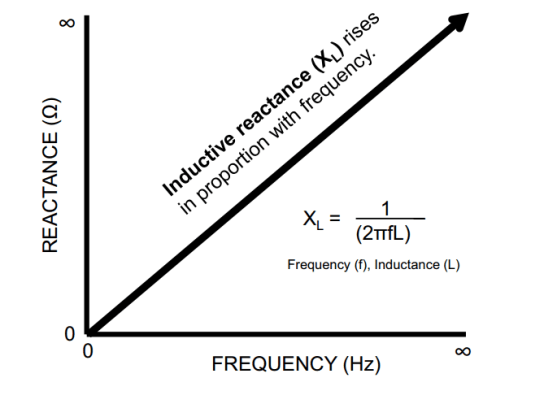
  • Unlike direct currents, alternating currents exhibit reactance (capacitive and inductive) because they have frequency and are phase associated.
  • In AC circuits, impedance (Z) consists of a real part (ohmic resistance) and an imaginary part (reactance of an inductor or capacitor). It is measured in ohms, and is the total opposition to current flow
  • Capacitors placed in DC circuits create an increasing resistance to current flow. This is because the charge at the negative plate of the capacitor accumulates, until maximum capacitance is reached and current flow ceases.
  • Capacitors in AC circuits allow current to flow, as the alternating direction of current flow prohibits a significant build up of charge on one of the plates.
  • Reactance is the resistance to AC that a capacitor or inductor exhibits and is inversely proportional to frequency.
  • This principle is used in filters to screen out DC currents and low frequency AC.
  • Inductors are coils of conducting wire wound around a ferrous or air core.
  • An increasing current flowing through an inductor generates a magnetic field around it. This magnetic field in turn creates an electromagnetic force, which opposes the current flow, known as back-emf. This effect is known as inductance, and its SI unit is the henry (H).
  • In a circuit where the rate of current change is 1 A/s, an inductance of one henry would generate one volt across the inductor.
  • Henry (H) = Voltage (V) × Time (s) / Amperes (A)
  • When the power is switched off, collapse of the magnetic field induces flow of electrons in the inductor and circuit, prolonging the flow of current for a short period.
  • Inductors placed in DC circuits will initially encounter transient resistance while the magnetic field is established. Once a steady state is reached, the reactance is negligible.
  • Conversely, inductors in AC circuits encounter increasing reactance proportional to the frequency. This is because the creation and subsequent reversal of magnetic field development produces a constant back-emf resisting current flow. Therefore, high-frequency AC will cause a high reactance in the inductor.
  • Inductors are used to filter out high-frequency alternating currents, or to smooth out the effect of power surges in monitoring equipment
  • Screen Shot 2018-08-14 at 11.25.12 AM.png


LASERS

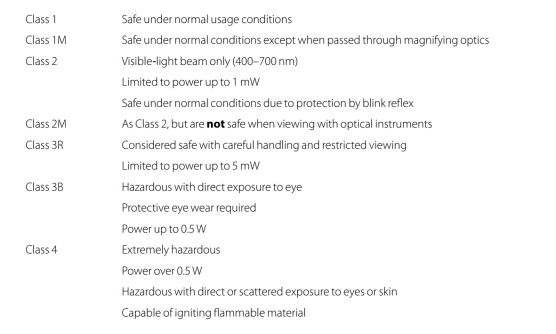
Screen Shot 2018-08-13 at 3.12.27 PM

    LASER is an acronym for Light Amplification by Stimulated Emission of Radiation.
    A laser comprises a laser tube constructed from an active lasing medium that can be a gas, solid or a liquid, with a mirror at each end of the tube
    Lasers produce an intense parallel beam of coherent monochromatic light (one specific wavelength of light) by the stimulated emission of photons from excited atoms
    Injecting energy from an external source (pumping) causes the lasing medium to become excited. Gas lasers are excited using an electric current applied to either end of the laser tube, while solid state and liquid lasers are excited using a high intensity light source. The mirrors cause photons to bounce back and forth within the laser medium, triggering further emission of photons by the process of stimulated emission. One mirror is partially reflective which allows some photons to escape in the form of the laser beam. The beam is then focused as required
    Electrons of atoms within a lasing medium normally reside in a stable low-energy level known as the ground state. Pumping excites electrons, raising them to higher energy levels. Because higher energy states are unstable in comparison to the ground state, there is a tendency for electrons to release excess energy and return to lower energy levels. This process is known as decay.
    As an electron decays from the metastable to ground state, it emits a photon of energy. If this photon strikes an excited electron in the metastable state, it incites it to emit another photon, which will have the same wavelength, waveform and direction as the incident photon. They are said to be in phase and coherent.
    Red and near-infrared lasers have the deepest penetration.
    Carbon dioxide lasers emit infrared light and have limited penetration, but are precise and can be used for cutting and vaporising.
    Argon lasers predominantly produce blue–green light at 488 and 514 nm, and are commonly used in ophthalmology.
    Neodymium-doped yttrium aluminium garnet (Nd:YAG) lasers have the deepest penetration and can cut and coagulate. They are used to resect gastrointestinal and bronchial tumours, and gynaecological lesions.
    LASERs are classified 1–4, 1 being least dangerous.
    Most medical lasers are class 3B and class 4. They pose a high risk to staff and patients.
    Lasers can ignite flammable material such as endotracheal tubes and surgical drapes. They can also cause airway and body cavity fires in the presence of high concentrations of flammable gases.
    The risk of airway fires can be reduced by using the lowest inspired oxygen concentration possible that achieves suitable oxygen saturations. In addition, using laser-safe endotracheal tubes with the cuffs filled with saline and dye helps to further reduce the risk of fires. The water in the cuff acts as a heat sink to reduce the likelihood of perforating and igniting the cuff with the laser. The dye provides a visual indication in the event of cuff perforation.