DRAW-OVER VAPORISERS IN A NUTSHELL FOR #Exams

They are placed inside the breathing system and rely on a negative pressure downstream from the vaporiser to create the flow required to entrain the agent. This negative pressure is generated either by the patient’s own inspiration or by a self-inflating bag

So they must have a very low resistance to flow to avoid additional resistance to the patient’s breathing.

Goldman vaporiser, the Oxford miniature vaporiser (OMV) and the Epstein MacIntosh vaporiser (EMV) etc are draw-over vaporisers. The triservice apparatus, used by the military, incorporates two OMVs

They are simpler, lightweight, smaller and less expensive.

As it is not possible to calibrate for the large range of tidal volumes created by the patient/ self-inflating bag, they are inaccurate

So they are not generally used in hospitals, and are reserved for ‘in-the-field’ use, where portability is required.

Reference: Al-Shaikh B, Stacey S. Essentials of Anaesthetic Equipment, 2nd edn. Edinburgh: Churchill Livingstone, 2002 . Davis PD, Kenny GNC. Basic Physics and Measurement in Anaesthesia, 5th edn. Oxford: Butterworth–Heinemann, 2003 .

Physics For Anesthesiologist: IMPEDANCE

Impedance is a term that is commonly used in the world of #electrophysiology and #BiomechanicalEngineering.

The chance of getting an electric shock is high when you have wet hands because the impedance of the skin is lower than when it is dry.

Thoracic impedance increases during inspiration.

When applying electric current to the chest during #defibrillation, less energy may reach the heart during the inspiratory phase than during the expiratory phase because of this phenomenon, thereby decreasing the possible success of defibrillation.

So better to attempt defibrillation during the expiratory phase of mechanical ventilation.

Where the #resistance of a circuit is dependent on the frequency of the current through it, the term impedance is used.

The unit of impedance is therefore the same as that of resistance (the ohm), but the symbol Z is used to differentiate it from the symbol used for resistance (Ω).

In case of a capacitor, as the frequency of the current increases, the current passes through the circuit more easily, i.e. the resistance of the capacitor falls with increasing current frequency.

In contrast, the resistance of an inductor rises as the frequency of the current increases.

#PhysicsForAnesthesiologist , #anesthesiologist , #anesthesia , #biomedical

Davis PD, Kenny GNC. Basic Physics and Measurement in Anaesthesia, 5th edn. Oxford: Butterworth–Heinemann, 2003; pp. 149–64 . Ewy GA, Hellman DA, McClung S, Taren D. Influence of ventilation phase on transthoracic impedance and defibrillation effectiveness. Crit Care Med 1980; 8: 164–6

Brainstem Testing for diagnosis of Brain Death


The brain stem often fails from the rostral to caudal direction and therefore it is logical to undertake testing in the same manner.

PUPILLARY REFLEXES :

The pupillary light reflex involves cranial nerves II and III and localizes to midbrain. The pupils should be nonreactive to both direct and consensual light reflex.

POINTS:

Pinpoint pupils are indicative of damage to descending sympathetic fibers as a result of damage to pons.

The size of the pupils only provides an indication of the site of brainstem involvement and is not crucial for testing brain stem death.

Clues: 2,3 pupil in MID row, some inPONdS

OCULOCEPHALIC REFLEX :

It involves cranial nerves III, VI, and VIII and interneurons within the midbrain and pons. On head movement toward right or left, the eyes remain “fixed” on a point in an intact patient. In the brain-dead patient, the eyes move with the head, hence the name “dolls eye” reflex.

POINTS:

Before performing this test the physician must rule out cervical fracture or instability.

Clues: Oh…Cee…368 dolls in MID row and PONdS

CORNEAL REFLEX :

The reflex tests the V, VII, and III cranial nerves and localizes entirely to the pons. In the intact patient, touching the cornea with a cotton swab causes eyelid closure.

The eye rotates upward, demonstrating the cranial nerve III component, known as “bell’s phenomenon.”

Corneal= sensation ; hence 5&7; plus 3 bells

OCULOVESTIBULAR REFLEX :

The oculovestibular reflex tests cranial nerves III, VI, VIII, and IV. It involves the entire pons and midbrain.

PROCEDURE :

Elevate the head 30°C. Irrigate tympanic membrane with 50-cc iced water or saline. Wait 1 min for response. Repeat test on the other side after waiting 5 min. If the oculovestibular reflex is intact using cold water as stimulus, the eyes tonically deviate toward the side of the stimulus immediately followed by a fast recoil toward the contralateral side (apparent nystagmus). In the brain stem dead patient this response is absent.

Clues: ‘broad test’ Pons & Medulla; 3,4,6, 8 COWS

GAG AND COUGH REFLEXES :

They require a functioning medulla and test cranial nerves IX and X. Both reflexes should be absent in brain stem death.

The cough reflex is easily tested by stimulation of carina by suction through the endotracheal tube. The gag reflex can be elicited by stimulating the posterior pharynx with a tongue blade.

APNEA TESTING :

This final test aims to demonstrate the failure of medullary centers to drive ventilation. Apnea test should be the last brain stem reflex to be tested.

OBJECTIVE:

Is to stimulate the medulla while avoiding hypoxia and hemodynamic compromise associated with acidosis secondary to hypercarbia.

PROCEDURE:

After ensuring preoxygenation for 10 min a blood gas is performed to confirm baseline PaCO2 and SaO2 .

With oxygen saturation greater than 95% the ventilatior is disconnected inducing apnea for a period of time to achieve ETCO2 above 6 KPa (=45 mmHg). A repeat arterial blood gases is used to confirm that the PaCO2 is at least 6 KPa and the pH is less than 7.40.

An oxygen flow rate of 2–5 L/min via an endotracheal catheter or in difficult cases CPAP may be used to maintain oxygenation till this state is attained.

Apnea is continued for a further 5 min after a PaCO2 of 6 KPa (=45 mmHg) has been achieved.

If there is no spontaneous respiratory response, a presumption of absence of respiratory activity is made.

A further blood gas can be done to confirm that the PaCO2 has risen by 0.5 KPa (=4 mmHg) from the initial 45 mmHg baseline.

Reference: Brain Death in Neurosurgical Critical Care Amit Prakash, Basil Matta , Essentials of Neurosurgical Anesthesia & Critical Care 2012

UPPER GI BLEED IN ICU PATIENTS: THE POINTS WHICH YOU SHOULD KEEP IN MIND

Incidence of overt Upper GI Bleed (UGIB) ranges from 1.5 to 8.5% of all ICU patients but may be as high as 15% if no prophylaxis is used.

RISK FACTORS

Mechanical ventilation >48 h

Coagulopathy – INR>1.5 or platelet count <50,000

Others: Shock, Sepsis, Hepatic failure,Acute Renal failure, Multiple trauma, Burns >35% of total body surface area, Organ transplantation, Head trauma, Spinal trauma, History of PUD or UGIB

SPECIFIC POINTS REGARDING TREATMENT

Thrombocytopenia can develop in neurosurgical patients on H2 Blockers

The use of H2Bs and PPIs may increase the frequency of nosocomial pneumonia.

PROPHYLAXIS IS RECOMMENDED FOR ICU PATIENTS WHO EXHIBIT:

Coagulopathy (platelet count < 50,000 per m 3 , INR > 1.5, partial thromboplastin time (PTT) >2 times the control value)

Mechanical ventilation >48 h

History of GI ulceration or bleeding within the past year

Two or more of the following risk factors: sepsis; ICU stay >1 week; occult GIB ≥6 days; glucocorticoid therapy (>250 mg hydrocortisone).

REASONS FOR UGIB IN ICU PATIENTS:

The glycoprotein mucous layer may be denuded by increased concentrations of refluxed bile salts or uremic toxins common in critically ill. Alternatively, or in addition, mucosal integrity may be compromised due to poor perfusion associated with shock, sepsis, and trauma.

Excessive gastrin stimulation of parietal cells has been detected in patients with head trauma as oppose to be normal or subnormal in most other ICU patients.

Systemic steroids double the risk of a new episode of UGIB or perforation. Concomitant use with high doses of NSAIDs has been associated with a 12-fold increased risk for upper GI complications.

Helicobacter pylori infection

EMPIRICAL THERAPY

Start with an IV bolus of 80 mg and continue IV infusion at 8 mg/h for a total of 72 h. If no signs of rebleeding after 24 h, switch to oral PPI.

Octreotide is used in variceal bleeding. Start with an IV bolus of 50 mcg and continue IV infusion at 50 mcg/h for 3–5 days.

UGIB IN HEAD INJURY & OTHER NEUROSURGICAL PATIENTS:

They are more prone for UGIB because of 1. Frequent use of systemic steroids 2. Increased gastrin secretion 3. Significant gastric intramucosal acidosis is common in severe head injury. 4. Primary insult to the central nervous system may result in derangement of splanchnic blood flow secondary to neurohumoral mechanisms.

In head injury, GI dysfunction also may manifest as gastroparesis, ileus, increased intestinal mucosal permeability

Plasma levels of cortisol and age are independent predictors of stress ulcers following acute head injury.

#GastroIntestinalBleed , #StressUlcer , #ICU , #Anesthesia , #CriticalCare, #IntensiveCare , #NeuroSurgery , #HeadInjury , #TBI,#NeuroCriticalCare

Reference: Gastrointestinal Hemorrhage in Neurosurgical Critical Care Meghan Bost, Kamila Vagnerova , Ch:84, Essentials of Neurosurgical Anesthesia & Critical Care 2012 Strategies for Prevention, Early Detection, and Successful Management of Perioperative Complications

STATIC COMPLIANCE, DYNAMIC COMPLIANCE & PLATEAU PRESSURE

Compliance is a measurement of the distensibility of the lung

Compliance of both the chest wall and the lung tissue is known as Total Lung Compliance

Total Lung Compliance = Change in volume / Change in pressure

Static Compliance is the truest measure of the compliance of the lung tissue

It is measured when there are no gases flowing into or out of the lungs

Static Compliance = Exhaled Tidal Volume / (Plateau Pressure-PEEP)

The Plateau Pressure is obtained by instituiting a 2 second inspiratory pause at the peak of inspiration. This pause creates the condition of no gases flowing into the lungs.

This reflects the pressure due to the elastic recoil forces of the lung tissue alone . No pressure resulting from the flow of gases is measured.

Normal value for Static Compliance is 70-100 mL/cm H2O. This means that for every 1 cm H2O pressure change in the lungs , there is a change in volume of 70-100 mL of gas

As Dynamic Compliance is a measurement taken while gases are moving in the lungs , it measures both the Compliance of the lung tissue and the resistance to air flow

It is easier to obtain as it doesn’t require the inspiratory hold maneuver

Dynamic Compliance = Exhaled Tidal Volume / (Peak Inspiratory Pressure-PEEP)

The normal value for Dynamic Compliance is 50-80 mL/cm H2O

Dynamic Compliance measures are always smaller than Static Compliance because Peak Airway Pressure is always greater than Plateau Pressure

A decrease in Dynamic Compliance may indicate a decrease in lung compliance or an increase in airway resistance.

VITAMIN K

Vitamin K is so named as it was originally called Koagulationsvitamin.

The body stores about 1 week’s supply of vitamin K.

Vitamin K is a fat-soluble vitamin

Vitamin K is required for the synthesis of six factors in the clotting cascade : factors II, VII, IX, X and the anticoagulants protein C and protein S.

γ -Carboxylation of these factors is carried out by the vitamin K-dependent carboxylase. This reaction subsequently allows calcium binding and the conformational change required to become active. The reaction involves the oxidation of vitamin K. Warfarin works by stopping the reversal of this oxidation.

Bile is required for absorption of vitamin K in the gut.

Menadiol, a synthesized form of vitamin K (K3), is water-soluble and therefore can be absorbed in conditions in which bile secretion is low. But, it is not recommended for use in neonates as it may produce haemolysis.

Haemorrhagic disease of the newborn is caused by a relative vitamin K deficiency.

Prophylaxis against haemorrhagic disease of the newborn is usually given at birth as an injection of the naturally occurring fat-soluble phytomenadione.

Spina Bifida : Anesthesia IMPLICATIONS

Incidence of Spina bifida occulta is 10%–25% of the population.

Associated with cord abnormalities (spinal dysraphism)

70% of those with cord abnormalities have dimpling or a hairy naevus at the base of the spine.

30% of patients with spinal dysraphism have neurological signs.

If such a patient comes for surgery, an MRI scan should be done to rule out a tethered cord.

Once this is excluded, it may be appropriate to proceed with regional analgesia at a site above the lesion.

The patient should be explained about the higher incidence of dural puncture because of abnormal ligamental structure.

Another point is, there may be incomplete spread of anaesthetic to sites below the lesion and consequently a suboptimal block may occur.

The epidural space volume is usually reduced and so, the epidural should be established with small aliquots of local anaesthetic to prevent a high block.

Spina bifida is also associated with a difficult intubation.

Spina bifida is a risk factor for latex allergy

Ref: Ali L, Stocks GM. Spina bifida, tethered cord and regional anaesthesia. Anaesthesia. 2005; 60(11): 1149–1150. Griffiths S, Durbridge JA. Anaesthetic implications of neurological disease in pregnancy. Contin Educ Anaesth Crit Care Pain. 2011; 11(5): 157–161. D’Astous J,Drouin MA, Rhine E 1992 Intraoperative anaphylaxis secondary to allergy to latex in children who have spina bifida. Report of two cases. Journal of Bone & Joint Surgery 74: 1084–6.

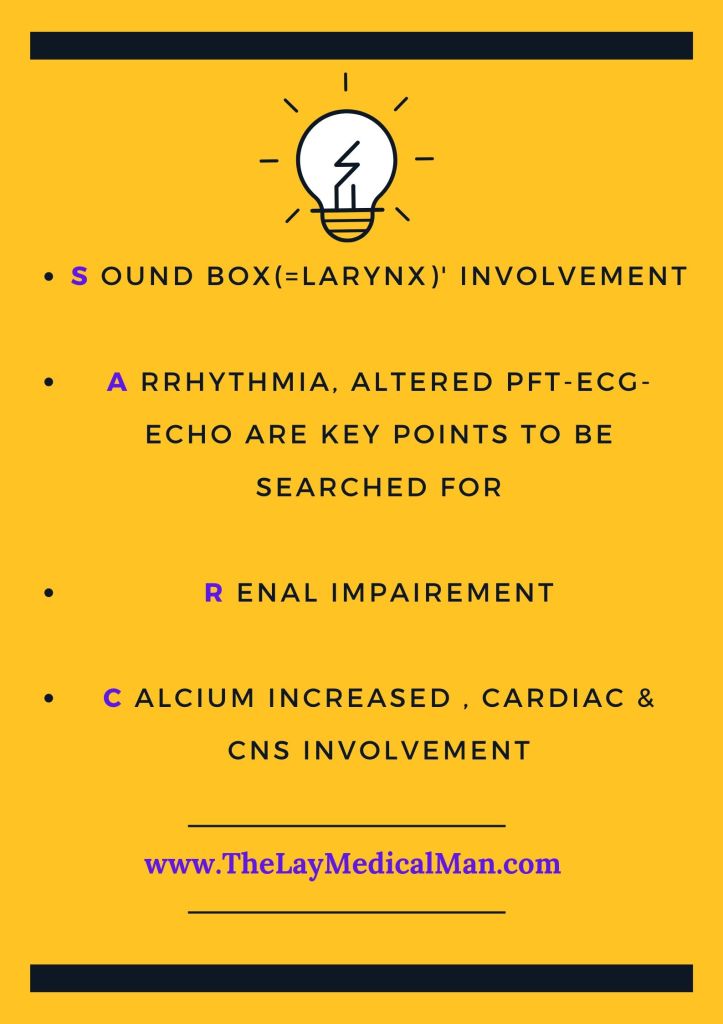
ANESTHESIA IMPLICATIONS IN SARCOIDOSIS: “SARC”

Ⓜ️NEMO> ‘SARC’

ADDITIONAL POINTS

PULMONARY INVOLVEMENT

PFT may be impaired

CXR may show bilateral hilar lymphadenopathy with increased reticular shadowing in the lung fields

Look for evidence of pulmonary hypertension

If there is widespread pulmonary involvement and the patient is symptomatic, lung function tests, including blood gases, should be performed.

HYPERCALCEMIA

It is secondary to the production of excess 1,25- dihydroxycholecalciferol. Nephrocalcinosis and renal failure may occur . So establish treatment for hypercalcemia

CARDIAC INVOLVEMENT

Cardiac involvement carries a poor prognosis and it’s diagnosis is of anaesthetic importance.

Localised granulomas and fibrous scarring most commonly occur in the basal portion of the ventricular septum and if they happen to involve the conducting system,  arrhythmias or conduction defects occur.

Less commonly, the distribution of granulomas may be widespread and they may coalesce to produce diffuse interstitial fibrosis. The resulting hypokinesia and subsequent heart failure is clinically indistinguishable from other cardiomyopathies. Myocardial imaging showed that the majority of these had an infiltrative cardiomyopathy. Pericardial effusions may also occur.

In those patients diagnosed as having cardiac involvement, the signs in order of frequency of presentation were:

# complete heart block
# ventricular ectopics or ventricular tachycardia
# myocardial disease causing heart failure
# sudden death
# first-degree heart block or bundle branch block.

In most of the patients with complete heart block and sarcoid the heart block was the first sign of the disease

The sudden onset of complete heart block during anaesthesia can occur

Difficulties with pacemaker management can be a feature of cardiac sarcoidosis. Patients with advanced disease may have automatic implantable cardioverter defibrillators inserted

A preoperative ECG is essential, even in young patients. An ECHO also may be ordered. If there is evidence of a conduction defect, a temporary pacemaker should be inserted before anaesthesia.

CNS INVOLVEMENT

Central nervous system sarcoid also carries a poor prognosis.

Presentation can vary widely and includes cranial nerve palsies,peripheral neuropathy,epilepsy,and cerebellar ataxia

AIRWAY INVOLVEMENT

Laryngeal sarcoidosis : the commonest lesion reported is an oedematous, pale,diffuse enlargement of the supraglottic structures

Infiltration of the airway may cause obstructive sleep apnoea

So need for an ENT evaluation preoperatively should be considered

DIAGNOSIS :

can be made on biopsy of a skin lesion,or lung and bronchial biopsy via a fibreoptic bronchoscope.

The Kveim test has a high positivity in the active stages, but is lower in the chronic disease.

Serum angiotensin- converting enzyme (ACE) level is an indicator of sarcoid activity

serum calcium and 24-h urinary calcium levels may also be increased in active sarcoid.

Treatment of active disease may include corticosteroids, immunosuppressants, methotrexate,NSAIDS and calcium chelating agents.

Reference: Medical disorders and anaesthetic problems , Rosemary Mason , Anesthesia Databook , A Perioperative and Peripartum Manual , 3/e

STEROID EQUIVALENT DOSES

Screen Shot 2018-09-03 at 12.04.12 PM

Gestational Diabetes : INFO WE GET FROM THE #ACOG 2013 GUIDELINES

Increased blood sugars 4-6 h prior to delivery leads to increased rates of hypoglycemia in the neonate. A maternal blood glucose value of more than 180 mg/dl has been conclusively proven to be associated with high risk of neonatal hypoglycemia.

The American College of Obstetrics and Gynecology and the American College of Endocrinology recommends maintenance of blood glucose between 70 and 110 mg/dl during labor (3.9-6.1 mmol/L) this goal is the same irrespective of whether the women has type 1 diabetes, type 2 diabetes or GDM.

The hepatic glucose supply is sufficient during the latent phase of labor, but during the active phase of labor the hepatic glucose supply is depleted so calorie supplementation is required.

During labor in a case with GDM controlled only on life-style modification, it is not compulsory to monitor blood sugars periodically and monitoring once in every 4-6 h is sufficient during labor

In patients on insulin it is mandatory to monitor the blood sugar every 2-4 h during the latent phase, every 1-2 h during the active phase

In patients for whom cesarean is planned, it always preferred to do the procedure early morning.

Patient needs to take her usual night dose of intermediate-acting insulin and the morning dose of insulin has to be withheld and patient needs to be kept nil by mouth.

If surgery is delayed it is needed to start basal and corrective regimen (DNS with short acting insulin) with one-third of the morning intermediate insulin dose with a 5% dextrose infusion to avoid ketosis. Blood glucose has to be monitored second hourly and if required subcutaneous dose of corrective dose of short acting insulin to be given.

After delivery, the requirement of insulin shows a sharp decline and in GDM it is advisable to continue the monitoring to see if the sugars have become normal in the postpartum period

In cases with type 1 and type 2 DM it is prudent to decrease the dose of insulin by 20-40% of the pregnancy dose as the requirement of insulin during lactation is less. During the breast-feeding, sometimes the requirement of insulin can fall drastically and these women may develop hypoglycemia, so the dose of insulin needs to be adjusted accordingly

Reference: ACOG Practice Bulletin, 137, 2013

Indian Journal of Endocrinology and Metabolism: Peripartum management of diabetes, Pramila Kalra and Manjunath Anakal