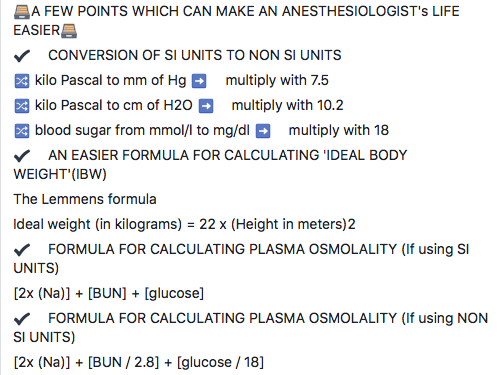
A FEW POINTS WHICH CAN MAKE AN ANESTHESIOLOGIST’s LIFE EASIER

The placenta forms a barrier to the transfer of drugs between the mother and the fetus, but increasing lipid-solubility, decreasing maternal protein binding, decreasing molecular weight, increased materno-fetal concentration gradient and placental blood flow etc will increase the placental transfer of drugs
The relative distribution of the drug across the placenta is represented by Feto-Maternal (F/M) concentration ratio
Pethidine and diamorphine are both metabolised in the fetus to less lipid-soluble products like norpethidine and morphine respectively, which remain on the fetal side of the placenta. The elimination half-lives of these drugs are also longer in the fetus because of immature hepatic metabolism. This again prolongs its existence in the fetal side.
Lipid solubility of drugs like thiopentone sodium are high; so they cross the placenta easily, and can accumulate as the pH is lower in the fetus
Diazepam is metabolised to less lipid-soluble products. So it can have an F/ M ratio of 2 even one hour after maternal administration.
Local anaesthetic agents are weak bases which are largely UN-IONISED at physiological pH, and cross the placenta readily. Foetal ‘trapping’ occurs only in severe acidosis, when the molecules become IONIZED in the fetal side.
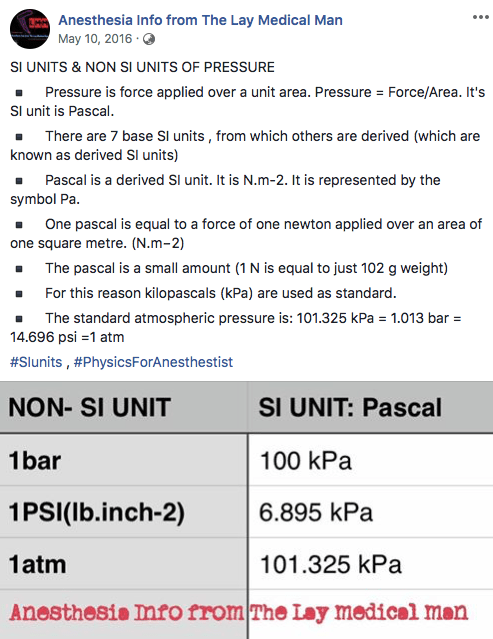
Dynamic or absolute viscosity is a measure of the resistance of a fluid or gas to flow. It is measured using a viscometer or rheometer.
The SI unit of dynamic (or absolute) viscosity is the pascal-second (Pa·s), equivalent to N·s/ m2.
Viscosity is independent of flow rate
Viscosity is independent of pressure
For a gas, viscosity decreases as its temperature increases
The relationship between viscosity and temperature and pressure only holds true for those fluids and gases that exhibit ‘Newtonian’ properties, i.e. substances that will always flow irrespective of forces acting upon them (e.g. crystalloid solutions and water).
Blood is a non-Newtonian fluid and its viscosity depends largely on haematocrit (and varies with flow rate).
Blood viscosity is increased by volatile anaesthetic agents, smoking and aging
A thixotropic substance is one that becomes less viscous over time when agitated. If it becomes more viscous with agitation, this is known as a rheopectic material.
Kinematic velocity is defined as the dynamic velocity of a substance divided by its density.


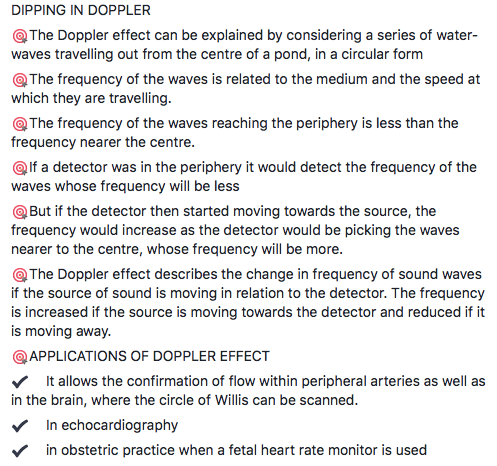
For this, we should know:
1. Oxygen delivered = FiO2 x Minute Volume
2. Duration of the transfer
For e.g. If we are expecting a duration of 2 hours (120 minutes) and we are having Size E cylinders and also need to deliver an FiO2 of 1 @ 6L / min
1. O2 delivered = 1 x 6 = 6L/ min
2. Size E has 660 L of O2, which will suffice for 660/6= 110 minutes ; so for 120 minutes, we need 2 cylinders

 The Lay Medical Man