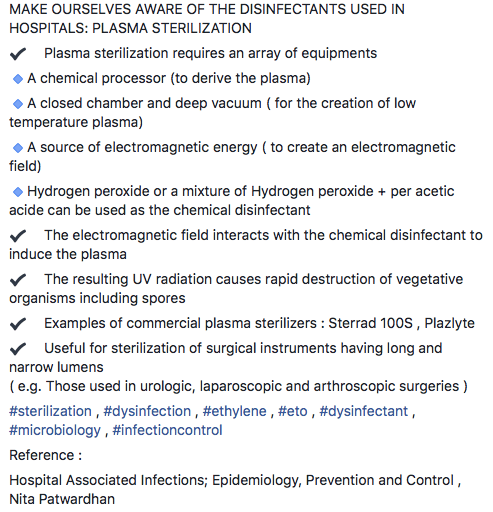
DISINFECTION: PLASMA STERILIZATION

Neuromuscular blocking agents (NMBAs) represent the most frequently incriminated substances for allergic reactions among all drugs used in the perioperative period, ranging from 50 to 70% (1)
They are substances responsible for IgE-mediated anaphylaxis. Among NMBAs, the following substances have been incriminated, in decreasing order of importance: suxamethonium, vecuronium, atracurium, pancuronium, rocuronium, mivacurium and cisatracurium.(1)
Incidence of anaphylactic reactions are seen more with suxamethonium and rocuronium. (2) (3)
These reactions are more severe than with latex allergy
Seem to occur more frequently in women than in men.
If rapid-sequence induction is not mandatory, safer alternatives like cisatracurium can be used , in place of Rocuronium
Regarding suxamethonium, more frequently it causes histamine release from mast cells and basophils, resulting in flushing and urticaria (without anaphylactic reactions)(4)
Regarding atracurium , histamine release is observed in 40% of patients who receive doses over 0.5 mg/kg, resulting in transient hypotension and tachycardia; this can be prevented by injecting the drug slowly over 75 seconds, reducing the dose or prior treatment with 0.1 mg/kg chlorpheniramine and 2 mg/kg cimetidine i.v. (4)
Cisatracurium will not cause histamine release in clinical dose range. Cisatracurium had the lowest rate of cross-reactivity in patients who had previously suffered anaphylaxis to rocuronium or vecuronium.(4)
Mivacurium causes transient fall in b.p. due to histamine release with doses above 0.2 mg/kg(4)
The estimated sensitivity of skin tests for muscle relaxants is approximately 94 to 97 %. (1)
#anaphylaxis , #allergy , #anaesthesia , #MuscleRelaxants , #criticalcare , #nmba , #AnaesthesiaComplications , #pharmacology ,#rocuronium , #cisatracurium
Reference:
(1) www.worldallergy.org , Allergy to Anesthetic Agents, Mertes Paul Michel, Demoly Pascal, Stenger Rodolphe , Updated May 2013 ,Originally posted: October 2007, Reviewed by: Mario Sánchez-Borges
(2)A. Gullo(Editor) Anaesthesia, Pain, Intensive Care and Emergency – A.P.I.C.E.
(3) Proceedings of the 22 nd Postgraduate Course in Critical Care Medicine, Incidents Provoked Specifically by Certain Drugs Used in Anaesthesia M. K LIMEK , T.H. O TTENS ,F.G RÜNE
(4) Lee’s Synopsis of Anaesthesia,13/e, p:191-193
(5) Br J Anaesth. 2013 Jun;110(6):981-7. Anaphylaxis to neuromuscular blocking drugs: incidence and cross-reactivity in Western Australia from 2002 to 2011., Sadleir PH1, Clarke RC, Bunning DL, Platt PR.


Tramadol- highlights
both opioid and non-opioid modes of action. .
(1)inhibition of noradrenaline re-uptake
(2)increased release and decreased re-uptake of serotonin in the spinal cord, and
(3)a weak effect on mu opioid receptors
The weak, opioid effect is mediated by an active metabolite, (+)-M1 (O-desmethyltramadol), formed via the genetically polymorphic P450 CYP2D6 iso-enzyme system. The biological activity of this system is variable, and individuals may be classified as extensive or poor metabolisers of tramadol.
Tramadol’s affinity for opioid receptors is about 6000 times weaker than morphine, but the (+)-M1 metabolite has an affinity about 200 times greater than tramadol. Poulsen et al. report much higher concentrations of the (+)-M1 metabolite and greater analgesic efficacy of tramadol in extensive metabolisers compared to poor metabolisers. Also noted was a reduction of nausea, vomiting and tiredness amongst poor metabolisers
Ondansetron competitively antagonises serotonin, subtype 3 (5-HT3) receptors in the CTZ and enteric neurones.
Peripheral 5-HT3 receptors are also involved in nociceptive pathways and ondansetron may alter 5-HT3 nociceptive responses at the level of dorsal horn neurones
Ondansetron can block sodium channels in a similar fashion to local anaesthetic agents, and exhibit agonist activity at mu opioid receptors, thus resulting in a peripheral anti-nociceptive effect.
Tramadol + Ondansetron
PONV due to Tramadol is often managed with, ondansetron
There is evidence that the concurrent use of these two drugs results in a mutual reduction of effect—tramadol becomes a less potent analgesic and ondansetron a less effective antiemetic.
But the effect of ondansetron on tramadol consumption diminished with time.
De Witte et al. found a significant (50%) increase in cumulative tramadol consumption during the first post-operative hour when patients were given ondansetron along with Tramadol.
Ondansetron is, in part, metabolised by the CYP2D6 iso-enzyme system—an iso-enzyme system responsible for formation of an active tramadol metabolite that has analgesic effect . Competition for this metabolic pathway may result in a reduction in formation of the (+)-M1 metabolite of tramadol and a consequent reduction in analgesic efficacy.
DO YOU KNOW? additional points++
There is animal and human evidence that both tramadol and ondansetron have local anaesthetic type properties.
Ondansetron was approximately fifteen times more potent than lignocaine and may well be a prototype molecule for the development of a new group of local anaesthetic agents.
These findings are further supported in a human clinical study by Memis et al. which showed that tramadol and ondansetron both significantly reduced the pain associated with the injection of the neuromuscular blocking drug, rocuronium.
Tropisetron and granisetron are able to reverse an aceaminophen-mediated analgesia completely.
References:
Anaesthesia. 2015 Feb;70(2):209-18. doi: 10.1111/anae.12948. Epub 2014 Dec 10.
The effect of ondansetron on the efficacy of postoperative tramadol: a systematic review and meta-analysis of a drug interaction.
Stevens AJ1, Woodman RJ, Owen H.
Ondansetron Inhibits the Analgesic Effects of Tramadol: A Possible 5-HT3 Spinal Receptor Involvement in Acute Pain in Humans
Arcioni, Roberto MD*,; della Rocca, Marco MD*,; Romanò, Sarah MD*,; Romano, Rocco MD†,; Pietropaoli, Paolo MD*, and; Gasparetto, Alessandro MD*
ScienceDirect Review
Aspects of tramadol and ondansetron interactions Bruce Hammonds, David A. Sidebotham, Brian J. Anderson
Ref: J.H. Ye, W.C. Mui, J. Ren, T.E. Hunt, W.H. Wu, V.K. Zbuzek Ondansetron exhibits the properties of a local anesthetic. Anesth. Analg., 85 (1997), pp. 1116–1121
Ref: Pickering G, Loriot MA, Libert F, et al. Analgesic effect of acetaminophen in humans: rst evidence of a central serotonergic mechanism. Clin Pharmacol Ther. 2006;79:371–8

 The Lay Medical Man