REFINE YOUR IMPRESSION OF 📕PaO2 Vs 📗SaO2 Vs 📘CaO2

⭕️Oxygen content ( PaO2 ) is the pressure of oxygen molecules dissolved in blood, and is measured by ABG analysis with units of kPa or mmHg

⭕️Oxygen saturation ( SaO2 ) is a measure of the percentage of haemoglobin sites that have oxygen bound, commonly measured with a pulse oximeter

⭕️Oxygen content ( CaO2 ) is the real measure of blood oxygen quantity as it accounts for dissolved and haemoglobin bound oxygen. (i.e. CaO2 directly reflects the TOTAL number of oxygen molecules in arterial blood, both bound and unbound to hemoglobin. It is given as the volume of oxygen carried in each 100 ml blood (mL O 2 /100 mL). Normal CaO2 ranges from 16 to 22 ml O2/dl.

EXPLANATION:

⭕️Oxygen saturation ( SaO2 ) is expressed as the percentage of haemoglobin-binding sites that are occupied by oxygen, thereby forming oxyhaemoglobin.

⭕️Arterial blood is normally at 97–98% O 2 saturation (i.e. 98% of the available haemoglobin is combined with O 2 ), whereas venous blood is normally at 74% O2 saturation.

⭕️O2 constitutes 21% of the atmosphere by volume and atmospheric PO2 is 159 mmHg at sea level . At an alveolar pressure of 104 mmHg, alveolar oxygen diffuses into pulmonary venous blood and raises its O2 content from 15 mL/100 mL to 20 mL/100 mL. Of this amount 19.75 mL is combined with haemoglobin and 0.25 mL is ‘free’ or dissolved in simple solution in the plasma. At this pressure of alveolar O2 , haemoglobin in the arterial blood normally becomes 98% saturated and and 2% of the haemoglobin remains reduced, i.e. free of oxygen.

⭕️PaO2 is determined by alveolar PO2 and the state of the alveolar-capillary interface, not by the amount of hemoglobin available to soak them up. PaO2 is not a function of hemoglobin content or of its characteristics. This explains why, for example, patients with severe anemia or carbon monoxide poisoning or methemoglobinemia can (and often do) have a normal PaO2.

⭕️The most common physiologic disturbance of lung architecture, and hence of a reduced PaO2, is ventilation-perfusion (V-Q) imbalance. Less common causes are reduced alveolar ventilation, diffusion block, and anatomic right to left shunting of blood.

⭕️Think of PaO2 as the driving pressure for oxygen molecules entering the red blood cell and chemically binding to hemoglobin; the higher the PaO2, the higher the SaO2.

⭕️ In contrast to the other two variables, CaO2 depends on the hemoglobin content and is directly related to it; Since the dissolved oxygen contributes minimally to CaO2 under physiologic conditions, CaO2 is determined almost entirely by hemoglobin content and SaO2, and is related linearly to either variable.

CaO2 = Hb (gm/dl) x 1.34 ml O2/gm Hb x SaO2 + PaO2 x (.003 ml O2/mm Hg/dl).


Screen Shot 2018-09-02 at 11.15.47 AM

Labetalol Pharmacology

Comes as 5 mg/mL ampoules

Blocks α, β1, and β2 adrenergic receptor sites.
Decreases heart rate and peripheral vascular resistance.

Ratio of alpha to beta blockade depends upon the route of administration (1:3 oral versus 1:7 IV)

Onset of action: 2‐5 minutes

Will not cause bronchoconstriction

Duration: 2‐4 hours

IV Bolus: 20 mg over at least 2 minutes as initial dose, may repeat with doses of 40-‐ 80 mg q10min; Do not exceed total dose of 300 mg

Infusion [ dilution 1 mg/mL] : starting 2 mg/min (2 mL/min) – 8 mg/min titrated to response. Do not exceed total dose of 300

As cumulative dose nears 300mg IV, duration of action extends to nearly 18 hours.

Ref: B Xu, F Charlton, A Makris, A Hennessy – Journal of hypertension, 2014

HYPOPHOSPHATAEMIA IN ICUs

Normal range (2.5-4.5 mg/dL),

Hypophosphataemia = phosphate concentration < 2.5 mg/dL or 0.81 mmol/L

CAUSES:

Poor Nutrition
Chronic Alcoholism
Diarrhoea
Beta 2 Agonists
Insulin Acetazolamide
Hemodialysis
Hyperparathyroidism

EFFECTS

Irritability
Confusion
Metabolic encephalopathy
Coma
Muscle weakness
Respiratory failure
Failure to wean from ventilator
Dysphagia
Ileus
cardiac arrhythmias and cardiomyopathy.
ODC shift to left

TREATMENT

Asymptomatic mild-to-moderate hypophosphatemia (1-2.5 mg/dL) can be treated with oral phosphate supplementation if the gastrointestinal tract is intact.

Symptomatic or severe hypophosphatemia (< 1.0 mg/dL) should be treated with intravenous phosphate.

Oral supplementation : 2.5 to 3.5 g (80 to 110 mmol) per day, divided over two to three doses.

Intravenous:

The required dose of initial intravenous phosphate may vary from 2.5 to 19.8 mg/kg.
Typically, 2-5 mg/kg of inorganic phosphate dissolved in 0.45% saline is given over 6-12 hours and repeated as needed.

Rapid or large infusions are dangerous : Large intravenous doses of phosphate may result in hyperphosphatemia, hypomagnesemia, hypocalcemia, and hypotension.

Hyperkalemia is prevented by using sodium phosphate instead of potassium phosphate in patients with potassium levels >4 mmol/L.

Do not mix with Calcium or Magnesium

Daily Phosphate level monitoring should be done

NEW INSIGHTS

FGF23 recently identified as a physiological regulator of phosphate and vitamin D metabolism

 FGF23 plays a central role in the pathogenesis of altered mineral metabolism and secondary hyperparathyroidism in CKD patients and post-transplant hypophosphatemia in kidney transplant recipients.

FGF23 can be used not only as a biomarker for assessing phosphate retention but also as a predictor of mortality and future development of re- fractory hyperparathyroidism.

ANTICOAGULANTS OF CHOICE IN VARIOUS LABORATORY TESTS

ESR WESTERGREN’S
COAGULATION STUDIES –> SODIUM CITRATE

ESR WINTROBE’S
PERIPHERAL SMEAR–> EDTA

Hb , PCV –> DOUBLE OXALATE

OSMOTIC FRAGILITY –> HEPARIN

BLOOD SUGAR–> SODIUM FLURIDE + OXALATE

POSTOPERATIVE AGITATION / EMERGENCE DELIRIUM IN CHILDREN AFTER SEVOFLURANE ANAESTHESIA

Incidence up to more than 40%

Might be occurring together with EEG-changes

Methods usually tried to reduce the incidence: addition of nitrous oxide, premedication with benzodiazepines, early extubation, switching to other inhaled anaesthetics

Propofol maintenance after sevoflurane induction seems to be the best alternative.

A recent study also indicates that a switch to desflurane for maintenance after sevoflurane inhalation induction reduces the incidence of emergence agitation by 50 %

A paranoid delusion is said to be a common feature of this state of agitation.

Information about this phenomenon should be explained to the parents before the procedure.

D for DANTROLENE

Dantrolene inhibits calcium release via RyR1 antagonism and impairs calcium-dependent muscle contraction.

This rapidly halts the increases in metabolism and secondarily results in a return to normal levels of catecholamines and potassium.

Dose is 2 mg/kg; repeat every 5 minutes until vital signs normalise, to a total dosage of 10 mg/kg if needed.

Dantrolene takes ~ 6 minutes to have any effect

The solution is prepared by mixing 20 mg of dantrolene with 3 g of mannitol in 60 ml of sterile water. Reconstitute each 20 mg vial with 60 ml sterile water. The powder for reconstitution contains mannitol and Sodium hydroxide. Use within 6 hours.

Since dantrolene is relatively insoluble, preparation is tedious and time consuming, and its preparation should not be the responsibility of the primary anesthesiologist involved in the patient’s management. (May occupy several nurses)

All patients who develop MH, require at least 24 hours of posttreatment management in a critical-care setting as there is chance of reappearance of symptoms ( known as recrudescence )

In the ICU, continue @1mg/kg q6h for 24 hours
May be given enterally if GIT function is normal (price ~ 1000 x less)

The actions of dantrolene include:

inhibition of release of Ca ++ from the SR, without affecting re-uptake
? antagonises the effects of Ca ++ at the actin/myosin – troponin/tropomyosin level
muscular weakness, which may potentiate NMJ blockade ~ 5-15 mg/kg produces significant muscular relaxation
there is no effect on NMJ transmission
up to 15 mg/kg there is no significant effect on the CVS
up to 30 mg/kg there is no significant effect on respiration

#dantrolene , #MalignantHyperthermia, #mh ,#anaesthesia

THE RIGHT WAY OF ADMINISTERING BLOOD PRODUCTS

Screen Shot 2018-09-01 at 5.22.07 PMPrefer a larger cannula: A doubling of the diameter of the cannula increases the flow rate of most fluids by a factor of 16.

In case of Whole blood, red cells, plasma and cryoprecipitate

>Use a new, sterile blood administration set containing an integral 170–200 micron filter

>Change the set at least 12-hourly during blood component infusion

>In a very warm climate, change the set more frequently and usually after every four units of blood, if given within a 12-hour period

In case of Platelet concentrates

Use a fresh blood administration set or platelet transfusion set, primed with saline.

WARMING BLOOD:

>There is no evidence that warming blood is beneficial to the patient when infusion is slow.

>At infusion rates greater than 100 ml/minute, cold blood may be a contributing factor in cardiac arrest. However, keeping the patient warm is probably more important than warming the infused blood.

>Warmed blood is most commonly required in:

[1]Large volume rapid transfusions:
Adults: greater than 50 ml/kg/hour
-Children: greater than 15 ml/kg/hour

[2]Exchange transfusion in infants

[3]Patients with clinically significant cold agglutinins.

>Blood SHOULD ONLY BE WARMED in a blood warmer. Blood warmers should have a visible thermometer and an audible warning alarm and should be properly maintained.

>Blood should never be warmed in a bowl of hot water as this could lead to haemolysis of the red cells which could be life-threatening.

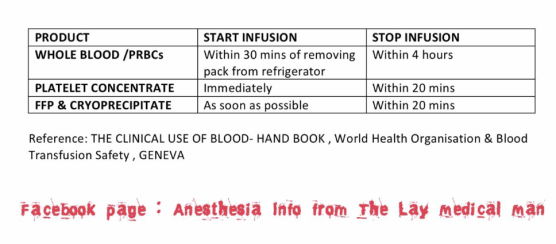
Severe reactions most commonly present during the first 15 minutes of a transfusion. All patients and, in particular, unconscious patients should be monitored during this period and for the first 15 minutes of each subsequent unit.

The transfusion of each unit of the blood or blood component should be completed within four hours of the pack being punctured. If a unit is not completed within four hours, discontinue its use and dispose of the remainder through the clinical waste system.

[ from “THE CLINICAL USE OF BLOOD”- HAND BOOK , World Health Organization & Blood Transfusion Safety , GENEVA ]

KNOWN SECRETS! – COEXISTING ILLNESS AND ANESTHESIA

1. The evaluation of risk factors, is for planning the anesthetic management, and will be of no use in predicting the outcome.
2. There is no justification for performing revascularisation purely to facilitate elective non cardiac surgery.
3. M.I. within the last 6 weeks, class iii-iv angina, decompensated heart failure, malignant arrhythmias, severe valvular heart disease, CABG/PTCA within the last 6 weeks constitute major Cardio Vascular risk factors for surgery.
4. Previous M.I. (>6weeks), class i-ii angina, compensated heart failure, T2 DM constitute intermediate C. V. risk factors.
5. Age > 70 years, uncontrolled systemic hypertension, arrhythmias, family h/o CAD, dyslipidemia, smoking, renal dysfunction, ECG abnormalities (LVH, RBBB/LBBB, ST segment anomalies) constitute minor C. V. risk factors.
6. Only emergency, life saving procedures should be performed during the first 6 weeks after a myocardial infarction (M. I.) and after CABG/PTCA with or without a coronary stent. The period between 6 weeks and 3 months are considered as a period of intermediate risk, when non urgent elective surgery should be postponed.
7. SURGICAL PREDICTORS OF INCREASED PERIOPERATIVE CARDIOVASCULAR RISK
(i) HIGH RISK (complication rate >5%)
#Emergency major to intermediate surgery, especially in elderly patients
#Aortic & major vascular surgery; and also peripheral vascular surgery
#Procedures involving: hemodynamic instability, long duration or large fluid/blood loss
(ii) INTERMEDIATE RISK (complication rate 1-5%)
#Carotid endarterectomy
#Head & neck surgery
#Abdominal/thoracic surgery
#Orthopaedic surgery
#Prostatectomy
(iii)LOW RISK (complication rate <1%)
#Endoscopic procedure
#Breast and superficial surgery
#Eye surgery
8. ACE inhibitors are withheld for 24 hours by some anesthetists.
9. Perioperative beta blockade should be continued for 72 hours postoperatively.
10. The gold standard for detecting intraoperative ischemia and assessing volume status & valvular function is TEE.
11. Most perioperative myocardial infarctions occur in the first 3 days postoperatively. Patients at risk for M.I. require effective analgesia and humidified oxygen therapy for atleast 72 hours after major surgery.
12. Severe hypertension (grade 3) has been associated with an increased incidence of perioperative hemodynamic instability, silent m.i. and arrhythmias; but evidence of a clinically significant increase in adverse outcome is lacking. The presence of endorgan damage due to hypertension is more important than the blood pressure per se.
13. Ideally the blood pressure should be maintained within 20% of the best estimate of preoperative pressure.
14. The treatment of arrhythmias produced by WPW syndrome includes Flecainide, Disopyramide, Procainamide and Amiodarone. Digoxin and Verapamil are contraindicated.
15. There is no evidence to suggest that, frequent ventricular ectopics or asymptomatic non sustained ventricuar tachycardia is associated with an increased incidence of perioperative M.I.
16. Sick sinus syndrome is associated with a high risk of thromboemboism and may be anticoaguated. If the patient is not having a permanent pacemaker, he/she needs a, temporary pacing wire inserted preoperatively.
17. Complete heart block, type ii second degree A-V block and lesser degrees of heart block, in the presence of symptoms or cardiac failure requires preoperative insertion of permanent or temporary insertion of pacemaker. Volatile agents prolong cardiac conduction and can worsen heart block. Atropine, Isoprenaline and facilities for external pacing should be kept ready.
18. ATRIOVENTRICULAR BLOCKS
(i) First degree block: P-R interval > 0.2 sec
(ii)Second degree block
Type I: progressive lengthening of PR interval, until conduction fails and a beat is dropped.
Type II: intermittent failure of AV conduction without preceding PR prolongation.
(iii) Third degree block
Complete dissociation of atria and ventricles as atrial impulses fails to be transmitted.
19. CHECKLIST FOR A PATIENT WITH PACEMAKER
a. Indication for pacemaker insertion
b. Mode of function of pacemaker
c. Functional status
d. Consider conversion of rate responsive pacemakers to fixed rate in the perioperative period.
e. Ensure use of only bipolar diathermy
f. If unipolar diathermy must be used, then the ground plate should be placed on the same site as the operating site, as far away from the pacemaker as possible. The frequency and duration of use should be minimised and the lowest possible current used.
g. MRI is contraindicated
h. Magnets should not be placed over pacemakers during surgery, as they have an unpredictable effect on the programming of modern pacemakers.
i. A backup pacing system, atropine, adrenaline, isoprenaline and a backup pacing system should be available, in case of pacemaker failure.
20. Anesthesia constitutes a significant risk in Hypertrophic Obstructive Cardiomyopathy. Patients will be having dynamic left ventricular outflow tract obstruction, often with secondary MR. They are prone to arrhythmias and sudden cardiac death. Look for an Ejection systolic murmur in auscultation and LVH in ecg. Confirmation is by ECHO. Avoid hypovolemia, vasodilatation and the use of catecholamines
21. Constrictive pericarditis poorly tolerate vasodilatation; especially at induction.
22. In valvular heart disease, antibiotic prophylaxis is especially required for dental surgeries and those involving instrumentation of upper respiratory tract and genitourinary system.
23. AORTIC STENOSIS
# Even an ejection systolic murmur in an asymptomatic patient also warrants careful preoperative examination/ ECHO, as symptoms tend to appear late in the disease only.
# Promptly treat tachycardia and AF.
# Maintain ventricular filling by avoiding hypovolemia and maintaining SVR.
# Vasodilatation may result in profound hypotension–> subendocardial ischemia and even sudden death.
# Aggressive treatment of hypotension is mandatory to prevent cardiogenic shock and/or cardiac arrest. Cardiopulmonary resuscitation is unlikely to be effective in patients with aortic stenosis because it is difficult, if not impossible, to create an adequate stroke volume across a stenotic aortic valve with cardiac compression.
24. AORTIC REGURGITATION
# Avoid vasoconstriction and bradycardia which increases the degree of regurgitation
# A mild tachycardia, moderate fluid loading, a degree of vasodilatation and avoidence of myocardial depression can improve the forward flow.
# Acute AR is a surgical emergency and may respond poorly to vasodilatation.
25. MITRAL STENOSIS
# Patients are prone to develop CCF and Pulmonary Edema.
# Atrial fibrillation is a trigger for acute deterioration; so should be treated preoperatively
# Avoid tachycardia, myocardial depression and excessive vasodilatation
# Hypovolemia compromises ventricular filling
# Fluid overload can easily precipitate pulmonary edema
# PCWP will be inaccurate in the presence of pulmonary hyperension. Avoid Nitrous oxide if there is evidence of pulmonary hypertension.
26. MITRAL REGURGITATION
# A mild tachycardia, a slight reduction in SVR and avoidance of myocardial depression are desirable.
# Avoid hypovolemia
27. There is little evidence that GA in ADULTS with URTI is associated with an increased risk of adverse respiratory events, although upper airway reactivity may be increased
28. In children with URTI, a higher incidence of adverse respiratory events have been demonstrated, but few of these adverse events result in postoperative sequelae. It has been suggested that surgery need not necessarily be postponed in children with mild URTI. Increased airway reactivity may persist for 4-6 weeks and if surgery is postponed, it should be for a period of at least 6 weeks.
29. In COPD, if the patient is having copious secretions, better to avoid anticholinergics, as it will impair the ability to clear secretions.
30. Even though regional anesthesia has the advantage of avoiding respiratory complications of GA, most patients, even those with quite severe COPD may be managed safely under carefully conducted GA.
31. Pressure Controlled Ventilation with a low respiratory rate and prolonged expiratory phase is suitable in COPD patients.
32. Epidural analgesia has been shown to decrease the incidence of postoperative pulmonary complications in thoracic and upper abdomnal surgery.
33. In patients with bronchial asthma, good depth of anesthesia, good muscle relaxation and i. v. Lidocaine can reduce the incidence of bronchospasm during intubation; topical lidocaine spray is not effective and may induce bronchoconstriction in some patients.
34. Circulatory disturbance during anesthesia and surgery may affect the absorption of subcutaneous insulin.

LAPAROSCOPIC MYOMECTOMY; INSIGHTS FOR THE ANESTHESIOLOGIST

# Preoperative treatment with GnRH analogue to shrink the fibroid

# Surgeon may intraoperatively inject dilute Vasopressin ( 1 IU in 100 mL RL) to reduce bleeding. IV Vasopressin can cause raised BP, myocardial ischemia, arrhythmias etc

# Position: Dorsal lithotomy; steep Trendlenberg to move the bowel out of surgical field

# Surgical time :1-4 hours; EBL: 100-600 mL

# Complications:

Puncture of major vessel/ severe bleeding

Insufflation in the wrong place

Air Embolism

Need for conversion to laparotomy

Peroneal nerve damage from positioning

# Pain score : 4-6

ANAESTHETIC MANAGEMENT OF SURGICAL PROCEDURES UNDER ECMO

The plastic components of the bypass circuit can sequester varying amounts of intravenous anesthetic agents resulting in unpredictable effects and side effects

Volatile anaesthetics are not usually available on ECMO circuits due to the difficulties in scavenging

Since anesthetic agents can alter preload and afterload, should be ready for volume replacement and administration of vasoactive agents

Should inform the perfusionist before changing the height of the surgical table, as this can alter the venous return to the ECMO circuit ( passive gravity assisted drainage)