SJOGRENS SYNDROME-anesthesia implications

🏳️‍🌈Preoperative abnormalities

1. Symptoms of the sicca syndrome include dryness of the eyes and skin.

2. Check for associated RA, SLE, scleroderma, the polymyositis, polyarteritis nodosa, chronic active hepatitis, and Grave’s disease.

3.Lung / airway : desiccation of the nose and bronchial tree, obstructive airways disease, interstitial lung disease

4.sensory / motor neuropathy may occur and CNS lesions have been described.

5.The patient may be taking corticosteroids or occasionally immunosuppressive agents.

🏳️‍🌈Anaesthetist’s concerns

1. Sometimes gross swelling of the salivary glands may make mask anaesthesia difficult.

2.The problems of pulmonary disease, if present.

3.The dry eyes are susceptible to damage during anaesthesia.

4.Allergy to antimicrobial agents, particularly penicillin, cephalosporins and trimethoprim

Management

1. careful assessment of the primary disease, and of any pulmonary involvement.

2. Drying agents should be avoided if possible.

3. The eyes should be protected with pads.

4. Anaesthetic gases should be humidified.

5. Steroid supplements may be required.

6. Care should be taken when prescribing antimicrobial agents
Practical issues in blood transfusion in pediatrics

1. Amount of transfusion to be given: It has been seen that transfusion with PRBC at a dose of 20 mL/kg is well tolerated and results in an overall decrease in number of transfusions compared to transfusions done at 10 mL/kg. There is also a higher rise in hemoglobin with a higher dose of PRBCs.

2. Properties of RBC products used in neonatal transfusion: a. RBCs should be freshly prepared and should not be more than 7 days old. This translates into a high 2, 3-DPG concentration and higher tissue extraction of oxygen.

3.Blood should be of newborn’s ABO and Rh group. It should be compatible with any ABO or atypical red cell antibody present in the maternal serum.

4. Volume and rate of transfusion:
a. Volume of packed RBC = Blood volume (mL/kg) x (desired minus actual hematocrit)/ hematocrit of transfused RBC
b. Rate of infusion should be less than 10 mL/kg/hour in the absence of cardiac failure.
c. Rate should not be more than 2 mL/kg/hour in the presence of cardiac failure.
d. If more volume is to be transfused, it should be done in smaller aliquots.

ANESTHESIA IMPLICATIONS-HAEMOCHROMATOSIS

/MNEMO/: ‘HEME LDH’

1. Liver Dysfunction
2. Diabetes
3. Heart Failure

EDTA induced pseudothrombocytopenia:

Problems: unnecessary investigations, delay in doing sx

Steps if suspected (asymptomatic persistent low plt counts):
Rpt PLT COUNT and PERI SMEAR using ANOTHER anticoagulant like heparin/citrate. Or use non-anticoagulated blood taken directly into the platelet counting diluent fluid.. Can see plt clumps in peripheral smear.

HYPOTHYROIDISM: ANESTHESIA CONCERNS

1.Hypothyroidism
2.Anemia
3.Reduced plasma volume
4.Impaired hepatic drug metabolism
5.Hypoglycemia
6.Impaired clearance of free water
7.Hyponatremia
8.Enlarged tongue
9.Nerve compression due to myxoedema
10.Delayed gastric emptying

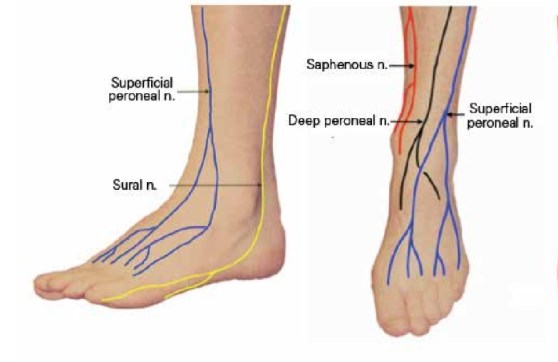
ANKLE BLOCK : NEEDLE DIRECTIONS

Posterior tibial nerve :
Introduce the needle along the medial aspect of the Achilles tendon, at the level of the cephalic (towards head) border of the medial malleolus. Advance, in an anterior direction, towards the posterior border of the tibia (nerve lies just posterior to the posterior tibial artery).If paraesthesia is felt, inject 3-5ml LA. If not, advance to contact the tibia, withdraw 0.5cm and then inject 5-7ml LA.

Sural nerve :
Introduce the needle along the lateral border of the Achilles tendon at the level of the cephalic border of the lateral malleolus.Advance anteriorly towards the fibula.If parasthesia is felt inject 3-5ml LA. If not, inject 5-7ml LA as the needle is withdrawn. This gives subcutaneous infiltration from the Achilles tendon to the fibula.

Infiltration around the remaining three nerves can be performed from a single site. The needle is inserted 1cm lateral to the tendon of extensor hallucis longis (or just lateral to the anterior tibial artery, if palpable), at the level of the cephalic borders of the malleoli. This tendon is prominent on the dorsum of the foot, during extension of the big toe.

Deep peroneal nerve :
From the position described above, advance the needle posteriorly (i.e. at 90¡ to the skin). Inject 3-5ml LA deep to the fascia, on either side of the anterior tibial artery.

Superficial peroneal nerve :
After blocking the deep peroneal nerve, withdraw the needle to just stay in the skin.
Turn the needle towards the lateral malleolus and inject 5ml LA in a subcutaneous band between the lateral malleolus and the anterior border of the tibia. This should reach all the branches of this nerve.

Saphenous nerve :
Again withdraw the needle to just stay in the skin and turn the needle to point towards the medial malleolus.Infiltrate 5ml LA subcutaneously as the needle is advanced towards the medial malleolus. The great saphenous vein lies in this area, just antero-medial to the medial malleolus, in order to infiltrate around the vein, without causing damage, it may be necessary to make a further skin puncture lateral to the vein.

Image courtesy: Semantic Scholar

ANTI #RHEUMATOID AGENTS PERIOPERATIVELY🎲

🏵  METHOTREXATE: caution in elderly,respiratory-renal-hepatic dysfunction. CONSIDER STOPPING 1 WEEK BEFORE

🏵  SULFASALAZINE: withhold atleast on day of surgery; as elimination is primarily renal and as reduction GFR is possible perioperatively

🏵  AZATHIOPRINE: withhold on day of surgery

🏵  HYDROXYCHLOROQUINE : can continue perioperatively

🏵  LEFLUNOMIDE : decreased wound healing; but stopping <2months prior to surgery unlikely to be beneficial

Amiodarone

AMIODARONE for arrhythmias
LD 150 mg over 10 mins.
INFUSION: 1mg/min x 6 hrs f/b 0.5mg/ min x 18 hrs
i.e. Load 900 mg in 50 cc syringe pump & give 3.33 ml/hr x 6 hrs f/b 1.66 ml/hr x 18 hrs

WHAT YOU WILL SEE IN THE SEROLOGY OF HEPATITIS B INFECTION

1) in a patient recovered from acute HBV: Anti HBsAg , Anti HBcAg Ig G

2) in a C/C carrier : HBsAg , Anti HBcAg Ig G

3) after immunisation : Anti HBsAg

4) best indicator of infectivity: HBeAg

5) best indicator of replication : HBV DNA

6) marker for window period : Anti HBcAg IgM

7) protective antibody : Anti HBsAg

8) acute infection : HBsAg, Anti HBcAg Ig M (plus in high virus load HBeAg and in low level infection Anti HBeAg)