
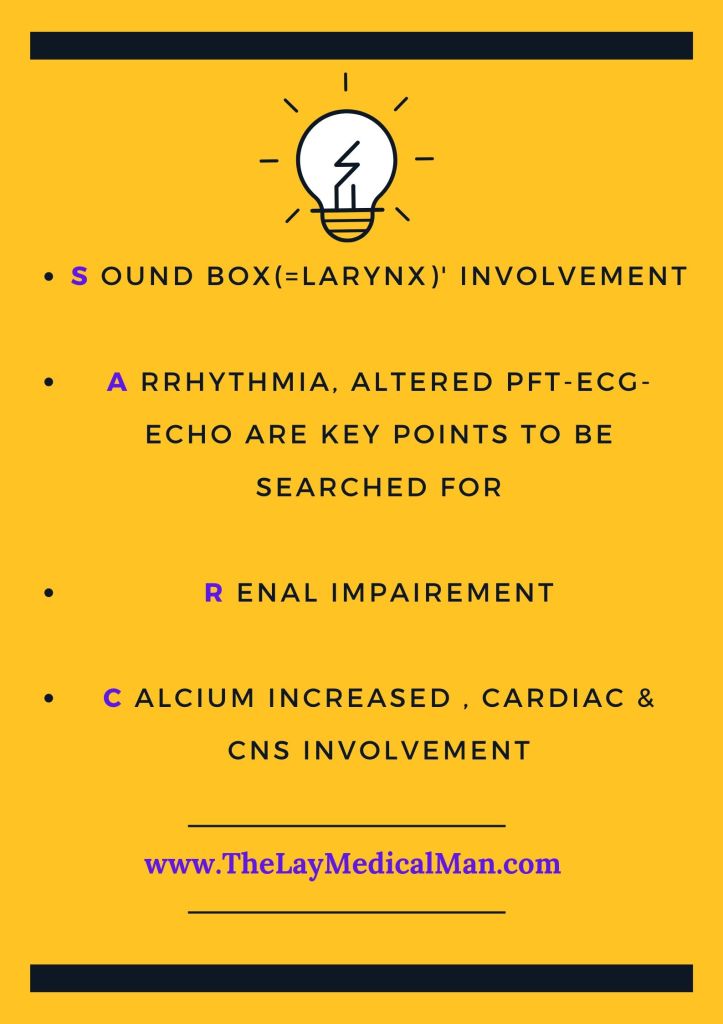
Ⓜ️NEMO> ‘SARC’
ADDITIONAL POINTS
PULMONARY INVOLVEMENT
PFT may be impaired
CXR may show bilateral hilar lymphadenopathy with increased reticular shadowing in the lung fields
Look for evidence of pulmonary hypertension
If there is widespread pulmonary involvement and the patient is symptomatic, lung function tests, including blood gases, should be performed.
HYPERCALCEMIA
It is secondary to the production of excess 1,25- dihydroxycholecalciferol. Nephrocalcinosis and renal failure may occur . So establish treatment for hypercalcemia
CARDIAC INVOLVEMENT
Cardiac involvement carries a poor prognosis and it’s diagnosis is of anaesthetic importance.
Localised granulomas and fibrous scarring most commonly occur in the basal portion of the ventricular septum and if they happen to involve the conducting system, arrhythmias or conduction defects occur.
Less commonly, the distribution of granulomas may be widespread and they may coalesce to produce diffuse interstitial fibrosis. The resulting hypokinesia and subsequent heart failure is clinically indistinguishable from other cardiomyopathies. Myocardial imaging showed that the majority of these had an infiltrative cardiomyopathy. Pericardial effusions may also occur.
In those patients diagnosed as having cardiac involvement, the signs in order of frequency of presentation were:
# complete heart block
# ventricular ectopics or ventricular tachycardia
# myocardial disease causing heart failure
# sudden death
# first-degree heart block or bundle branch block.
In most of the patients with complete heart block and sarcoid the heart block was the first sign of the disease
The sudden onset of complete heart block during anaesthesia can occur
Difficulties with pacemaker management can be a feature of cardiac sarcoidosis. Patients with advanced disease may have automatic implantable cardioverter defibrillators inserted
A preoperative ECG is essential, even in young patients. An ECHO also may be ordered. If there is evidence of a conduction defect, a temporary pacemaker should be inserted before anaesthesia.
CNS INVOLVEMENT
Central nervous system sarcoid also carries a poor prognosis.
Presentation can vary widely and includes cranial nerve palsies,peripheral neuropathy,epilepsy,and cerebellar ataxia
AIRWAY INVOLVEMENT
Laryngeal sarcoidosis : the commonest lesion reported is an oedematous, pale,diffuse enlargement of the supraglottic structures
Infiltration of the airway may cause obstructive sleep apnoea
So need for an ENT evaluation preoperatively should be considered
DIAGNOSIS :
can be made on biopsy of a skin lesion,or lung and bronchial biopsy via a fibreoptic bronchoscope.
The Kveim test has a high positivity in the active stages, but is lower in the chronic disease.
Serum angiotensin- converting enzyme (ACE) level is an indicator of sarcoid activity
serum calcium and 24-h urinary calcium levels may also be increased in active sarcoid.
Treatment of active disease may include corticosteroids, immunosuppressants, methotrexate,NSAIDS and calcium chelating agents.
Reference: Medical disorders and anaesthetic problems , Rosemary Mason , Anesthesia Databook , A Perioperative and Peripartum Manual , 3/e
 The Lay Medical Man