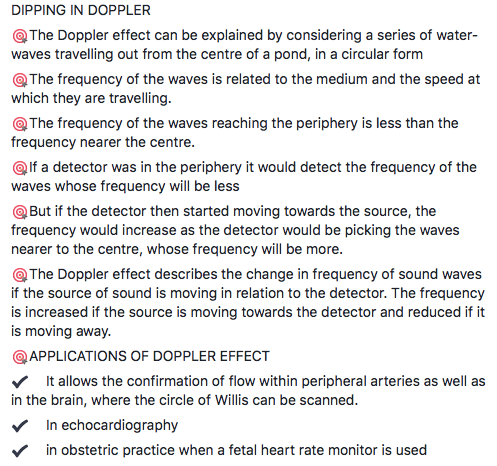
DIPPING IN DOPPLER

For this, we should know:
1. Oxygen delivered = FiO2 x Minute Volume
2. Duration of the transfer
For e.g. If we are expecting a duration of 2 hours (120 minutes) and we are having Size E cylinders and also need to deliver an FiO2 of 1 @ 6L / min
1. O2 delivered = 1 x 6 = 6L/ min
2. Size E has 660 L of O2, which will suffice for 660/6= 110 minutes ; so for 120 minutes, we need 2 cylinders
Furosemide is a loop diuretic
It interferes with the concentrating capacity of the loop of Henle.
It is effective in patients with renal dysfunction, whereas the thiazides are NOT.
It potentiates the nephrotoxic effects of cephalosporins and the ototoxic effects of aminoglycosides.
NSAIDs inhibit renal prostaglandin, causing sodium to be retained, which reduces the diuresis caused by furosemide.
Furosemide is a venous and arteriolar dilator and thus reduces both preload and afterload in a time frame just before the period of onset of a significant diuresis.
Dexamethasone is an extremely effective antiemetic for children.
Usually a one-off dose of 4 mg is given.
This single dose has not been shown to produce significant adverse effects such as immunosuppression and poor wound healing.
Has rescue antiemetic properties
Most effective if given early on in the operation.
An awake patient may complain of an uncomfortable sensation of perineal warmth, when dexamethasone is given
Cotrimoxazole
Ciprofloxacin
Rifampin
Minocycline
Novobiocin
Vancomycin (problem is it’s high MIC)
 The Lay Medical Man