Anesthesia concerns in Takotsubo / Stress Cardiomyopathy and it’s management in the ICU

Various stress-related cardiomyopathy syndromes are

(1) classic Takotsubo cardiomyopathy, which presents as an acute coronary syndrome

(2) left ventricular dysfunction associated with acute intracranial disease, especially Aneurysmal SAH

(3) transient cardiomyopathy, which occurs during other critical illness, especially sepsis, and

(4) transient cardiomyopathy associated with pheochromocytoma and exogenous catecholamine administration

Takotsubo Cardiomyopathy is also known as takotsubo syndrome, broken heart syndrome, ampulla cardiomyopathy, transient left ventricular apical ballooing, apical ballooning syndrome, transient left ventricular dysfunction syndrome, and stress [induced] cardiomyopathy

It was first described in Japan in 1990

Patients don’t have significant epicardial coronary artery disease

It presents like an acute coronary syndrome ; but symptoms like chest pain, dyspnea, and ECG changes may not be there in all cases

Was most frequently described in postmenopausal elderly women

Was often triggered by stressful situations.

Classic pattern of wall motion abnormality observed is “apical ballooning” usually associated with hyperkinesia of the basal segments ( but its NOT pathognomonic of the disease)

Onset is often preceded / precipitated by emotional or physiologic stress (NOT invariably)

Researchers at the Mayo Clinic proposed diagnostic criteria in 2004, which have been modified recently :

(1) transient hypokinesis, akinesis or dyskinesis in the left ventricular mid segments with or without apical involvement; regional wall motion abnormalities that extend beyond a single epicardial vascular distribution; and frequently, but not always, a stressful trigger

(2) the absence of obstructive coronary disease or angiographic evidence of acute plaque rupture

(3) new ECG abnormalities (ST-segment elevation and / or T-wave inversion) or modest elevation in cardiac troponin; and

(4) the absence of pheochromocytoma and myocarditis.

The most commonly accepted cause is excessive adrenergic/ catecholamine stimulation, which damages cardiomyocytes

Reports of its acute precipitation by administration of catecholamines (like adrenaline or dobutamine) and its reproduction by infusion of adrenaline in primates support this hypothesis

Most patients recover without complications; but others may develop complications like congestive heart failure, pulmonary edema often requiring endotracheal intubation and mechanical ventilation, cardiogenic shock requiring vasopressor or inotropic therapy and even intraaortic balloon pumping

Regarding treatment in the acute phase, avoidance of adrenergic agonists and initiation of antiadrenergic therapy (e.g., adrenergic blocking drugs or centrally acting 2 agonists) have been advocated

In patients presenting with left ventricular outflow tract obstruction, catecholamines are particularly contraindicated

If inotropic therapy is needed (as in case of heart failure, pulmonary edema, and cardiogenic shock etc) there has been suggestions, that the calcium sensitizer levosimendan may be the better choice

One school of thought is that a substantial portion of the damage caused by catecholamine toxicity to the myocardium has likely occurred by the time of clinical presentation, and thus administration of antiadrenergic therapy at this time is unlikely to completely reverse injury. Infact, in a number of reported cases, catecholamines seem to have facilitated recovery in patients with acute left ventricular dysfunction

Reference: anesthesia-analgesia March 2010 • Volume 110 • Number 3 ,circ.ahajournals
HAVE YOU SEEN PERSISTENT UNEXPLAINED HYPOXAEMIA IN ADULT PATIENTS ? ONE IMPORTANT D.D. IS PFO

Persistent unexplained hypoxaemia can result from the presence of a Patent Foramen Ovale (PFO)

A quarter of young adults have a #PFO

Actually there is no deficiency of atrial septal tissue per se, in such cases

In the absence of left atrial dilation, the defect functions as a flap valve, only allowing right-to-left flow.

Normally, left atrial pressure exceeds right atrial pressure and no shunting occurs.

However, if right-sided pressures increase, right-to-left shunting and therefore potential hypoxaemia can occur.

Acutely, this may become evident in such patients

during #ventilator asynchrony

with maintenance of high positive end-expiratory pressures (PEEP) during mechanical ventilation

in #ARDS patients with acute cor pulmonale or with right ventricular systolic dysfunction, particularly as part of the right ventricular infarction syndrome.

The diagnosis should be considered in any intensive care patient in whom the degree of hypoxaemia appears disproportionate, and should be detectable by colour Doppler.

Management might include a counterintuitive decrease in positive end-expiratory pressure ( #PEEP )and the re-establishment of spontaneous ventilation.

#Hypoxia , #MechanicalVentilation , #ICU , #CriticalCare , #Anaesthesia , #IntensiveCare

Reference: AAGBI Core Topics in Anaesthesia 2015 , Echocardiography and Anaesthesia, Jonathan H. Rosser and Nicholas J. Morgan-Hughes

UPPER GI BLEED IN ICU PATIENTS: THE POINTS WHICH YOU SHOULD KEEP IN MIND

Incidence of overt Upper GI Bleed (UGIB) ranges from 1.5 to 8.5% of all ICU patients but may be as high as 15% if no prophylaxis is used.

RISK FACTORS

Mechanical ventilation >48 h

Coagulopathy – INR>1.5 or platelet count <50,000

Others: Shock, Sepsis, Hepatic failure,Acute Renal failure, Multiple trauma, Burns >35% of total body surface area, Organ transplantation, Head trauma, Spinal trauma, History of PUD or UGIB

SPECIFIC POINTS REGARDING TREATMENT

Thrombocytopenia can develop in neurosurgical patients on H2 Blockers

The use of H2Bs and PPIs may increase the frequency of nosocomial pneumonia.

PROPHYLAXIS IS RECOMMENDED FOR ICU PATIENTS WHO EXHIBIT:

Coagulopathy (platelet count < 50,000 per m 3 , INR > 1.5, partial thromboplastin time (PTT) >2 times the control value)

Mechanical ventilation >48 h

History of GI ulceration or bleeding within the past year

Two or more of the following risk factors: sepsis; ICU stay >1 week; occult GIB ≥6 days; glucocorticoid therapy (>250 mg hydrocortisone).

REASONS FOR UGIB IN ICU PATIENTS:

The glycoprotein mucous layer may be denuded by increased concentrations of refluxed bile salts or uremic toxins common in critically ill. Alternatively, or in addition, mucosal integrity may be compromised due to poor perfusion associated with shock, sepsis, and trauma.

Excessive gastrin stimulation of parietal cells has been detected in patients with head trauma as oppose to be normal or subnormal in most other ICU patients.

Systemic steroids double the risk of a new episode of UGIB or perforation. Concomitant use with high doses of NSAIDs has been associated with a 12-fold increased risk for upper GI complications.

Helicobacter pylori infection

EMPIRICAL THERAPY

Start with an IV bolus of 80 mg and continue IV infusion at 8 mg/h for a total of 72 h. If no signs of rebleeding after 24 h, switch to oral PPI.

Octreotide is used in variceal bleeding. Start with an IV bolus of 50 mcg and continue IV infusion at 50 mcg/h for 3–5 days.

UGIB IN HEAD INJURY & OTHER NEUROSURGICAL PATIENTS:

They are more prone for UGIB because of 1. Frequent use of systemic steroids 2. Increased gastrin secretion 3. Significant gastric intramucosal acidosis is common in severe head injury. 4. Primary insult to the central nervous system may result in derangement of splanchnic blood flow secondary to neurohumoral mechanisms.

In head injury, GI dysfunction also may manifest as gastroparesis, ileus, increased intestinal mucosal permeability

Plasma levels of cortisol and age are independent predictors of stress ulcers following acute head injury.

#GastroIntestinalBleed , #StressUlcer , #ICU , #Anesthesia , #CriticalCare, #IntensiveCare , #NeuroSurgery , #HeadInjury , #TBI,#NeuroCriticalCare

Reference: Gastrointestinal Hemorrhage in Neurosurgical Critical Care Meghan Bost, Kamila Vagnerova , Ch:84, Essentials of Neurosurgical Anesthesia & Critical Care 2012 Strategies for Prevention, Early Detection, and Successful Management of Perioperative Complications

Spina Bifida : Anesthesia IMPLICATIONS

Incidence of Spina bifida occulta is 10%–25% of the population.

Associated with cord abnormalities (spinal dysraphism)

70% of those with cord abnormalities have dimpling or a hairy naevus at the base of the spine.

30% of patients with spinal dysraphism have neurological signs.

If such a patient comes for surgery, an MRI scan should be done to rule out a tethered cord.

Once this is excluded, it may be appropriate to proceed with regional analgesia at a site above the lesion.

The patient should be explained about the higher incidence of dural puncture because of abnormal ligamental structure.

Another point is, there may be incomplete spread of anaesthetic to sites below the lesion and consequently a suboptimal block may occur.

The epidural space volume is usually reduced and so, the epidural should be established with small aliquots of local anaesthetic to prevent a high block.

Spina bifida is also associated with a difficult intubation.

Spina bifida is a risk factor for latex allergy

Ref: Ali L, Stocks GM. Spina bifida, tethered cord and regional anaesthesia. Anaesthesia. 2005; 60(11): 1149–1150. Griffiths S, Durbridge JA. Anaesthetic implications of neurological disease in pregnancy. Contin Educ Anaesth Crit Care Pain. 2011; 11(5): 157–161. D’Astous J,Drouin MA, Rhine E 1992 Intraoperative anaphylaxis secondary to allergy to latex in children who have spina bifida. Report of two cases. Journal of Bone & Joint Surgery 74: 1084–6.

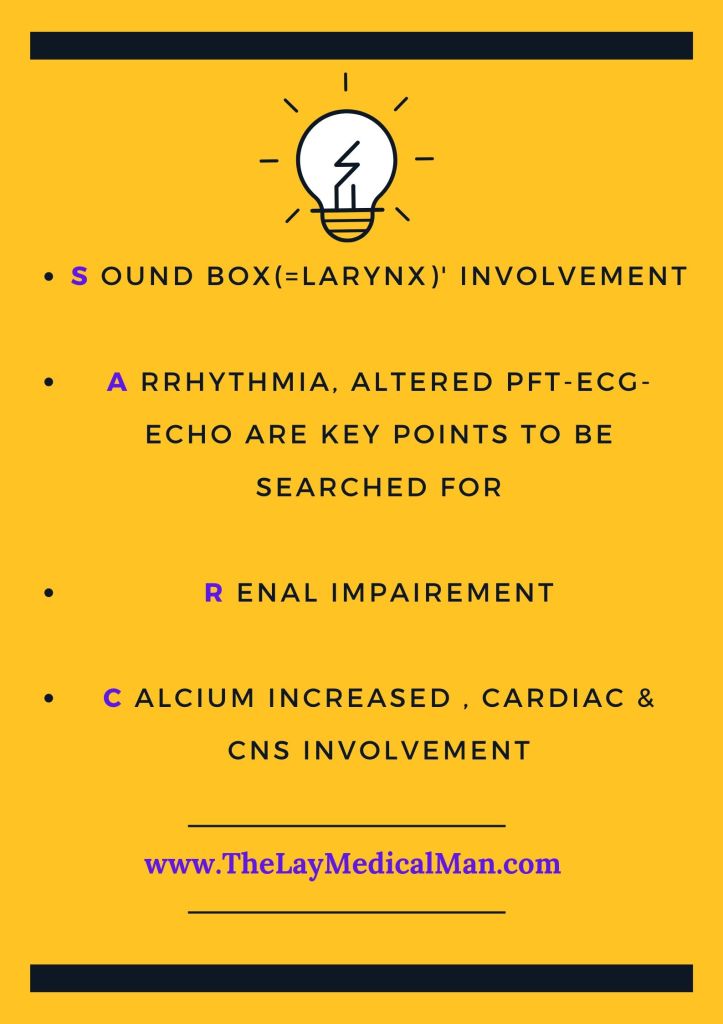
ANESTHESIA IMPLICATIONS IN SARCOIDOSIS: “SARC”

Ⓜ️NEMO> ‘SARC’

ADDITIONAL POINTS

PULMONARY INVOLVEMENT

PFT may be impaired

CXR may show bilateral hilar lymphadenopathy with increased reticular shadowing in the lung fields

Look for evidence of pulmonary hypertension

If there is widespread pulmonary involvement and the patient is symptomatic, lung function tests, including blood gases, should be performed.

HYPERCALCEMIA

It is secondary to the production of excess 1,25- dihydroxycholecalciferol. Nephrocalcinosis and renal failure may occur . So establish treatment for hypercalcemia

CARDIAC INVOLVEMENT

Cardiac involvement carries a poor prognosis and it’s diagnosis is of anaesthetic importance.

Localised granulomas and fibrous scarring most commonly occur in the basal portion of the ventricular septum and if they happen to involve the conducting system,  arrhythmias or conduction defects occur.

Less commonly, the distribution of granulomas may be widespread and they may coalesce to produce diffuse interstitial fibrosis. The resulting hypokinesia and subsequent heart failure is clinically indistinguishable from other cardiomyopathies. Myocardial imaging showed that the majority of these had an infiltrative cardiomyopathy. Pericardial effusions may also occur.

In those patients diagnosed as having cardiac involvement, the signs in order of frequency of presentation were:

# complete heart block
# ventricular ectopics or ventricular tachycardia
# myocardial disease causing heart failure
# sudden death
# first-degree heart block or bundle branch block.

In most of the patients with complete heart block and sarcoid the heart block was the first sign of the disease

The sudden onset of complete heart block during anaesthesia can occur

Difficulties with pacemaker management can be a feature of cardiac sarcoidosis. Patients with advanced disease may have automatic implantable cardioverter defibrillators inserted

A preoperative ECG is essential, even in young patients. An ECHO also may be ordered. If there is evidence of a conduction defect, a temporary pacemaker should be inserted before anaesthesia.

CNS INVOLVEMENT

Central nervous system sarcoid also carries a poor prognosis.

Presentation can vary widely and includes cranial nerve palsies,peripheral neuropathy,epilepsy,and cerebellar ataxia

AIRWAY INVOLVEMENT

Laryngeal sarcoidosis : the commonest lesion reported is an oedematous, pale,diffuse enlargement of the supraglottic structures

Infiltration of the airway may cause obstructive sleep apnoea

So need for an ENT evaluation preoperatively should be considered

DIAGNOSIS :

can be made on biopsy of a skin lesion,or lung and bronchial biopsy via a fibreoptic bronchoscope.

The Kveim test has a high positivity in the active stages, but is lower in the chronic disease.

Serum angiotensin- converting enzyme (ACE) level is an indicator of sarcoid activity

serum calcium and 24-h urinary calcium levels may also be increased in active sarcoid.

Treatment of active disease may include corticosteroids, immunosuppressants, methotrexate,NSAIDS and calcium chelating agents.

Reference: Medical disorders and anaesthetic problems , Rosemary Mason , Anesthesia Databook , A Perioperative and Peripartum Manual , 3/e

Gestational Diabetes : INFO WE GET FROM THE #ACOG 2013 GUIDELINES

Increased blood sugars 4-6 h prior to delivery leads to increased rates of hypoglycemia in the neonate. A maternal blood glucose value of more than 180 mg/dl has been conclusively proven to be associated with high risk of neonatal hypoglycemia.

The American College of Obstetrics and Gynecology and the American College of Endocrinology recommends maintenance of blood glucose between 70 and 110 mg/dl during labor (3.9-6.1 mmol/L) this goal is the same irrespective of whether the women has type 1 diabetes, type 2 diabetes or GDM.

The hepatic glucose supply is sufficient during the latent phase of labor, but during the active phase of labor the hepatic glucose supply is depleted so calorie supplementation is required.

During labor in a case with GDM controlled only on life-style modification, it is not compulsory to monitor blood sugars periodically and monitoring once in every 4-6 h is sufficient during labor

In patients on insulin it is mandatory to monitor the blood sugar every 2-4 h during the latent phase, every 1-2 h during the active phase

In patients for whom cesarean is planned, it always preferred to do the procedure early morning.

Patient needs to take her usual night dose of intermediate-acting insulin and the morning dose of insulin has to be withheld and patient needs to be kept nil by mouth.

If surgery is delayed it is needed to start basal and corrective regimen (DNS with short acting insulin) with one-third of the morning intermediate insulin dose with a 5% dextrose infusion to avoid ketosis. Blood glucose has to be monitored second hourly and if required subcutaneous dose of corrective dose of short acting insulin to be given.

After delivery, the requirement of insulin shows a sharp decline and in GDM it is advisable to continue the monitoring to see if the sugars have become normal in the postpartum period

In cases with type 1 and type 2 DM it is prudent to decrease the dose of insulin by 20-40% of the pregnancy dose as the requirement of insulin during lactation is less. During the breast-feeding, sometimes the requirement of insulin can fall drastically and these women may develop hypoglycemia, so the dose of insulin needs to be adjusted accordingly

Reference: ACOG Practice Bulletin, 137, 2013

Indian Journal of Endocrinology and Metabolism: Peripartum management of diabetes, Pramila Kalra and Manjunath Anakal

PHARMACOLOGICAL TREATMENT OF ACUTE SEVERE ASTHMA ( BASED ON 2014 BTS GUIDELINES)

Supplementary oxygen to all hypoxaemic patients with acute severe asthma to maintain an SpO2 level of 94-98%

Nebulisers for giving nebulised β2 agonist bronchodilators should preferably be driven by oxygen. A flow rate of 6 l/min is required to drive most nebulisers

High-dose inhaled β2 agonists as first line agents in patients with acute asthma. Repeat doses of β2 agonists at 15–30 minute intervals or give continuous nebulisation of salbutamol at 5–10 mg/hour (requires appropriate nebuliser) if there is an inadequate response to initial treatment. Higher bolus doses, for example 10 mg of salbutamol, are unlikely to be more effective (2.5–5 mg salbutamol in children >2 years).

There is no evidence for any difference in efficacy between salbutamol and terbutaline. Nebulised adrenaline (epinephrine), a non-selective β2 agonist, does not have significant benefit over salbutamol or terbutaline.

Add nebulised ipratropium bromide (0.5 mg 4-6 hourly) to β2 agonist treatment for patients with acute severe or life-threatening asthma or those with a poor initial response to β2 agonist therapy. ( 250 micrograms/dose in children >2 years).

Consider giving a single dose of IV magnesium sulphate (1.2-2 g IV infusion over 20 minutes) to patients with acute severe asthma who have not had a good initial response to inhaled bronchodilator therapy.

Nebulised magnesium is not recommended for treatment in adults with acute asthma. Consider adding 150 mg magnesium sulphate to each nebulised salbutamol and ipratropium in the first hour in children >2 years with a short duration of acute severe asthma symptoms presenting with an oxygen saturation less than 92%.

Routine prescription of antibiotics is not indicated for patients with acute asthma.

SECOND LINE TREATMENT OF ACUTE ASTHMA

Consider early addition of a single bolus dose of intravenous salbutamol (15 micrograms/kg over 10 minutes) in a severe asthma attack where the patient has not responded to initial inhaled therapy.

Consider aminophylline for children >2 years with severe or life-threatening asthma unresponsive to maximal doses of bronchodilators and steroids. A 5 mg/kg loading dose should be given over 20 minutes with ECG monitoring (omit in those receiving maintenance oral theophyllines) followed by a continuous infusion at 1 mg/kg/hour. Measure serum theophylline levels in patients already receiving oral treatment and in those receiving prolonged treatment.

NOTE:

Give steroids in adequate doses in all cases of acute asthma attack.

Prednisolone 40–50 mg daily or parenteral hydrocortisone 400 mg daily (100 mg six-hourly in adults and 4 mg/kg repeated four hourly in children >2 years ) are as effective as higher doses. Continue prednisolone 40–50 mg daily for at least five days or until recovery. ( In children >2 years, treatment for up to three days is usually sufficient).

Following recovery from the acute asthma attack steroids can be stopped abruptly. Doses do not need tapering provided the patient receives Inhaled Corticosteroids

In adults with an acute asthma attack, i.v. aminophylline is not likely to result in any additional bronchodilation compared to standard care with inhaled bronchodilators and steroids. Side effects such as arrhythmias and vomiting are increased if Iv aminophylline is used

Heliox is not recommended for use in patients with acute asthma outside a clinical trial setting

Although theoretically furosemide may produce bronchodilation, a review of three small trials failed to show any significant benefit of treatment with nebulised furosemide compared to β 2 agonists

Anesthesia / Medical implications of Von Hippel–Lindau disease (vHLD)

vHLD usually presents in young adults with cerebellar, medullary or spinal haemangioblastomas, retinal angiomatosis, renal cell carcinoma and phaeochromocytoma

The frequency of phaeochromocytomas is 7–20%

About 25% of patients with CNS haemangioblastomas subsequently turn out to have vHLD.

Erythrocytosis and a high haematocrit are common and has to be searched for.

Surgery for one manifestation of the disease may be complicated by the presence of an undiagnosed #phaeochromocytoma. In this situation, pharmacological control of phaeochromocytoma should get more priority and surgery may have to be carried out in two stages

Spinal Anaesthesia may be dangerous in the presence of an undiagnosed cerebral or spinal tumour. Another point is, spinal cord haemangioblastomas can occur at more than one level. An MRI if already done, can help us to take a proper decision.

Pregnancy may worsen the disease, by increasing the vascularity of tumours. Urgent and life saving neurosurgical intervention may become necessary: for e.g. when a spinal tumor bleeds, when a tumor obstructs CSF flow and causes acute hydrocephalus. Sometimes elective procedures like removal of a phaeochromocytoma which became evident during pregnancy has to be removed. It may become necessary to carry out these procedures during pregnancy or along with a Caesarean section.

Surgery may be required for more than one lesion at the same time.

So careful assessment should be made for lesions other than the one for which anaesthesia is required, and in particular for any symptoms and signs of cerebral, cerebellar or spinal cord tumours and phaeochromocytoma.

In the situation in which two lesions are present, decisions may have to be made as to whether to operate simultaneously or separately . During pregnancy the management of the delivery must be carefully planned in advance.

Although 24-h urinary screening for catecholamines can be performed, plasma normetanephrines and metanephrines are the most sensitive tests for detecting phaeochromocytomas in patients with family predisposition

Reference: Anaesthetic management of a patient with von Hippel–Lindau disease: a combination of bilateral phaeochromocytoma and spinal cord haemangioblastoma. European Journal of Anaesthesiology 13: 81–3. , Anesthesia Databook, 3rd edition

IMPORTANT FACTORS THAT AFFECT DRUG METABOLISM IN THE ELDERLY

Screen Shot 2018-09-02 at 5.16.40 PM

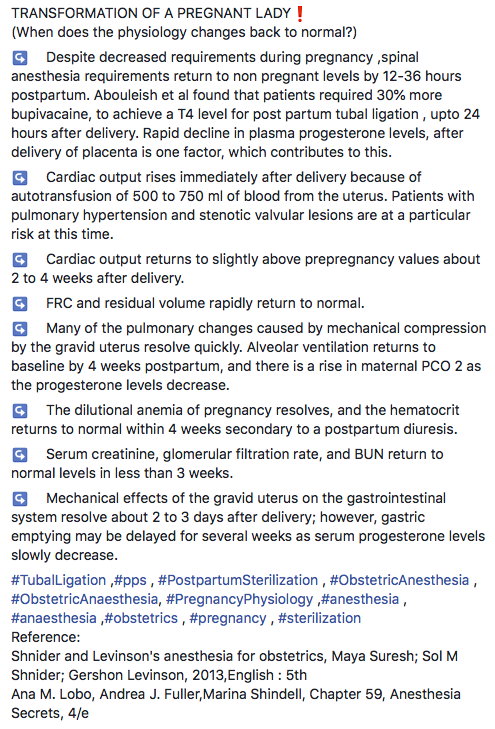
TRANSFORMATION OF A PREGNANT LADY (When does the physiology changes back to normal?)

Screen Shot 2018-09-02 at 4.11.53 PM