VISCOUS FACTS

Dynamic or absolute viscosity is a measure of the resistance of a fluid or gas to flow. It is measured using a viscometer or rheometer.

The SI unit of dynamic (or absolute) viscosity is the pascal-second (Pa·s), equivalent to N·s/ m2.

Viscosity is independent of flow rate

Viscosity is independent of pressure

For a gas, viscosity decreases as its temperature increases

The relationship between viscosity and temperature and pressure only holds true for those fluids and gases that exhibit ‘Newtonian’ properties, i.e. substances that will always flow irrespective of forces acting upon them (e.g. crystalloid solutions and water).

Blood is a non-Newtonian fluid and its viscosity depends largely on haematocrit (and varies with flow rate).

Blood viscosity is increased by volatile anaesthetic agents, smoking and aging

A thixotropic substance is one that becomes less viscous over time when agitated. If it becomes more viscous with agitation, this is known as a rheopectic material.

Kinematic velocity is defined as the dynamic velocity of a substance divided by its density.


AMIDE LOCAL ANESTHETICS

CALCULATION OF THE VOLUME OF OXYGEN / NUMBER OF OXYGEN CYLINDERS REQUIRED FOR A PATIENT TRANSFER

For this, we should know:
1. Oxygen delivered = FiO2 x Minute Volume
2. Duration of the transfer

For e.g. If we are expecting a duration of 2 hours (120 minutes) and we are having Size E cylinders and also need to deliver an FiO2 of 1 @ 6L / min

1. O2 delivered = 1 x 6 = 6L/ min
2. Size E has 660 L of O2, which will suffice for 660/6= 110 minutes ; so for 120 minutes, we need 2 cylinders

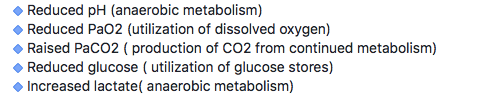
ERRORS THAT MAY HAPPEN, IF AN ARTERIAL BLOOD GAS SAMPLE REMAINS FOR QUITE SOME TIME IN ROOM AIR, BEFORE ANALYSIS

Screen Shot 2018-09-02 at 6.23.11 PM

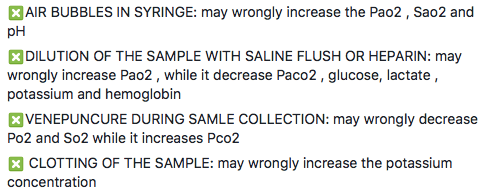
ERRORS IN ABG SAMPLING: CAUSES & CONSEQUENCES

Screen Shot 2018-09-02 at 6.21.23 PM

FUROSEMIDE , THIAZIDES & NSAIDs : A FEW FACTS

Furosemide is a loop diuretic

It interferes with the concentrating capacity of the loop of Henle.

It is effective in patients with renal dysfunction, whereas the thiazides are NOT.

It potentiates the nephrotoxic effects of cephalosporins and the ototoxic effects of aminoglycosides.

NSAIDs inhibit renal prostaglandin, causing sodium to be retained, which reduces the diuresis caused by furosemide.

Furosemide is a venous and arteriolar dilator and thus reduces both preload and afterload in a time frame just before the period of onset of a significant diuresis.

DEXAMETHASONE AS AN ANTIEMETIC; THINGS TO BE KEPT IN MIND

Dexamethasone is an extremely effective antiemetic for children.

Usually a one-off dose of 4 mg is given.

This single dose has not been shown to produce significant adverse effects such as immunosuppression and poor wound healing.

Has rescue antiemetic properties

Most effective if given early on in the operation.

An awake patient may complain of an uncomfortable sensation of perineal warmth, when dexamethasone is given

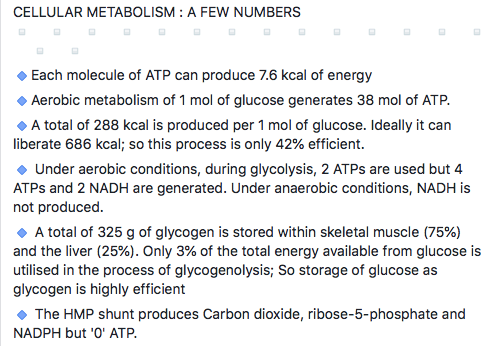
CELLULAR METABOLISM : A FEW NUMBERS

Screen Shot 2018-09-02 at 5.19.19 PM