#Tapentadol

🚩Is a new centrally acting analgesic that relies on a dual mechanism of action. These are mu opioid receptor agonism and norepinephrine (noradrenaline) reuptake inhibition
🚩It is therefore not a classical opioid, but represents a unique class of analgesic drug (MOR-NRI).
🚩It is now registered for use in the treatment of moderate to severe chronic pain that proves unresponsive to conventional non-narcotic medications in many countries.
🚩Tapentadol has a much lower affinity (20 times less) to the mu receptor than morphine, but its analgesic effect is only around three times less than morphine.
🚩This discrepancy is explained by its inhibitory effect on norepinephrine reuptake, strengthening descending inhibitory pathways of pain control
🚩Tapentadol is seen by some as similar to tramadol, but differs in a number of important points:
▶️It is not a racemic mixture of two enantiomers with different pharmacological effects
▶️Has no active metabolites (which are relevant for tramadol’s mu opioid receptor agonism)
▶️Has only minimal serotonin effects
🚩This means that interactions with other serotonergic drugs (such as anti-depressants) are unlikely, reliance on metabolism by the cytochrome P450 system for increased efficacy is not required and retention of active metabolites causing potential adverse effects is not a concern.

NB

🔻Tramadol is a 4 phenyl piperidine analogue of codeine
🔻It has a weak central action at opioid receptors
🔻And also on descending monaminergic pathways (also responsible for the side effects)
🔻Hence known as an atypical centrally acting opioid
🔻It’s M1 metabolite has more affinity to opioid receptors than parent compound
🔻So metabolites are important in maintaining efficacy
#Opioids , #Pharmacology , #analgesia , #PalliativeCare , #Pain , #SideEffects , #NewDrugs , #medicine , #anaesthesia
Reference: Recent advances in the pharmacological management of acute and chronic pain Stephan A. Schug, Catherine Goddard, Annals of Palliative Medicine, Vol 3, No 4 October 2014
NEURO #ANATOMY OF THE OLFACTORY SYSTEM : How some smells induce tears and sniffing in you❓

😤 Olfactory receptors 1️⃣ are the most important cells of the olfactory epithelium and they are the first order neurons of the cranial nerve I
😤There are approximately 100 million such receptors in the olfactory epithelium found along the roof of the nasal cavity including the superior and upper middle conchae
😤Olfactory receptors project through the cribriform plate in the ethmoid bone
😤They have multiple cilia immersed in a surrounding matrix of mucus and a long dendrite
😤Odiferous chemicals get dissolved in this mucus and then trigger the olfactory receptors
😤The impulses pass through the neuron to the olfactory bulb (lies in base of frontal cortex in anterior fossa), which has projections to cortical areas
😤The primary olfactory area in the temporal lobe process such informations through it’s connections with the hypothalamus, thalamus and frontal cortex
😤The other major cell type is basal cells 2️⃣ found deep to the olfactory neurons (olfactory neurons have a half-life of one month) and replace them, as they mature
😤3️⃣Sustentacular or supporting cells constitute the columnar mucus epithelium found between the receptors
😤There are 4️⃣Olfactory (Bowman’s) glands found in the connective tissue beneath the olfactory epithelium which produce the mucus in which the odiferous chemicals dissolve
❓➡️ 🅰️ Finally answer to the question
😤The innervation of the olfactory epithelial cells from cranial nerve VII (facial nerve) explains the tears and sniffing evoked by some smells.
Reference: Tortora GJ, Grabowski SR. Principles of Anatomy and Physiology, 8th edn. New York, NY: HarperCollins, 1996; pp. 454–5
#smell , #Olfaction , #PhysiologyForExams , #NeuroAnatomy , #anesthesiology

♈️#PhysicsForAnesthesiologist : Beer-Lambert Law

☢️The #pulseoximeter works based on Beer-Lambert law, which relates the attenuation of light to the properties of the material through which the light is travelling.
☢️It helps us in the calculation of the absorbance of a solution.
☢️According to the law, the absorbance of a solution depends on:
🖍The concentration of that solution, i.e. the more molecules of a light-absorbing compound there are in the sample, the more light will be absorbed.
🖍The path-length of light travelling through the solution, i.e. the longer the length of the sample container, the more light will be absorbed because the light will come into contact with more molecules.
🖍A = εlc where
🔻A is absorbance of light
🔻ε is the molar extinction coefficient(l mol–1 cm–1). It compensates for variance in concentration and the path-length, to allow comparison between solutions.
🔻l is the length of solution that the light passes through.
🔻c is the concentration of the compound in solution, expressed in mol L–1
☢️In the pulse oximeter, the concentration and molar extinction coefficient are constant. The only variable becomes the path length, which alters as arterial blood expands the vessels in a pulsatile fashion.
#Anesthesia, #PhysicsAndMedicine , #MedicalExams

The #Pulseoximeter and the science behind

☝️️Pulseoximeter measures the percentage of arterial hemoglobin in the blood that is saturated with oxygen

☝️️It consists of 2 LEDs & a photodiode arranged on either side of an adhesive strip and an electronic processor

☝️️Light from LEDs travel through the patient’s body part and is detected by the photodiode

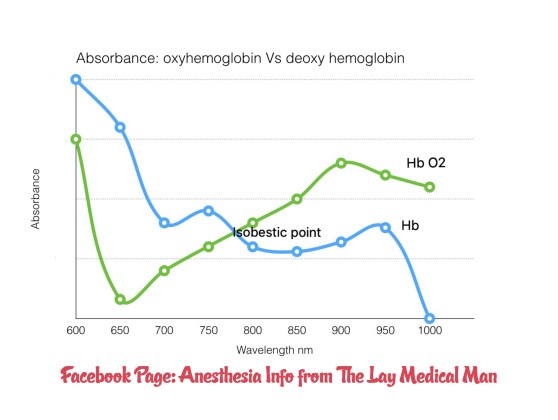
☝️️One LED emits light at 660 nm (red light) and the other at 940 nm (infrared light)

☝️️Oxyhaemoglobin and deoxyhaemoglobin absorb these wavelengths differently

☝️️Oxyhaemoglobin absorbs more infrared light (940 nm) and allows more red light (660 nm) to pass through

☝️️Deoxyhaemoglobin absorbs more red light (660 nm) and allows more infrared light (940 nm) to pass through

☝️️Isobestic point is at 806 nm

☝️️The LEDs flash in sequence: one on, then the other, then both off (to allow correction for ambient light). This triplet sequence happens 30 times per second

☝️️The amount of light transmitted through the patient at each frequency is detected by the photodiode.

☝️️The microprocessor corrects for ambient light, and also for the difference between arterial and venous saturations by deducting the minimum transmitted light, during diastole, from the maximum during systole.

☝️️After this, the ratio of oxy to deoxyhaemoglobin is determined and from this the percentage oxygen saturations is determined, using an empirical table derived from healthy volunteers who were exposed to varying degrees of hypoxia.

💅🏽Apart from the common causes like movement, nail varnish, diathermy,  others like

🔻severe anaemia

🔻cardiac arrhythmias

🔻Methaemoglobinaemia (characteristically cause saturations to be measured at around 85%)

🔻Increased venous pulsation, e.g. severe tricuspid regurgitation

🔻i.v. methylene blue dye (because it absorbs light in the 660–670 nm range also may cause erroneously low readings

💅🏻Carboxy hemoglobin (CO-Hb has similar absorption spectra as that of oxy-Hb) is detected by normal pulse oximeters as oxy hemoglobin–> erroneous high readings

💅🏻Cyanide prevents oxygen being utilised in respiration and so its extraction from the blood falls; so in cyanide poisoning, though the value is not inaccurate, it should be interpreted as inappropriately high

☝️️Fetal haemoglobin and Hb S (sickle) do not affect readings

☝️️The human volunteers used to construct empirical saturation tables did not have their oxygen saturations dropped below approximately 85%; hence readings below this number are extrapolated, not validated.

img_1994

CEREBRAL PHYSIOLOGY

A SORE STORY : THE PROPELLORS OF #INFLAMMATION 

🔥The process of inflammation is maintained by 3 important mechanisms:
✔️Vasodilation ✔️Increased capillary permeability ✔️Migration of leucocytes
🔥WHO IS DOING THESE?
▪️PLASMA DERIVED MEDIATORS:
✔️BRADYKININ –> Vasodilation & Increased capillary permeability
✔️COMPLEMENT MEDIATORS –> Mast cell degranulation –> Vasodilation & Increased capillary permeability + activate neutrophils and phagocyte migration
✔️COAGULATION: Forms a protective clot over the injured area
✔️ FIBRINOLYSIS: Activates neutrophils & macrophages by Fibrin Degradation Products (FDP)
▪️CELL DERIVED MEDIATORS:
✔️HISTAMINE (from basophils and mast cells) –> Vasodilation & Increased capillary permeability
✔️LEUKOTRIENES (from basophils and mast cells) –> chemotaxis of granulocytes
Ⓜ️NEMO> ” leukoTRYenes TRY to catch granulocytes”
✔️TUMOR NECROSIS FACTOR (cytokine from macrophage) –> activates endothelial cells , enhances phagocytosis
Ⓜ️NEMO> “TN(F)™ = F for ‘Fagocytosis’ TM= TNF is from Macrophages ”
✔️CHEMOKINES are chemotactic #cytokines
✔️NITRIC OXIDE (from endothelial cells and macrophages) is a powerful vasodilator and smooth-muscle relaxant.

The Life of P.I. (Perfusion Index)

🚤 Reduction of plethysmographic pulse wave amplitude (PPWA) has been proven to be a reliable method for detecting the IV injection of an exogenous vasopressor ( for e.g. The adrenaline in epidural test dose)

🚤 Currently, a numerical value has been added to new pulseoximeters indicating the PPWA, termed the perfusion index (PI), to augment its clinical applicability.

🚤i.e. PI is the numerical value of the amplitude of the plethysmographic pulse wave that is displayed on many pulse oximeters.

🚤 Using pulse oximetry, a variable amount of light is absorbed by pulsating arterial flow (AC) and a constant amount of light is absorbed by nonpulsating blood and tissue (DC). The pulsating signal indexed against nonpulsating signal and expressed as ratio is commonly referred to as the perfusion index
🚤 It depends on the distensibility of the vascular wall and the intravascular pulse pressure. Usually the effect of autonomic impulses upon distensibility is so strong that it predominates the opposite effect of pulse pressure.
🚤 Decreases in PI resulting from pain and other stressful stimuli are due to vasoconstriction of the finger arterial bed rather than changes in the pulse pressure
Reference: The Efficacy of Perfusion Index as an Indicator for Intravascular Injection of Epinephrine-Containing Epidural Test Dose in Propofol-Anesthetized Adults, Anesth Analg 2009;108:549 –53)

Circle of Willis : #ShortNote ❗️

 ⭕️The #CircleofWillis is a vital arterial structure on the ventral surface of the brain that joins the two internal carotid arteries (ICAs) (two-thirds of the supply) with the two vertebral arteries to supply the contents of the cranium 
⭕️The vertebral arteries enter the cranial cavity through the foramen magnum and join to become the basilar artery, which supplies blood to the posterior portion of the circle of Willis. 
⭕️The internal carotid arteries enter the skull through the carotid canals and supply the anterior circulation of the brain.
⭕️After entering the skull, the ICA branches into two main vessels: the Anterior Cerebral Artery (ACA) and Middle Cerebral Artery (MCA).
⭕️The MCA supplies the lateral surface of the brain, traveling in the Sylvian fissure
⭕️The ACAs also originate from the ICA and run anterior and medially towards the midline, coursing over the corpus callosum, between the hemispheres in the longitudinal fissure, and supplying the medial aspect of the hemispheres as far back as the splenium. The anterior cerebral arteries are joined together by a single anterior communicating artery(ACom)
⭕️An ACA #stroke can result in paralysis or sensory loss of the legs, whereas a MCA stroke can result in loss of paralysis or sensory loss of the face and/or arms. A MCA stroke of the dominant hemisphere may injure the language centers and produce aphasia.
⭕️The two vertebral arteries lie on either side of the medulla and join anteriorly at the caudal border of the pons to form the basilar artery. 
⭕️The vertebral arteries give off the posterior inferior cerebellar artery(PICA), before joining to form the basilar artery
⭕️Another important single artery that is created by the merger of the two vertebral arteries is the anterior spinal artery.
⭕️The basilar artery gives rise to a number of important paired branches. Posterior to anterior, these are: anterior inferior cerebellar artery(AICA), superior cerebellar artery(SCA).
⭕️The vertebral arteries supply the medulla via small, penetrating branches. 
⭕️The basilar artery supplies the pons through small penetrating vessels.
⭕️PICA supply the inferior surface of the cerebellum, as well as the lateral medulla
⭕️AICA supplies the anterior portions of the cerebellum and the lateral pons.
⭕️SCAs supply the cerebellum and lateral midbrain
⭕️The basilar artery gives rise to the posterior cerebral arteries (PCAs), which join the anterior part of the circle of Willis via the posterior communicating arteries(PCom). PCAs supply the occipital lobe and lateral midbrain 
⭕️The thalamus is supplied by perforators that originate from the tip of the basilar artery and the proximal PCA
⭕️Basilar artery strokes usually are fatal because they cause the loss of cardiac, respiratory, and reticular activating function. Patients who survive may have a clinical syndrome known as locked-in syndrome in which the patient cannot move as the ventral brainstem tracts (motor) are destroyed, but the sensory tracts (more dorsal) may be left intact. These patients are unable to move, speak, or communicate with the world, except by blinking and possibly through upgaze.

N.B.: VENOUS DRAINAGE

🔻The superior sagittal sinus lies along the attached edge of the falx cerebri, dividing the hemispheres, and usually drains into the right transverse sinus. 
🔻The inferior sagittal sinus lies along the free edge of the falx and drains via the straight sinus into the left transverse sinus (The straight sinus lies in the tentorium cerebelli.) 
🔻The transverse sinuses merge into the sigmoid sinuses before emerging from the cranium as the internal jugular veins.  
🔻Deeper cranial structures drain via the two internal cerebral veins, which join to form the great cerebral vein (of Galen). This also drains into the inferior sagittal sinus.  
🔻The cavernous sinuses lie on either side of the pituitary fossa and drain eventually into the transverse sinuses.
#Anatomy , #NeuroAnatomy , #BloodSupplyOfBrain , #Neurology , #NeuroAnesthesia , #NeuroSurgery , #NeurologyICU , #ICU

Paravertebral Blocks


  • A paravertebral block is essentially a unilateral block of the spinal nerve, including the dorsal and ventral rami, as well as the sympathetic chain ganglion. These blocks can be performed at any vertebral level. However, they are most commonly performed at the thoracic level because of anatomic considerations.
  • They provide analgesia for ✔️Unilateral thoracic pain ✔️Rib fracture ✔️Refractory angina✔️Hyperhydrosis etc
  • Usually a single level injection may cover less than four dermatomes
  • Can be given under USG guidance or using a landmark technique
  • Point to be marked at a point 25 mm lateral to the spinous process of the level to be blocked
  • After local anesthetic infiltration an 18 G epidural catheter is inserted to a depth, not greater than 35 mm till transverse process are hit (they are fairly superficial) and then the needle should be walked off the transverse process caudally, until it is 10mm deeper than the depth at which bone was initially contacted. (cranial walking of the needle increases the chance of pneumothorax)
  • A loss of resistance to injection when the costotransverse ligament is passed is a clue to achieving of correct needle position,; but this is not as marked as the loss of resistance achieved during epidural insertion.
  • If using a peripheral nerve stimulator, contraction of intercostal muscle or transverse abdominis may be elicited
  • 3-5 mL of ropivacaine or levobupivacaine can be used per level. Addition of Clonidine may prolong the blockade