A FEW PROSPECTIVE TECHNIQUES TO MEASURE ANALGESIA INTRA-OPERATIVELY 

🤖Current electroencephalogram (EEG)-derived measures like BIS, provide information on cortical activity and hypnosis but are less accurate regarding subcortical activity, which is expected to vary with the degree of antinociception. 
🤖Efforts to develop methods for monitoring these subcortical activities produced a few indices, which may provide some use intra-operatively 
🤖Recently, the neurophysiologically based EEG measures of cortical input (CI) and cortical state (CS) have been shown to be prospective indicators of analgesia/anti-nociception and hypnosis, respectively. Composite Cortical State (CCS) is an alternate measure of CS.
🤖Composite Variability Index (CVI) is another recently developed EEG-derived measure of antinociception based on a weighted combination of BIS and estimated electromyographic activity.
🤖CCS and BIS show strong correlations, suggesting that they behave similarly as indicators of hypnosis.
Reference: Comparisons of Electroencephalographically Derived Measures of Hypnosis and Antinociception in Response to Standardized Stimuli During Target-Controlled 

Propofol-Remifentanil Anesthesia, Mehrnaz Shoushtarian, Marko M. Sahinovic, Anthony R. Absalom, Alain F. Kalmar, Hugo E. M. Vereecke, David T. J. Liley and Michel M. R. F. Struys, anesthesia-analgesia, February 2016 • Volume 122 • Number 2

WHAT IS SURGICAL STRESS INDEX (SSI)❓

🔵 SSI is an index which measures the surgical stress response in patients under anesthesia

🔵 It assess the balance between the intensity of surgical stimulation and the level of antinociception (e.g. Opioid analgesia , neuraxial or nerve blockade)
🔵 SSI uses two continuous cardiovascular variables, both obtained from Photo Plethysmography (PPG) waveforms of SpO2
(1) The interval between successive hearts beats (HBI)
(2) PPG amplitude (PPGA)
🔵Photoplethysmography (PPG), i.e. pulse oximetry, is primarily used to produce an estimation of the relative concentration of oxyhemoglobin in blood.
🔵 PPG is related to volume changes and contains information about the peripheral blood circulation, including skin vasomotion. Skin vasomotion is controlled by the sympathetic nervous system, which is activated during surgical stress.
🔵 Changes in PPG amplitude (PPGA) reflect changes in the peripheral vascular bed, controlled by the sympathetic nervous system . Increased PPGA response has been associated with nociception during general anesthesia.
🔵SSI values near 100 correspond to a high stress level, and values near zero to a low stress level.
🔵 In trials, SSI correlated positively with the intensity of painful stimuli and negatively with the analgesic concentration
🔵 SSI has been shown to be capable of differentiating decreases in HR achieved with opioid from those accomplished with a beta blocker (Ahonen et al. 2007).
🔵 An optimal range for SSI during anesthesia has not yet been recommended.
Reference: Measurements of adequacy of anesthesia and level of consciousness during surgery and intensive care, Johanna Wennervirta, Department of Anesthesiology and Intensive Care Medicine, Helsinki University Hospital
#anaesthesia , #anaesthesiology , #anaesthesiologist

👁➖BE AWARE OF AWARENESS ➖👁

💣Premedication with amnestic reduces the chance of awareness. Also, if awareness occurs, psychological trauma is less likely without recall.
💣Light induction doses and liberal use of muscle relaxants ,without giving adequate concern to the depth of anaesthesia can increase the chance of awareness.
💣Better to give re-bolus with i.v. hypnotic during multiple intubation attempts. Consider using inhalation induction technique.
💣Beta-blockers, can reduce MAC-Awake and may also decrease the likelihood of PTSD.
💣We can consider ear plugs or headphones to reduce awareness of noises in the OR.
💣Nitrous oxide, Ketamine and Opioids suppress cortical arousal during painful stimulation, which may reduce the probability of awareness. But BIS (Bi Spectral Index) and other EEG monitors do not accurately predict the depth of anesthesia with these drugs. (Because, even though they produce hypnosis, they do not modulate GABA-A receptors and are associated with unchanged or increased high frequency EEG signals.)
💣Propofol, barbiturates, etomidate, and halogenated volatile anesthetic agents all modulate GABA-A receptor activity and shift the cortical EEG to lower frequencies. So, BIS and other EEG-based monitors provide strong correlation with hypnosis for this group of general anesthetics.
💣MAC for N2O & volatile anesthetics is additive (i.e. a mixture of 0.5 MAC N2O plus 0.5 MAC volatile suppresses movement in response to pain like 1 MAC volatile. The HYPNOTIC activities of nitrous oxide and volatile anesthetics are sub-additive. (i.e. a mixture of 0.5 MAC-awake N2O + 0.5 MAC-awake volatile anesthetic is not as hypnotic as 1 MAC-awake volatile. This suggests that N2O has an action which antagonizes the hypnosis induced by volatile anesthetics, perhaps via direct cortical arousal.
💣Many studies say, BIS is not useful in case of dexmedetomidine also; while some others say it will help.
#awareness , #anesthesia , #sedation , #AwarenessAnesthesia , #bis , #AwarenessSurgery

➖➖➖➖➖➖➖➖➖➖➖➖➖➖➖➖➖➖
Reference:

CampagnaJA,MillerKW,FormanSA:Mechanismsofactionsof inhaled anesthetics. N Engl J Med 348:2110-2124, 2003
SleighJW,BarnardJP:Entropyisblindtonitrousoxide.Canwesee why? Br J Anaesth 92:159-161, 2004 39.
ChortkoffBS,BennettHL,EgerEI2nd:Doesnitrousoxideantagonize isoflurane-induced suppression of learning? Anesthesiology 79: 724-732, 1993 40.
KatohT,IkedaK,BitoH:Doesnitrousoxideantagonizesevofluraneinduced hypnosis? Br J Anaesth 79:465-468, 1997
Update on Bispectral Index monitoring Jay W. Johansen,Best Practice & Research Clinical Anaesthesiology Volume 20, Issue 1, March 2006, Pages 81–99

EXPLICIT AND IMPLICIT AWARENESS DURING ANESTHESIA

😐(Explicit = Fully and clearly expressed)

😐(Implicit =Implied or understood though not directly expressed)

😐The incidence of awareness is around 0.1–0.2%

😐Explicit Awareness is intentional or conscious recollection of prior experiences as assessed by tests or recall or recognition, which are also called direct memory test.

😐Implicit Awareness is perception without conscious recall. The patient denies recall, but may remember “something” under hypnosis.

😐Awareness (deliberate)

Surgery conducted under local or regional anaesthesia. During some neurosurgical procedures, the patient is woken up to assess whether surgery has affected, or will affect, important areas.

😐STAGES OF AWARENESS ( Griffith and Jones )

1. Conscious perception with explicit memory;

2. Conscious perception without explicit memory;

3. Dreaming;

4. Subconscious perception with implicit memory;

5. No perception and no implicit memory.

😐CAUSES

🔻may result from a failure of the apparatus to deliver adequate concentrations of anesthetic agent. Such failures include leaks, faulty or empty vaporizers, a misconnected or disconnected breathing system, inaccurate pumps, misplaced venous cannula and occluded infusion tubing

🔻failure of the clinician to monitor the concentrations of inspired and expired volatile agents may result in inadequate anesthetic agent being delivered. TIVA is more difficult to monitor in this respect.

🔻may result from an inadequate dosing of the anesthetic agent as represented by the alveolar concentration (it is important to remember that the MAC value that is quoted is only the MAC 50 ) or the computed blood concentration in target-controlled infusion (TCI).

🔻may result from an altered physiology or pharmacodynamics in the patient e.g. Anxiety may increase dose requirements

🔻may result from the wearing off of the induction agent during a difficult intubation sequence or with the anesthetic techniques for rigid bronchoscopy

😐CLINICAL SIGNS

🔻In the spontaneously breathing patient who is not paralyzed, awareness may be manifest by purposeful movement.

🔻Sympathetic stimulation: the main clinical signs are tachycardia, hypertension, diaphoresis and lacrimation; but their absence does not exclude awareness. Attempts have been made to quantify these objectively by using the PRST scoring system (blood Pressure, heart Rate, Sweating, Tear formation)..

😐SEQUELAE:

Commonest is the occurrence of a post-traumatic stress syndrome, whose typical features may include nightmares, insomnia, panic attacks and agoraphobia.

😐CHECKLIST FOLLOWING A COMPLAINT OF AWARENESS DURING GENERAL ANAESTHESIA

1. Visit the patient as soon as possible, along with a witness (Preferably a consultant)

2. Take a full history and document the patient’s exact memory of events

3. Attempt to confirm the validity of the account

4. Keep your own copy of the account

5. Give a full explanation to the patient

6. Offer the patient follow-up, including psychological support, and document that this has been offered

7. Reassure the patient that they can safely have further general anaesthetics, with minimal risk of a further episode of awareness

8. If the cause is not known, try to determine it

9. Notify your medical defence organisation

10. Notify your hospital administration

11. Notify the patient’s GP
#awareness , #ptsd , #AnesthesiaComplications , #TheLayMedicalMan , From http://www.facebook.com/drunnikrishnanz , partial reference from frca.uk , #anaesthesia

#Tapentadol

🚩Is a new centrally acting analgesic that relies on a dual mechanism of action. These are mu opioid receptor agonism and norepinephrine (noradrenaline) reuptake inhibition
🚩It is therefore not a classical opioid, but represents a unique class of analgesic drug (MOR-NRI).
🚩It is now registered for use in the treatment of moderate to severe chronic pain that proves unresponsive to conventional non-narcotic medications in many countries.
🚩Tapentadol has a much lower affinity (20 times less) to the mu receptor than morphine, but its analgesic effect is only around three times less than morphine.
🚩This discrepancy is explained by its inhibitory effect on norepinephrine reuptake, strengthening descending inhibitory pathways of pain control
🚩Tapentadol is seen by some as similar to tramadol, but differs in a number of important points:
▶️It is not a racemic mixture of two enantiomers with different pharmacological effects
▶️Has no active metabolites (which are relevant for tramadol’s mu opioid receptor agonism)
▶️Has only minimal serotonin effects
🚩This means that interactions with other serotonergic drugs (such as anti-depressants) are unlikely, reliance on metabolism by the cytochrome P450 system for increased efficacy is not required and retention of active metabolites causing potential adverse effects is not a concern.

NB

🔻Tramadol is a 4 phenyl piperidine analogue of codeine
🔻It has a weak central action at opioid receptors
🔻And also on descending monaminergic pathways (also responsible for the side effects)
🔻Hence known as an atypical centrally acting opioid
🔻It’s M1 metabolite has more affinity to opioid receptors than parent compound
🔻So metabolites are important in maintaining efficacy
#Opioids , #Pharmacology , #analgesia , #PalliativeCare , #Pain , #SideEffects , #NewDrugs , #medicine , #anaesthesia
Reference: Recent advances in the pharmacological management of acute and chronic pain Stephan A. Schug, Catherine Goddard, Annals of Palliative Medicine, Vol 3, No 4 October 2014

NEURO #ANATOMY OF THE OLFACTORY SYSTEM : How some smells induce tears and sniffing in you❓

😤 Olfactory receptors 1️⃣ are the most important cells of the olfactory epithelium and they are the first order neurons of the cranial nerve I
😤There are approximately 100 million such receptors in the olfactory epithelium found along the roof of the nasal cavity including the superior and upper middle conchae
😤Olfactory receptors project through the cribriform plate in the ethmoid bone
😤They have multiple cilia immersed in a surrounding matrix of mucus and a long dendrite
😤Odiferous chemicals get dissolved in this mucus and then trigger the olfactory receptors
😤The impulses pass through the neuron to the olfactory bulb (lies in base of frontal cortex in anterior fossa), which has projections to cortical areas
😤The primary olfactory area in the temporal lobe process such informations through it’s connections with the hypothalamus, thalamus and frontal cortex
😤The other major cell type is basal cells 2️⃣ found deep to the olfactory neurons (olfactory neurons have a half-life of one month) and replace them, as they mature
😤3️⃣Sustentacular or supporting cells constitute the columnar mucus epithelium found between the receptors
😤There are 4️⃣Olfactory (Bowman’s) glands found in the connective tissue beneath the olfactory epithelium which produce the mucus in which the odiferous chemicals dissolve
❓➡️ 🅰️ Finally answer to the question
😤The innervation of the olfactory epithelial cells from cranial nerve VII (facial nerve) explains the tears and sniffing evoked by some smells.
Reference: Tortora GJ, Grabowski SR. Principles of Anatomy and Physiology, 8th edn. New York, NY: HarperCollins, 1996; pp. 454–5
#smell , #Olfaction , #PhysiologyForExams , #NeuroAnatomy , #anesthesiology

♈️#PhysicsForAnesthesiologist : Beer-Lambert Law

☢️The #pulseoximeter works based on Beer-Lambert law, which relates the attenuation of light to the properties of the material through which the light is travelling.
☢️It helps us in the calculation of the absorbance of a solution.
☢️According to the law, the absorbance of a solution depends on:
🖍The concentration of that solution, i.e. the more molecules of a light-absorbing compound there are in the sample, the more light will be absorbed.
🖍The path-length of light travelling through the solution, i.e. the longer the length of the sample container, the more light will be absorbed because the light will come into contact with more molecules.
🖍A = εlc where
🔻A is absorbance of light
🔻ε is the molar extinction coefficient(l mol–1 cm–1). It compensates for variance in concentration and the path-length, to allow comparison between solutions.
🔻l is the length of solution that the light passes through.
🔻c is the concentration of the compound in solution, expressed in mol L–1
☢️In the pulse oximeter, the concentration and molar extinction coefficient are constant. The only variable becomes the path length, which alters as arterial blood expands the vessels in a pulsatile fashion.
#Anesthesia, #PhysicsAndMedicine , #MedicalExams

The #Pulseoximeter and the science behind

☝️️Pulseoximeter measures the percentage of arterial hemoglobin in the blood that is saturated with oxygen

☝️️It consists of 2 LEDs & a photodiode arranged on either side of an adhesive strip and an electronic processor

☝️️Light from LEDs travel through the patient’s body part and is detected by the photodiode

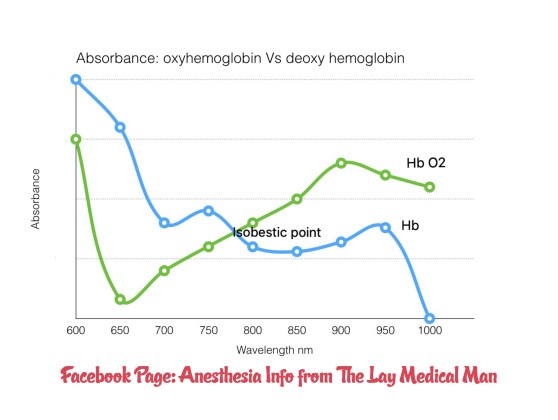
☝️️One LED emits light at 660 nm (red light) and the other at 940 nm (infrared light)

☝️️Oxyhaemoglobin and deoxyhaemoglobin absorb these wavelengths differently

☝️️Oxyhaemoglobin absorbs more infrared light (940 nm) and allows more red light (660 nm) to pass through

☝️️Deoxyhaemoglobin absorbs more red light (660 nm) and allows more infrared light (940 nm) to pass through

☝️️Isobestic point is at 806 nm

☝️️The LEDs flash in sequence: one on, then the other, then both off (to allow correction for ambient light). This triplet sequence happens 30 times per second

☝️️The amount of light transmitted through the patient at each frequency is detected by the photodiode.

☝️️The microprocessor corrects for ambient light, and also for the difference between arterial and venous saturations by deducting the minimum transmitted light, during diastole, from the maximum during systole.

☝️️After this, the ratio of oxy to deoxyhaemoglobin is determined and from this the percentage oxygen saturations is determined, using an empirical table derived from healthy volunteers who were exposed to varying degrees of hypoxia.

💅🏽Apart from the common causes like movement, nail varnish, diathermy,  others like

🔻severe anaemia

🔻cardiac arrhythmias

🔻Methaemoglobinaemia (characteristically cause saturations to be measured at around 85%)

🔻Increased venous pulsation, e.g. severe tricuspid regurgitation

🔻i.v. methylene blue dye (because it absorbs light in the 660–670 nm range also may cause erroneously low readings

💅🏻Carboxy hemoglobin (CO-Hb has similar absorption spectra as that of oxy-Hb) is detected by normal pulse oximeters as oxy hemoglobin–> erroneous high readings

💅🏻Cyanide prevents oxygen being utilised in respiration and so its extraction from the blood falls; so in cyanide poisoning, though the value is not inaccurate, it should be interpreted as inappropriately high

☝️️Fetal haemoglobin and Hb S (sickle) do not affect readings

☝️️The human volunteers used to construct empirical saturation tables did not have their oxygen saturations dropped below approximately 85%; hence readings below this number are extrapolated, not validated.

img_1994

CEREBRAL PHYSIOLOGY

A SORE STORY : THE PROPELLORS OF #INFLAMMATION 

🔥The process of inflammation is maintained by 3 important mechanisms:
✔️Vasodilation ✔️Increased capillary permeability ✔️Migration of leucocytes
🔥WHO IS DOING THESE?
▪️PLASMA DERIVED MEDIATORS:
✔️BRADYKININ –> Vasodilation & Increased capillary permeability
✔️COMPLEMENT MEDIATORS –> Mast cell degranulation –> Vasodilation & Increased capillary permeability + activate neutrophils and phagocyte migration
✔️COAGULATION: Forms a protective clot over the injured area
✔️ FIBRINOLYSIS: Activates neutrophils & macrophages by Fibrin Degradation Products (FDP)
▪️CELL DERIVED MEDIATORS:
✔️HISTAMINE (from basophils and mast cells) –> Vasodilation & Increased capillary permeability
✔️LEUKOTRIENES (from basophils and mast cells) –> chemotaxis of granulocytes
Ⓜ️NEMO> ” leukoTRYenes TRY to catch granulocytes”
✔️TUMOR NECROSIS FACTOR (cytokine from macrophage) –> activates endothelial cells , enhances phagocytosis
Ⓜ️NEMO> “TN(F)™ = F for ‘Fagocytosis’ TM= TNF is from Macrophages ”
✔️CHEMOKINES are chemotactic #cytokines
✔️NITRIC OXIDE (from endothelial cells and macrophages) is a powerful vasodilator and smooth-muscle relaxant.