ASA-PS UPDATE 2014

DO YOU KNOW?

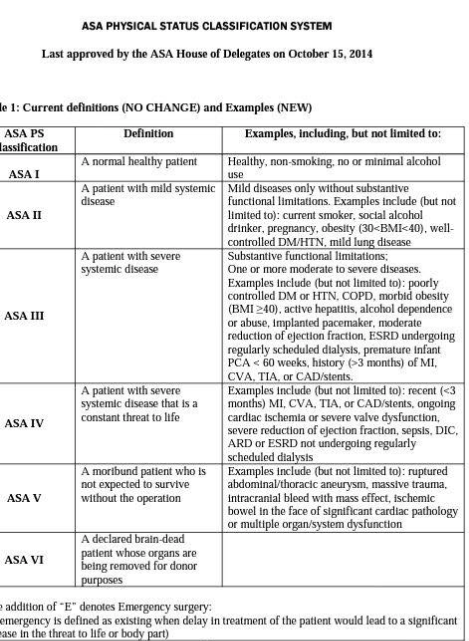
A social drinker is ASA II

A smoker is ASA II

Pregnant patient is ASA II

Obese patient is ASA II

Morbid obesity is not ASA II, but ASA III

Alcohol dependence without any documented systemic illness is also ASA III

Premature infant is ASA III

ESRD with regular HD is ASA III

ESRD without regular HD is ASA IV

Evidence of Sepsis or DIC- ASA IV

Intracranial bleed with mass effect is ASA V

A cardiac patient with bowel ischemia is ASA V

Screen Shot 2018-09-01 at 2.54.32 PM

Magnesium Sulphate therapy in preeclampsia

Continuous Intravenous Infusion
Magnesium sulfate 4-g to 6-g loading dose diluted in 100 mL fluid administered intravenously over 15 minutes, followed by continuous intravenous infusion at 1 to 2 g per hour. Discontinue 24 hours after delivery or last seizure.

If convulsions persist after 15 min, give up to 2 gram more intravenously as a 20% solution at a rate not to exceed 1g/min. If the patient weighs >70 kg then an additional 2 grams may be given slowly

Only give the next IM dose, or only continue the IV infusion if:
Respiratory rate > 16/min
Urine output > 25 ml/h
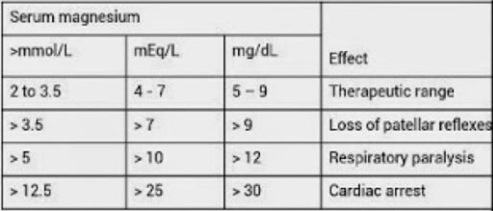
Patellar reflexes are present

If urine output < 100 ml in 4 h and there are no other signs of magnesium toxicity, reduce the IV infusion to 0.5 g/h.

If patellar reflexes are depressed and respiration is normal, withhold further doses of magnesium sulfate until the reflexes return and request magnesium level.
If there is concern about respiratory depression , stop magnesium, give oxygen by mask and give:
Calcium gluconate (10mL of 10% solution over 10 minutes)

ACOG TASK FORCE 2013
… For women with severe preeclampsia, the administration of intrapartum and postpartum magnesium sulfate to prevent eclampsia is recommended. For women with preeclampsia undergoing cesarean delivery, the continued intraoperative administration of parenteral magnesium sulfate to prevent eclampsia is recommended.

Screen Shot 2018-09-01 at 2.25.30 PM

SPONDYLOEPIPHYSEAL DYSPLASIA

ANESTHETIC CONCERNS

1. Short trachea with 15 rings or less; high chance of accidental one lung ventilation

2. Chances of Laryngeal Stenosis… Some times an unanticipated difficulty for passing tube, may trigger edema and stridor

3. Atlanto axial instability, can cause, massive cord edema, even with moderate neck flexion. Take LATERAL CERVICAL SPINE VIEWS IN FLEXION AND EXTENSION PREOPERATIVELY. If atlantoaxial instability is present and patient requires GA, give MANUAL IN LINE STABILIZATION/ do AWAKE FOB.

4. Restricted lung function accompanied by impending respiratory failure, is a situation, where we may be more inclined towards SAB in such patients (e.g. Pregnancy, where the uterus further compromise lung function). So regional anesthesia may be appropriate, if technically feasible.

5. Technical difficulties with SAB/EDB; epidural space located 2.5 cm from skin was reported in one case.

MULTIPLE SCLEROSIS- ANESTHESIA IMPLICATIONS, TREATMENT

This is the most frequently occurring demyelinating neuromuscular disorder. It’s a chronic progressive disease characterized by repeated exacerbations and partial remissions. It is characterized by the formation of plaques within the brain and spinal cord. These plaques cause demyelination around the axons, resulting in weakness and spasticity as well as sensory dysfunction.Upper motor neurone lesions, cerebellar lesions and sensory deficits are common.

Anaesthetic considerations.

  • General anaesthesia does not exacerbate MS. Non-depolarizing neuromuscular blocking agents may be used in normal doses. Caution should be exercised when using depolarizing neuromuscular blocking agents if the patient is debilitated. With the use of Suxamethonium, there is a risk of hyperkalemia

Regional blockade.

  • Local anaesthetics may exacerbate the symptoms due to the increased sensitivity of demyelinated axons to local anaesthetic toxicity. New lesions may develop coincidentally at the time of regional blockade and subsequent symptoms may be difficult to differentiate from nerve injury or may be blamed on the block. Complications have been reported with spinal anesthesia (Weak myelin sheath and direct neurotoxicity from LAs have been suggested as reason for this). Epidural may be relatively safer in this regard. (In epidural technique, there will be a lower concentration of LA in white matter). Therefore in general, regional blockade may be relatively contraindicated.

Temperature maintenance is important as symptoms can deteriorate with an increase in temperature, as demyelinated axons are also more sensitive to heat.

Most often, postop exacerbation, if it occurs, is due to fever and infections

We should explain the chance of exacerbation of symptoms before any form of regional anesthesia

TREATMENT

  • The treatment of MS includes treating acute attacks to limit sequelae, prophylactic medications to  reduce rate of progression, and symptomatic/supportive therapy

  • Acute attacks are treated with high-dose corticosteroids, i.v. methylprednisolone 500–1000 mg every day divided every 6 or 12 hours; tapered over 7–10 days.

  • Prophylactic medications include the disease-modifying drugs interferon β and glatiramer acetate. Side effects include local infections, fatigue, depression, and anxiety. Regular CBC, LFT, and electrolyte checks are needed.

  • For progressive disease, immunomodulatory drugs such as methotrexate, cyclosporine, cyclophosphamide, azathioprine, total lymphoid irradiation, mitoxantrone (risk of cardiotoxicity), mycophenolate mofetil, or interferon-β may be employed

  • Symptomatic therapies include antidepressants for depression, anticholinergics for hyperreflexic bladder, alpha-blockers or cholinergics/catherization for flaccid bladder, amantadine for fatigue, antispasticity drugs (baclofen, tinzanidine, dantrolene, benzodiazepines) for muscle spasticity, AEDs for tremor, clonus, and pain, and sildenafil for sexual dysfunction. More invasive methods, for example, botulinum toxin injections for focal spasticity or bladder augmentation for spastic bladder may be required in more severe cases

  • Supportive care includes physical/occupational therapy, coping strategies or lifestyle modifications, cognitive-behavioral therapy, and emotional support.

  • In more severe cases, ambulatory aids or wheelchairs and other home-assist devices and caregiver support may be necessary

G6PD Deficiency

# Makes the RBC membrane friable and leads to episodic hemolytic anemia n jaundice
# Stress (surgery or anesthesia), drugs, newborn period, infection, exposure to fava beans are stimulants/risk factors.
# Culprit drug list is long: vit C n K, Methylene blue (caution in rx of methemoglobinemia),SNP, prilocaine.
Check for anemia, need for transfusion, jaundice(can also appear postop),cataract(increased incidence)
Malignant Hyperthermia has been reported in association
Avoid elective surgeries during a hemolytic episode
Give a folic acid suppliment perioperatively
Paracetamol,Phenytoin,L Dopa etc are safe.

SJOGRENS SYNDROME-anesthesia implications

🏳️‍🌈Preoperative abnormalities

1. Symptoms of the sicca syndrome include dryness of the eyes and skin.

2. Check for associated RA, SLE, scleroderma, the polymyositis, polyarteritis nodosa, chronic active hepatitis, and Grave’s disease.

3.Lung / airway : desiccation of the nose and bronchial tree, obstructive airways disease, interstitial lung disease

4.sensory / motor neuropathy may occur and CNS lesions have been described.

5.The patient may be taking corticosteroids or occasionally immunosuppressive agents.

🏳️‍🌈Anaesthetist’s concerns

1. Sometimes gross swelling of the salivary glands may make mask anaesthesia difficult.

2.The problems of pulmonary disease, if present.

3.The dry eyes are susceptible to damage during anaesthesia.

4.Allergy to antimicrobial agents, particularly penicillin, cephalosporins and trimethoprim

Management

1. careful assessment of the primary disease, and of any pulmonary involvement.

2. Drying agents should be avoided if possible.

3. The eyes should be protected with pads.

4. Anaesthetic gases should be humidified.

5. Steroid supplements may be required.

6. Care should be taken when prescribing antimicrobial agents

Practical issues in blood transfusion in pediatrics

1. Amount of transfusion to be given: It has been seen that transfusion with PRBC at a dose of 20 mL/kg is well tolerated and results in an overall decrease in number of transfusions compared to transfusions done at 10 mL/kg. There is also a higher rise in hemoglobin with a higher dose of PRBCs.

2. Properties of RBC products used in neonatal transfusion: a. RBCs should be freshly prepared and should not be more than 7 days old. This translates into a high 2, 3-DPG concentration and higher tissue extraction of oxygen.

3.Blood should be of newborn’s ABO and Rh group. It should be compatible with any ABO or atypical red cell antibody present in the maternal serum.

4. Volume and rate of transfusion:
a. Volume of packed RBC = Blood volume (mL/kg) x (desired minus actual hematocrit)/ hematocrit of transfused RBC
b. Rate of infusion should be less than 10 mL/kg/hour in the absence of cardiac failure.
c. Rate should not be more than 2 mL/kg/hour in the presence of cardiac failure.
d. If more volume is to be transfused, it should be done in smaller aliquots.

ANESTHESIA IMPLICATIONS-HAEMOCHROMATOSIS

/MNEMO/: ‘HEME LDH’

1. Liver Dysfunction
2. Diabetes
3. Heart Failure

EDTA induced pseudothrombocytopenia:

Problems: unnecessary investigations, delay in doing sx

Steps if suspected (asymptomatic persistent low plt counts):
Rpt PLT COUNT and PERI SMEAR using ANOTHER anticoagulant like heparin/citrate. Or use non-anticoagulated blood taken directly into the platelet counting diluent fluid.. Can see plt clumps in peripheral smear.

HYPOTHYROIDISM: ANESTHESIA CONCERNS

1.Hypothyroidism
2.Anemia
3.Reduced plasma volume
4.Impaired hepatic drug metabolism
5.Hypoglycemia
6.Impaired clearance of free water
7.Hyponatremia
8.Enlarged tongue
9.Nerve compression due to myxoedema
10.Delayed gastric emptying