A FEW FACTS ABOUT COAGULATION FUNCTION, IT’S MONITORING & Regional Anesthesia IN OBSTETRIC PATIENTS

During routine epidural or spinal anaesthesia, accidental puncture of epidural veins occurs in 1–18% of patients

The incidence of hematoma after epidural techniques is estimated to be in the order of 1:150,000 after epidural placement and 1:220,000 after spinal injection in the general population

removal of epidural catheters posed an equal risk to insertion ( Van- dermeulen et al)

Surgery on spinal haematoma should ideally be performed within 8–12 h of the identification of symptoms in order to improve the chances of recovery.

The overall risk of death in those having general anaesthesia for caesarean section was quoted in 2007 as being just over 1:25,000.

The levels of factors VII, VIII and fibrinogen increase and those of anticoagulation factors decrease, causing augmented coagulation and decreased fibrinolysis in pregnancy.

There is no evidence to support routine full blood count (FBC) or coagulation tests in women before the performance of a regional block in those who have had

normal FBC results

no bleeding history

no signs or symptoms of liver disease

no signs or symptoms of pre-eclampsia, abruption or clinical signs of disseminated intravascular coagulation

no recent anticoagulant treatment.

In women with known thrombocytopaenia, a Full Blood Count (FBC) should be checked within 24 h of a regional procedure.

In women with mild to moderate pre-eclampsia, the course of the disease can be unpredictable and so FBC be checked within 6 h. In addition, coagulation tests should be performed if platelets are <100000/mcL or if there is abnormal liver function.

In severe disease, FBC and clotting should be checked immediately before a procedure, as platelet levels in particular can decline rapidly.

Women with pregnancy-induced hypertension alone do not require an FBC before a regional procedure

Activated partial thromboplastin time ratio (APTTR) and international normalised ratio (INR) are slightly decreased in late pregnancy.

In a patient who receives LMWH, if he/she is simultaneously taking NSAID+Aspirin, there is an increased risk if last dose of LMWH is between 12-24 hours; it further increases if last dose is <12 hours

In patients with pre-eclampsia and platelet count between 75000-100000/mcL, there is an increased risk even if coagulation tests are normal; but it increases further if the counts has not been stable (=decreasing platelet count)

#obstetrics , #anesthesia , #coagulation , #anaesthesia

Reference: Abnormalities of Coagulation and Obstetric Anaesthesia, Hilary Swales, AAGBI Core Topics in Anaesthesia 2015
VIVA SCENE: COMPATIBILITY IN BLOOD TRANSFUSIONS: RBC Vs FFP Vs PLATELETS AND OTHER QUESTIONS

COMPATIBILITY: RBC TRANSFUSION

In red cell transfusion, there must be ABO and RhD compatibility between the donor’s red cells and the recipient’s plasma.

All healthy normal adults of group A, group B and group O have ANTIBODIES IN THEIR PLASMA against the red cell types (antigens) that they have not inherited

Among the ABO blood groups:

Group A individuals have antibody to group B

Group B individuals have antibody to group A

Group O individuals have antibody to group A and group B

Group AB individuals do not have antibody to group A or B. So,

1 Group O individuals can receive blood from group O donors only ( as the antibodies against A or B in their plasma will react with any A or B antigens which enter the circulation)

2 Group A individuals can receive blood from group A and O donors

3 Group B individuals can receive blood from group B and O donors

4 Group AB individuals can receive blood from AB donors, and also from group A, B and O donors ( as their plasma don’t have any antibodies against any antigens)

RhD RED CELL ANTIGENS AND ANTIBODIES

Is the second most important group system. Out of the existing C,D and E antigens, D is the most antigenic one. Anti D antibodies are not normally found in the blood of Rh negative individuals; instead they develop it only when itcomes into contact with Rh positive blood during child birth or inappropriate transfusion. In case of subsequent transfusins or pregnancies with Rh positive blood- this can cause rapid destruction of RhD positive red cells (Hemolytic disease of the newborn[HDN] in subsequent pregnancies; to prevent this sensitization we should give Rhesus imunoglobulin= Anti-D prophylaxis- to the Rh negative mother who gave birth to an Rh positive baby). The fetal red cells are haemolysed, causing severe anaemia. HDN due to ABO incompatibility is usually less severe than Rh incompatibility.). FFP does not need to be Rh-compatible. Anti-D prophylaxis is not necessary in Rh D-negative recipients of Rh D-positive FFP. 

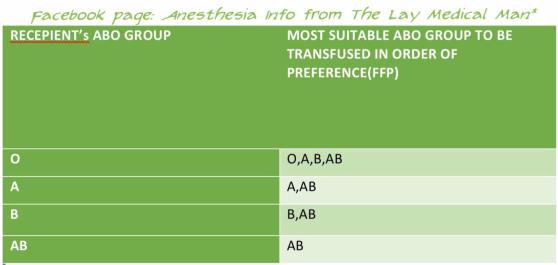
PLASMA TRANSFUSION: COMPATIBILITY

In plasma transfusion, group AB plasma can be given to a patient of any ABO group because it contains neither anti-A nor anti-B antibody.

1 Group AB plasma (no antibodies) can be given to any ABO group patients

2 Group A plasma (anti-B) can be given to group O and A patients

3 Group B plasma (anti-A) can be given to group O and B patients

4 Group O plasma (anti-A + anti-B) can be given to group O patients only

FFP does not need to be Rh-compatible (However, the unit will still be labelled as Rh +ve or Rh −ve) ; anti-D prophylaxis is not necessary in Rh D-negative recipients of Rh D-positive FFP

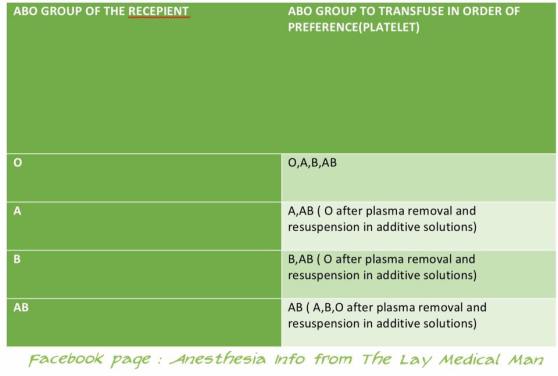
PLATELET TRANSFUSION: COMPATIBILITY

The Platelet Concentrates( PCs ) transfused must be ABO-identical, or at least ABO-compatible, in order to give a good yield ( Ideally, ABO identical units should be used but, in an emergency, ABO non-identical units can be used, although the improvement seen in platelet count post-transfusion may be less.)

Group O PC can be used for patients with blood groups A, B, and AB ONLY IF, they are resuspended in additive/preservative solutions, or if negative for high titre anti-A/A,B

ABO-incompatible PCs have reduced efficacy and, preferably, should not be used

Rh-negative patients, in particular women of childbearing age, should receive, if possible, RhD-negative PC

In the case of a transfusion of a RhD-positive PC to a RhD-negative women of childbearing age, 250 IU (50 μg) of anti-D immunoglobulin should be administered, a dose able to cover the transfusion of five therapeutic doses of PC in 6 weeks

ACUTE EMERGENCY : COMPATIBILITY

During an acute emergency, the blood bank may send group O (and possibly RhD negative) blood, especially if there is any risk of errors in patient identification. This may be the safest way to avoid a serious mismatched transfusion, in such situations.

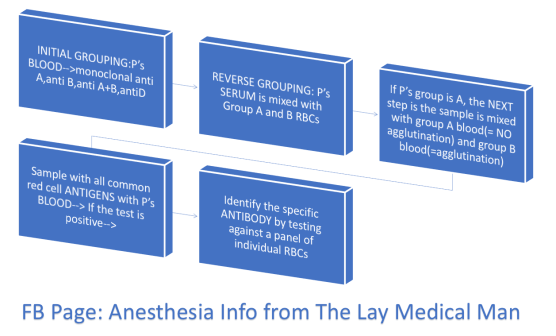
HOW A GROUP AND SAVE IS PERFORMED? (P’s = Patient’s)

Screen Shot 2019-08-11 at 11.48.54 am

#BloodTransfusion , #ABO , #BloodGroup , #TransfusionMedicine , #Anaesthesia , #Anesthesia , #Bloodbank

Reference: The Clinical Use of Blood, Handbook, WHO,
Recommendations for the transfusion of plasma and platelets Giancarlo Liumbruno, Francesco Bennardello, […], and as Italian Society of Transfusion Medicine and Immunohaematology (SIMTI) Working Party

15000768_1139329719436181_1357356490299776143_o14915305_1139329722769514_5358933164978110125_n


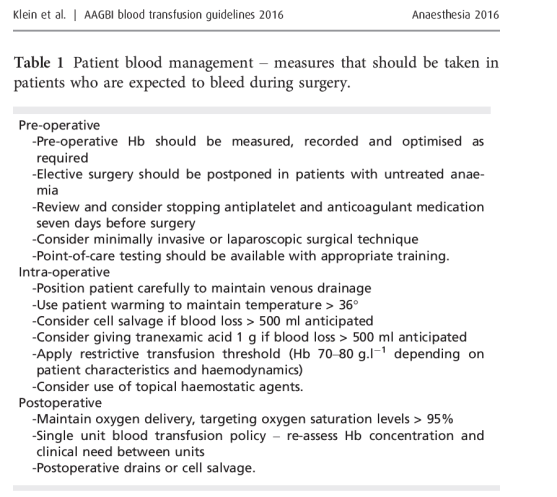
AAGBI GUIDELINES 2016

Screen Shot 2019-08-11 at 12.01.43 pm

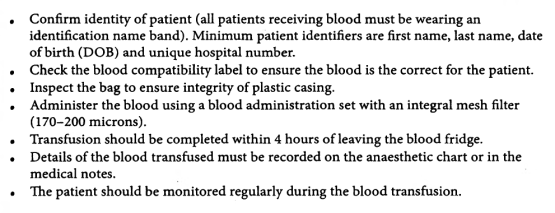
HOW WILL YOU TRANSFUSE THE BLOOD?

Screen Shot 2019-08-11 at 1.16.04 pm

Also preoperatively the need for transfusion must have been explained and written informed consent should have been taken

A general Hb threshold of 7.0 g/dl should apply as a guide for red cell transfusion. 8.0 g/dl for patients with IHD

ALSO NOTE:

A transfusion of 10 ml/kg of RBC should increase Hb by approximately 2.0 g/dl-

Cryoprecipitate should be given in a dose of 510 ml.kg-1

Platelets should be given in a dose of 1020 ml.kg-1.

Fresh frozen plasma may be given in doses of 1015 ml.kg-1.

Tranexamic acid can be used in children: a loading dose of 15 mg.kg-followed by infusion 2 mg.kg-1.h-1 should be used in trauma

Succinylcholine aka Suxamethonium

Two molecules of acetyl choline joined together by the acetyl group forms Succinylcholine

It can be presented as chloride, bromide or iodide salt

When presented as the chloride salt, it’s a solution with concentration 50 mg/ mL

When presented as bromide or iodide salts, they are powders, with more stability, shell life and suited for warm climates; but has to be reconstituted before use

pH of the solution is around 4

So they are destroyed by mixing it with alkaline solutions (e.g. Thiopentone )

#anesthesiology , #anaesthesia , #pharmacology

Reference: Kestin I. Suxamethonium. Update in Anaesthesia 1992; 1: article 7. Peck T, Hill S, Williams M. Pharmacology for Anaesthesia and Intensive Care, 3rd edn. Cambridge: Cambridge University Press, 2008; pp. 179–84 .

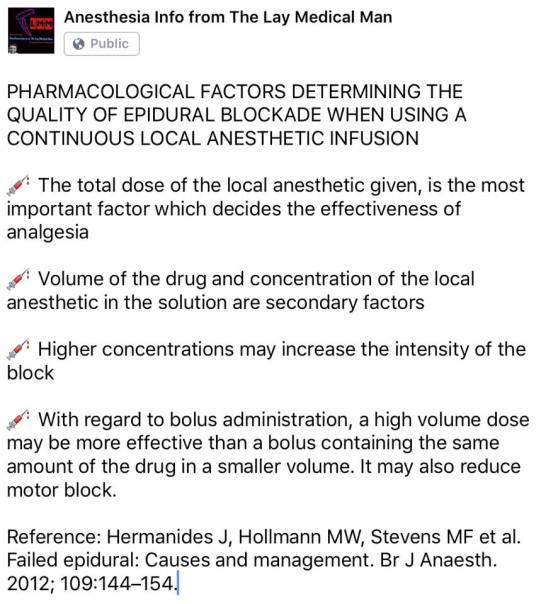
Pharmacological factors determining the quality of epidural blockade when using a continuous local anesthetic infusion

14522753_1129522723750214_2057384185164985570_n

FIBROMYALGIA- AN OVERVIEW

Is a common chronic pain condition, characterised by

Pain ( Spontaneous, widespread , diffuse, worse in the morning, hypersensitivity to all painful stimuli, >3 months duration, 11 out of 18 defined tender points produce tenderness on digital palpation)
Sleep disturbances
Fatigue

Pathophysiology may include

dysfunction of descending inhibitory pathways
abnormal neurotransmitter release
central sensitisation etc

Tricyclic antidepressants ( like Amitriptyline 5-10 mg ) may be effective in fibromyalgia as they reduce pain & fatigue and improve sleep

Other therapies used:

Pregabalin
Gabapentin
Newer MAO inhibitors like pirlindole
TENS
Acupuncture
Intravenous lignocaine
Injection of trigger points
Cognitive Behavioural Therapy
Warm bath
Complimentary therapies

#pain , #fibromyalgia , #PainManagement

Reference: Dedhia JT, Bone ME. Pain and fibromyalgia. Contin Educ Anaesth Crit Care Pain. 2009; 9(5): 162–166.

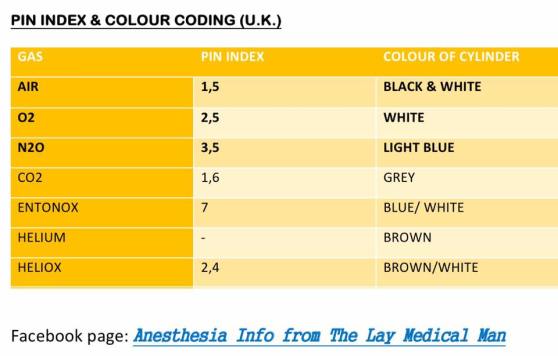
PIN INDEX

14721733_1121864291182724_3787877376021354340_n

HOW Hb S BECOMES A VILLAIN IN SICKLE CELL DISEASE (SCD) ?

Inherited as Autosomal Recessive disease (MNEMO> Sickle Cell Disease causes Recession of RBC function)

A single DNA base change ( Beta chain) causes SCD

DNA base change is Adenine for Thymine & the resultant amino acid change is Valine for Glutamic Acid ( MNEMO> Adenine Added; Valine got a Welcome; Glutamine has to Go )

Thus Hb S is produced. As Valine is hydrophobic, the deoxygenated Hb is less water soluble and gets precipitated & polymerized inside the RBC

This polymerization slightly reduces the overall affinity for O2; otherwise the affinity for O2 is same for Hb A and Hb S

These changes also make the RBCs more rigid and contributes to sickling and microvascular occlusion

Regarding hypoxaemia, HbS will precipitate at a PO2 of 5–6 kPa (37-45 mm of Hg). As venous PO2 lies in this range, in case of homozygous individuals having only abnormal Hb will have continuous sickling

Patients with sickle cell trait experience sickling at much lower partial pressures (2.5–4 kPa / 19-30 mm of Hg )

Sickledex test produces a turbidity and becomes positive even with a very small amount of Hb S: so it CAN NOT differentiate between homo & heterozygous states

Reference: Smith T, Pinnock C, Lin T. Fundamentals of Anaesthesia, 3rd edn. Cambridge: Cambridge University Press, 2009; pp. 234–5

A BIOPIC ABOUT THYROXIN

Tyrosine derived from thyroglobulin is combined with iodine to produce T3 & T4 (Thyroxin)

T3 is 5 times more active than T4, though T4 is produced in larger amounts

‘ACTIVITIES OF TSH’

Increase the size & number of thyroid gland cells
Increase iodide binding
Increase the release of thyroglobulin into the colloid of the gland
Increase pinocytosis of colloid by the thyroid cells
Increase hormone production
Increase release of already produced hormone from the bound thyroglobulin into the bloodstream

In bloodstream the hormones are 99% protein bound.

Thyroxin Binding Globulin (TBG) has the greatest affinity; but Albumin has the greatest capacity for binding the hormones. Thyroxine-binding prealbumin (TBPA) also bind them

REGULATION OF HORMONAL ACTIVITY

For regulation of the hormonal levels, the negative feedback is mediated by the unbound free fraction
Stress inhibits production
Warmth decreases production
Cold increases production
Glucocorticoids, dopamine & somatostatin inhibit TSH secretion

Reference: Smith T, Pinnock C, Lin T. Fundamentals of Anaesthesia, 3rd edn. Cambridge: Cambridge University Press, 2009; p. 474 .

CAUDAL BLOCKS: A FEW FACTS

Most effective for children <20 Kg (~ under 6 years of age) and for dermatomes below T10

Common side effects are weakness of legs, urinary retention etc

Because of this, sometimes a caudal block may necessitate overnight admission

The incidence of epidural hematoma has been reported as 1 in 80000 cases

Dose calculation can be done using Armitage ( 0.5 mL/kg for lumbosacral & 1 mL/kg for lumbar blockade, with 0.25% levobupivacaine ) or Scott formulas

Additives used in caudal block:

Preservative free Ketamine: Extend duration of analgesia; not used in infants <6 months of age due to fear of neurotoxicity

Clonidine : Extend duration of analgesia; not used in preterm infants and neonates due to higher incidence of bradycardia and apnoea. Provides postoperative sedation also.

Opioids when used as additives produce side effects like respiratory depression, pruritus & PONV

#EpiduralBlock , #Anaesthesia , #Anesthesia

References: De Beer DAH, Thomas ML. Caudal additives in children: solutions or problems? Br J Anaesth. 2003; 90: 487–498. Patel D. Epidural analgesia for children. Contin Educ Anaesth Crit Care Pain. 2006; 6(2): 63–66.

Iron (Fe) metabolism

We ingest dietary iron in the form of either as free Fe or as haem bound Fe

The efficiency of absorption varies & is between 5-25% only

It also depends on total body Fe stores

We cannot expel iron by metabolism: then what’s the way? (1) We depend on slow losses through cell sloughing, menstruation, bleeding etc (2) We absorb only what we want

Fe is absorbed through duodenal & jejunal mucosa

If it’s free Fe, it attaches itself to a specific receptor ( it’s expression depends on the total body Fe stores) on the apical membrane of the cell. Fe is absorbed by active transport.

If haem-bound Fe, it enters the cell by pinocytosis, and inside the cell, haem is broken down

Here it binds with apoferritin to form ferritin, which is the intracellular storage form.

When required, Fe is released into the plasma. Here it binds with the transport molecule beta-transferrin ( it’s expression is also dependent on total body Fe store)