VIVA SCENE: HYPOCALCAEMIA

Plasma calcium < 2.2 mmol/L

Normal values: Total calcium 2.25-2.60 mmol/L; ionised calcium 1.12-1.32 mmol/L

HYPOCALCAEMIA CAUSES:

  • Decreased parathyroid hormone

  • Decreased Vitamin D activity (e.g. intestinal malabsorption, liver disease, CRF)

  • Increased calcium loss (e.g. chelating agents, calcification of soft tissues)

  • Decreased ionised calcium (e.g. alkalosis)

  • Tumour Lysis Syndrome
  • Diarrhoea, vomiting, and nasogastric suction can cause hypomagnesaemia with secondary hypocalcaemia (HSH)

CLINICAL FEATURES:

  • Tetany
  • Seizures
  • Emotional instability/agitation/anxiety
  • Myopathy

ECG:

  • QTc prolongation by prolonging the ST segment

  • Torsades de pointes and atrial fibrillation in severe cases

NB: The corrected QT interval (QTc) is taken as the time between the beginning of the QRS complex and the end of the T wave, it is less than 440 ms in men and 460 ms in women. Severe hypocalcaemia (less than 1.9 mmol/L) may cause a prolongation of the QTc. A QTc greater than 500 ms is associated with an increased risk of Torsades de Pointes.

TREATMENT:

  • Ca2+ 0.5mL/kg (max 20mL) of 10% calcium gluconate OR 0.2mL/kg of 10% calcium chloride
  • Administer by slow IV (max 2 mL/min), repeat if necessary.
  • Calcium can precipitate or exacerbate digitalis toxicity therefore IV calcium must be given very slowly in patients on digoxin and the ECG must be monitored continuously

VIVA SCENE: CARBON MONOXIDE (CO) POISONING

AETIOLOGY: Carbon monoxide is produced by incomplete combustion and is found in car exhaust, faulty heaters, fires and in industrial settings. Carboxyhaemoglobin (COHb) concentrations in cigarette smokers range as high as 10%.

MECHANISM: Binds to Hb with 210 times affinity than O2: so reduce the O2 carrying capacity of blood. Also disrupts oxidative metabolism, binds to myoglobin and cytochrome oxidases, causes lipid peroxidation. Final result is tissue hypoxia. Severity depends on the duration of exposure, CO levels and patients pre-event health status: pre-existing cerebral disease, cardiac failure, hypovolemia and anemia increase toxicity

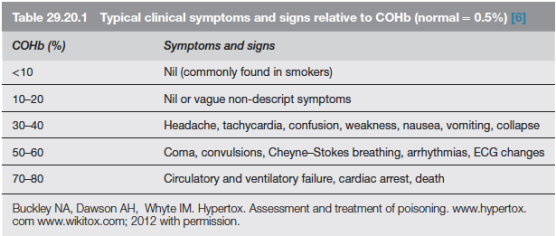
DIFFERENTIAL DIAGNOSIS: Cyanide poisoning ( suspected when CNS effects are out of proportion with COHb concentrations and if there is a marked lactic acidosis)

Screen Shot 2019-09-04 at 11.31.29 am

EVALUATION & MANAGEMENT:

  • ABC approach
  • Secure the airway; if GCS<8, consider intubation
  • Stabilize respiration:  consider mechanical ventilation or CPAP
  • Get intravenous access
  • Send samples for estimation of Hb(?anemia), electrolytes (dyselectrolytemias worsen the cardiac toxicity), COHb levels (to confirm diagnosis; useless in prognosis), blood sugar, ABG and cardiac enzymes. Take an ECG.
  • Metabolic acidosis due to lactate give a clue to the extend of ischemia. Net effect of metabolic acidosis may be beneficial on O2 delivery; but treated if pH<7
  • Patient discouraged from activity
  • 100% O2 reduces the half life of COHb from 4 hours (in ambient air) to 40 minutes. 4 to 6 h of 100% normobaric oxygen will remove over 90% of the carbon monoxide. Oxygen toxicity is unlikely with less than 24 h treatment
  • When immediately available, hyperbaric oxygen (HBO) should be considered with serious CO poisoning. Oxygen at 2–3 atmospheres will further reduce the half-life of COHb to about 20 min but, more importantly, it causes very rapid reversal of tissue hypoxia due to oxygenation of tissue from oxygen dissolved in the plasma. Some clinicians implement it based on the presence of any of the following: history of loss of consciousness, abnormal neuropsychiatric testing or neurological signs, pregnancy. COMPLICATIONS OF HBO: decompression sickness, rupture of tympanic membranes, damaged sinuses, oxygen toxicity

  • CO PRODUCTION WITH SODALIME USE: Occurs when inhalational agents with CHF2 moiety such as desflurane, enflurane, and isoflurane are used with desiccated soda lime granules that was left unused for a long time. Can be significant in smokers especially when very low flows are used. Factors increasing the production of CO include° Type of inhaled anaesthetic agent (magnitude of CO production from greatest to least is desflurane > enflurane > isoflurane > sevoflurane)° High absorbent dryness ° Type of absorbent (at a given water content, baralyme produces more CO than soda lime)° Increased temperature° Higher anaesthetic concentration

VIVA AID: INTRAVENOUS FLUIDS IN PAEDIATRIC POPULATION; SALIENT POINTS FROM VARIOUS GUIDELINES

NICE 2015 GUIDELINES

  • For fluid resuscitation in children and young people: use glucose‑free crystalloids that contain sodium in the range 131–154 mmol/litre, with a bolus of 20 ml/kg over less than 10 minutes. Take into account pre‑existing conditions like cardiac disease or kidney disease, as smaller fluid volumes may be needed.
  • For term neonates who need IV fluid resuscitation: use glucose‑free crystalloids that contain sodium in the range 131–154 mmol/litre, with a bolus of 10–20 ml/kg over less than 10 minutes.
  • Do not use tetrastarch for fluid resuscitation.
  • Calculate routine maintenance IV fluid rates for children and young people using the Holliday–Segar formula (100 ml/kg/day for the first 10 kg of weight, 50 ml/kg/day for the next 10 kg and 20 ml/kg/day for the weight over 20 kg). Be aware that over a 24‑hour period, males rarely need more than 2500 ml and females rarely need more than 2000 ml of fluids.
  • Calculate routine maintenance IV fluid rates for term neonates according to their age, using the following as a guide:
  • From birth to day 1: 50–60 ml/kg/day.
  • Day 2: 70–80 ml/kg/day.
  • Day 3: 80–100 ml/kg/day.
  • Day 4: 100–120 ml/kg/day.
  • Days 5–28: 120–150 ml/kg/day.
  • IV fluids for routine maintenance in children and young people: initially use isotonic crystalloids that contain sodium in the range 131–154 mmol/litre.
  • Measure plasma electrolyte concentrations and blood glucose when starting IV fluids for routine maintenance (except before most elective surgery), and at least every 24 hours thereafter.
  • Base any subsequent IV fluid prescriptions on the plasma electrolyte concentrations and blood glucose measurements.
  • If term neonates need IV fluids for routine maintenance: initially use isotonic crystalloids that contain sodium in the range 131–154 mmol/litre with 5–10% glucose
  • If there is a risk of water retention associated with non‑osmotic antidiuretic hormone (ADH) secretion, consider either:
    • restricting fluids to 50–80% of routine maintenance needs or
    • reducing fluids, calculated on the basis of insensible losses within the range 300–400 ml/m2/24 hours plus urinary output.

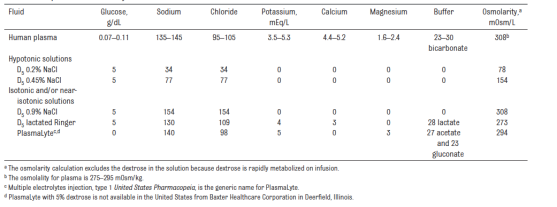
Screen Shot 2019-08-16 at 5.28.16 pm

EUROPEAN CONSENSUS 2011 FOR INTRAOPERATIVE FLUID THERAPY

An appropriate solution for intraoperative infusion in children should have an osmolarity and sodium content close to the physiologic range in order to avoid hyponatraemia, an addition of 1–2.5% glucose in order to avoid hypoglycaemia, lipolysis or hyperglycaemia and should also include metabolic anions (i.e. acetate, lactate or malate) as bicarbonate precursors to avoid acid–base balance disturbances (i.e. hyperchloraemic acidosis). The intraoperative infusion of isotonic solutions containing 1–2.5% glucose in children is considered well established use in Europe

BELGIAN PERIOPERATIVE FLUID RECOMMENDATIONS 2012

For children undergoing uncomplicated day-case surgery or minor surgery and those expected to remain nil-by-mouth for at least 24 hours after surgery or undergoing major surgery, a full volume maintenance fluid should be administered during the intraoperative period and immediate post-operative periodas this is associated both with a reduced incidence of postoperative nausea and vomiting particularly in those children receiving opioids, and with a significantly reduced postoperative increase in ADH concentration. The latter presumed to be a result of correction of hypovolemia. 

During the first postoperative day, decreased volumes of the maintenance fluid consisting of an isotonic solution at two-thirds or 70% of the calculated maintenance rate is recommended, provided the child is normovolemic.

This solution would preferably be enriched with glucose 5% (50 ml glucose 50% in 500 ml fluid) in order to provide an adequate caloric supply as recommended (4 to 8 mg glucose/kg/min). In addition, the osmolarity of such a solution makes it possible to be administered on a peripheral venous access.

Recognizing that fluids used to replace ongoing losses should reflect the electrolyte composition of fluid lost, NaCl 0.9% has been considered as appropriate in most cases. Isotonic fluids including colloids are to be used as a bolus in the event of hypovolemia.

Consider iv. fluids as medications.

Administer isotonic fluids (saline 0.9%, Plasmalyte®, Hartmann® or colloids) as a bolus in the event of hypovolemia.

Monitoring plasma electrolytes and glucose concentrations regularly i.e. once daily or more if clinically indicated (documented plasma [Na] < 135 mmol/L)

AMERICAN ACADEMY OF PAEDIATRICS 2018

The American Academy of Pediatrics recommends that patients 28 days to 18 years of age requiring maintenance IVFs should receive isotonic solutions with appropriate potassium chloride and dextrose because they significantly decrease the risk of developing hyponatremia. (For the purposes of this guideline, isotonic solutions have a sodium concentration similar to PlasmaLyte, or 0.9% NaCl)

APA CONSENSUS GUIDELINE ON PERIOPERATIVE FLUID MANAGEMENT IN CHILDREN 2007/ 2010 REVIEW

EXECUTIVE SUMMARY

1. Children can safely be allowed clear fluids 2 hours before surgery without increasing the risk of aspiration.

2. Food should normally be withheld for 6 hours prior to surgery in children aged 6 months or older.

3. In children under 6 months of age it is probably safe to allow a breast milk feed up to 4 hours before surgery

4. Dehydration without signs of hypovolaemia should be corrected slowly.

5. Hypovolaemia should be corrected rapidly to maintain cardiac output and organ perfusion.

6. In the child, a fall in blood pressure is a late sign of hypovolaemia.

7. Maintenance fluid requirements should be calculated using the formula of Holliday and Segar

8. A fluid management plan for any child should address 3 key issues

i. any fluid deficit which is present

ii. maintenance fluid requirements

iii. any losses due to surgery e.g. blood loss, 3rd space losses

9. During surgery all of these requirements should be managed by giving isotonic fluid in all children over 1 month of age

10. The majority of children over 1 month of age will maintain a normal blood sugar if given non-dextrose containing fluid during surgery

11. Children at risk of hypoglycaemia if non-dextrose containing fluid is given are those on parenteral nutrition or a dextrose containing solution prior to theatre, children of low body weight (<3rd centile) or having surgery of more than 3 hours duration and children having extensive regional anaesthesia. These children at risk should be given dextrose containing solutions or have their blood glucose monitored during surgery.

12. Blood loss during surgery should be replaced initially with crystalloid or colloid, and then with blood once the haematocrit has fallen to 25%. Children with cyanotic congenital heart disease and neonates may need a higher haematocrit to maintain oxygenation.

13. Fluid therapy should be monitored by daily electrolyte estimation, use of a fluid input/output chart and daily weighing if feasible.

14. Acute dilutional hyponatraemia is a medical emergency and should be managed in PICU.

ANTIPSEUDOMONAL AGENTS

A 70 year-old female is intubated 5 days after hospital admission for hypoxemic respiratory failure after a witnessed aspiration event. Prior to admission, the patient lived in a nursing home, and recently was treated for left leg cellulitis with a short course of intravenous antibiotics. Her medications include metoprolol, metformin, glyburide, atorvastatin, and baby aspirin. Three days after intubation, the patient is noted to have a temperature of 102.5 °F, a blood pressure of 70/50 mmHg, a white blood cell count of 20.0 × 10⁹/L, with purulent secretions suctioned from the endotracheal tube. You decide to initiate antibiotic therapy. Which of the following is the best antibiotic regimen to initiate at this time?

A. Ceftriaxone and ertapenem

B. Imipenem, levofloxacin and vancomycin

C. Meropenem, cefepime, and piperacillin-tazobactam

D. Cefepime and daptomycin

E. Ceftriaxone and azithromycin

Answer: Yes its B!

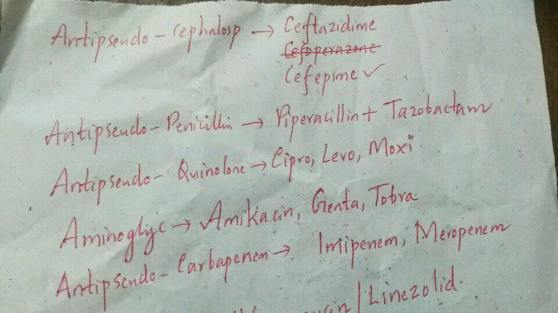
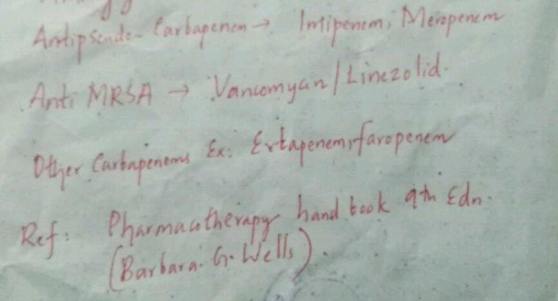
Healthcare associated infections are almost routine in today’s critical care units, and the increasing rates of multi-drug resistant (MDR) organisms is taking a toll on our clinical and economic systems. Ventilator associated pneumonia (VAP) is a subtype of healthcare associated infection, and is defined by the diagnosis of clinical pneumonia 48–72 h after intubation. Duration of mechanical ventilation, antibiotic use history, geography, co-morbidities, and the epidemiology of the ICU population all determine the etiology of a nosocomial pneumonia. Aerobic gram negative bacilli are the most common pathogens causing VAP. These include Klebsiella, Escherichia coli, Pseudomonas, Acinetobacter, Stenotrophomonas, Enterobacter, Citrobacter, Proteus, and Serratia species. Pseudomonas is the most prevalent pathogen recovered in VAP. With the emergence of MDR organisms, Methicillin resistant Staphylococcus aureus (MRSA) is also an important etiology of VAP, as well as anaerobes such as Bacteroides species. Community acquired pathogens, including Streptococcus and Haemophilus species are less likely to cause VAP. The antibiotic regimen that should be initiated depends on the suspicion that a patient harbors MDR pathogens. Usually, if a patient is hospitalized for more than 5 days, the possibility of MDR pathogens is high, particularly if a patient has been on intravenous antibiotic therapy recently. The first line treatment would include an antipseudomonal cephalosporin or an antipseudomonal carbapenem or an antipseudomonal penicillin with Beta lactamase inhibitor, plus an antipseudomonal fluoroquinolone or aminoglycoside, plus an anti-MRSA agent . Azithromycin should be considered for atypical coverage if Legionella is high on the differential and in severely ill patients. If an MDR pathogen is not suspected, a third-generation cephalosporin or respiratory fluoroquinolone or non-antipseudomonal carbapenem should be considered. Daptomycin is not appropriate to use for pulmonary infections, as it is inactivated by surfactant.

See the pictures for examples of these drug categories

37737577_1877901745578971_2212098029354221568_n

37731262_1877901735578972_4224498105422184448_n

WHEN VENTILATOR GIVEs ALARM & SHOWS ‘PATIENT-DEMAND IS HIGH’ : Troubleshooting the Ventilator

Check for causes:

Increased airway resistance- if so give bronchodilators

Anxiety–> increased RR + muscle tension–> increased airway resistance –> increased demand: Optimise sedation

Check for leaks in circuit and correct

If flow rate seems too low: Set higher inspiratory flow rate or reduce inspiratory time especially if patient is showing tachypnea

If Tidal volume or RR set too low: Increase it

Double triggering or breath stacking can happen if inspiratory time set is lower compared to that of the patient and ventilatory demand is high: Try increasing the inspiratory time or change to pressure control modes

NB:

Peak Inspiratory Pressure high with normal Plateau Pressure = it’s Increased airway resistance

Both (a)Peak Inspiratory Pressure and (b)Plateau Pressure are high and (a)-(b) is normal= it’s reduced compliance or auto peep

#CriticalCare , #MechanicalVentilation ,#VentilationBasics , #Ventilation , #anesthesia , #anesthesiologist , #ICUnurse , #ICUdoctor , #ICU

MECHANICAL VENTILATION FACTS

WHAT WILL HAPPEN IF WE GIVE A LARGE CARBOHYDRATE DIET TO AN ALREADY MALNOURISHED PATIENT IN THE ICU?

If we introduce nutritional support ( enteral or parenteral) based on the requirements of a regular healthy adult, to a malnourished patient, there will be a significant rise in basal insulin secretion, which will draw Potassium and Phosphate into the cell leading to hypokalemia, hypophosphatemia and fatal fluid shifts. ( Both rapid initiation and large amounts are dangerous). Phosphate depletion is also associated with increased urinary Magnesium excretion.

It can also be associated with Renal failure, Respiratory failure, Neuromuscular failure, Cardiac failure and Arrhythmias

This is known as “Refeeding Syndrome

So to avoid this, in patients at risk ( e.g. chronic alcoholics, those who have not eaten anything in last 5 days etc) , we should introduce nutritional support at not more than 50% of the daily requirement , for the first two days.

Feeding rates can be increased to normal levels, if there is no evidence of refeeding syndrome clinically and biochemically, thereafter.

NICE guidelines for the high risk patients : start support with a maximum 10 kCal per kg per day, with thiamine & B complex supplementation. Biochemical parameters to be monitored closely.

There is no need for Prefeeding correction of electrolytes

#ICU , #nutrition , #NutritionInICU , #CriticalCare , #Anesthesia , #Anaesthesiology
Reference: Mehanna HM, Moledina J. Refeeding syndrome: What it is, and how to prevent and treat it. BMJ. 2008; 336(7659): 1495–1498

Anesthesia concerns in Takotsubo / Stress Cardiomyopathy and it’s management in the ICU

Various stress-related cardiomyopathy syndromes are

(1) classic Takotsubo cardiomyopathy, which presents as an acute coronary syndrome

(2) left ventricular dysfunction associated with acute intracranial disease, especially Aneurysmal SAH

(3) transient cardiomyopathy, which occurs during other critical illness, especially sepsis, and

(4) transient cardiomyopathy associated with pheochromocytoma and exogenous catecholamine administration

Takotsubo Cardiomyopathy is also known as takotsubo syndrome, broken heart syndrome, ampulla cardiomyopathy, transient left ventricular apical ballooing, apical ballooning syndrome, transient left ventricular dysfunction syndrome, and stress [induced] cardiomyopathy

It was first described in Japan in 1990

Patients don’t have significant epicardial coronary artery disease

It presents like an acute coronary syndrome ; but symptoms like chest pain, dyspnea, and ECG changes may not be there in all cases

Was most frequently described in postmenopausal elderly women

Was often triggered by stressful situations.

Classic pattern of wall motion abnormality observed is “apical ballooning” usually associated with hyperkinesia of the basal segments ( but its NOT pathognomonic of the disease)

Onset is often preceded / precipitated by emotional or physiologic stress (NOT invariably)

Researchers at the Mayo Clinic proposed diagnostic criteria in 2004, which have been modified recently :

(1) transient hypokinesis, akinesis or dyskinesis in the left ventricular mid segments with or without apical involvement; regional wall motion abnormalities that extend beyond a single epicardial vascular distribution; and frequently, but not always, a stressful trigger

(2) the absence of obstructive coronary disease or angiographic evidence of acute plaque rupture

(3) new ECG abnormalities (ST-segment elevation and / or T-wave inversion) or modest elevation in cardiac troponin; and

(4) the absence of pheochromocytoma and myocarditis.

The most commonly accepted cause is excessive adrenergic/ catecholamine stimulation, which damages cardiomyocytes

Reports of its acute precipitation by administration of catecholamines (like adrenaline or dobutamine) and its reproduction by infusion of adrenaline in primates support this hypothesis

Most patients recover without complications; but others may develop complications like congestive heart failure, pulmonary edema often requiring endotracheal intubation and mechanical ventilation, cardiogenic shock requiring vasopressor or inotropic therapy and even intraaortic balloon pumping

Regarding treatment in the acute phase, avoidance of adrenergic agonists and initiation of antiadrenergic therapy (e.g., adrenergic blocking drugs or centrally acting 2 agonists) have been advocated

In patients presenting with left ventricular outflow tract obstruction, catecholamines are particularly contraindicated

If inotropic therapy is needed (as in case of heart failure, pulmonary edema, and cardiogenic shock etc) there has been suggestions, that the calcium sensitizer levosimendan may be the better choice

One school of thought is that a substantial portion of the damage caused by catecholamine toxicity to the myocardium has likely occurred by the time of clinical presentation, and thus administration of antiadrenergic therapy at this time is unlikely to completely reverse injury. Infact, in a number of reported cases, catecholamines seem to have facilitated recovery in patients with acute left ventricular dysfunction

Reference: anesthesia-analgesia March 2010 • Volume 110 • Number 3 ,circ.ahajournals

Brainstem Testing for diagnosis of Brain Death


The brain stem often fails from the rostral to caudal direction and therefore it is logical to undertake testing in the same manner.

PUPILLARY REFLEXES :

The pupillary light reflex involves cranial nerves II and III and localizes to midbrain. The pupils should be nonreactive to both direct and consensual light reflex.

POINTS:

Pinpoint pupils are indicative of damage to descending sympathetic fibers as a result of damage to pons.

The size of the pupils only provides an indication of the site of brainstem involvement and is not crucial for testing brain stem death.

Clues: 2,3 pupil in MID row, some inPONdS

OCULOCEPHALIC REFLEX :

It involves cranial nerves III, VI, and VIII and interneurons within the midbrain and pons. On head movement toward right or left, the eyes remain “fixed” on a point in an intact patient. In the brain-dead patient, the eyes move with the head, hence the name “dolls eye” reflex.

POINTS:

Before performing this test the physician must rule out cervical fracture or instability.

Clues: Oh…Cee…368 dolls in MID row and PONdS

CORNEAL REFLEX :

The reflex tests the V, VII, and III cranial nerves and localizes entirely to the pons. In the intact patient, touching the cornea with a cotton swab causes eyelid closure.

The eye rotates upward, demonstrating the cranial nerve III component, known as “bell’s phenomenon.”

Corneal= sensation ; hence 5&7; plus 3 bells

OCULOVESTIBULAR REFLEX :

The oculovestibular reflex tests cranial nerves III, VI, VIII, and IV. It involves the entire pons and midbrain.

PROCEDURE :

Elevate the head 30°C. Irrigate tympanic membrane with 50-cc iced water or saline. Wait 1 min for response. Repeat test on the other side after waiting 5 min. If the oculovestibular reflex is intact using cold water as stimulus, the eyes tonically deviate toward the side of the stimulus immediately followed by a fast recoil toward the contralateral side (apparent nystagmus). In the brain stem dead patient this response is absent.

Clues: ‘broad test’ Pons & Medulla; 3,4,6, 8 COWS

GAG AND COUGH REFLEXES :

They require a functioning medulla and test cranial nerves IX and X. Both reflexes should be absent in brain stem death.

The cough reflex is easily tested by stimulation of carina by suction through the endotracheal tube. The gag reflex can be elicited by stimulating the posterior pharynx with a tongue blade.

APNEA TESTING :

This final test aims to demonstrate the failure of medullary centers to drive ventilation. Apnea test should be the last brain stem reflex to be tested.

OBJECTIVE:

Is to stimulate the medulla while avoiding hypoxia and hemodynamic compromise associated with acidosis secondary to hypercarbia.

PROCEDURE:

After ensuring preoxygenation for 10 min a blood gas is performed to confirm baseline PaCO2 and SaO2 .

With oxygen saturation greater than 95% the ventilatior is disconnected inducing apnea for a period of time to achieve ETCO2 above 6 KPa (=45 mmHg). A repeat arterial blood gases is used to confirm that the PaCO2 is at least 6 KPa and the pH is less than 7.40.

An oxygen flow rate of 2–5 L/min via an endotracheal catheter or in difficult cases CPAP may be used to maintain oxygenation till this state is attained.

Apnea is continued for a further 5 min after a PaCO2 of 6 KPa (=45 mmHg) has been achieved.

If there is no spontaneous respiratory response, a presumption of absence of respiratory activity is made.

A further blood gas can be done to confirm that the PaCO2 has risen by 0.5 KPa (=4 mmHg) from the initial 45 mmHg baseline.

Reference: Brain Death in Neurosurgical Critical Care Amit Prakash, Basil Matta , Essentials of Neurosurgical Anesthesia & Critical Care 2012

UPPER GI BLEED IN ICU PATIENTS: THE POINTS WHICH YOU SHOULD KEEP IN MIND

Incidence of overt Upper GI Bleed (UGIB) ranges from 1.5 to 8.5% of all ICU patients but may be as high as 15% if no prophylaxis is used.

RISK FACTORS

Mechanical ventilation >48 h

Coagulopathy – INR>1.5 or platelet count <50,000

Others: Shock, Sepsis, Hepatic failure,Acute Renal failure, Multiple trauma, Burns >35% of total body surface area, Organ transplantation, Head trauma, Spinal trauma, History of PUD or UGIB

SPECIFIC POINTS REGARDING TREATMENT

Thrombocytopenia can develop in neurosurgical patients on H2 Blockers

The use of H2Bs and PPIs may increase the frequency of nosocomial pneumonia.

PROPHYLAXIS IS RECOMMENDED FOR ICU PATIENTS WHO EXHIBIT:

Coagulopathy (platelet count < 50,000 per m 3 , INR > 1.5, partial thromboplastin time (PTT) >2 times the control value)

Mechanical ventilation >48 h

History of GI ulceration or bleeding within the past year

Two or more of the following risk factors: sepsis; ICU stay >1 week; occult GIB ≥6 days; glucocorticoid therapy (>250 mg hydrocortisone).

REASONS FOR UGIB IN ICU PATIENTS:

The glycoprotein mucous layer may be denuded by increased concentrations of refluxed bile salts or uremic toxins common in critically ill. Alternatively, or in addition, mucosal integrity may be compromised due to poor perfusion associated with shock, sepsis, and trauma.

Excessive gastrin stimulation of parietal cells has been detected in patients with head trauma as oppose to be normal or subnormal in most other ICU patients.

Systemic steroids double the risk of a new episode of UGIB or perforation. Concomitant use with high doses of NSAIDs has been associated with a 12-fold increased risk for upper GI complications.

Helicobacter pylori infection

EMPIRICAL THERAPY

Start with an IV bolus of 80 mg and continue IV infusion at 8 mg/h for a total of 72 h. If no signs of rebleeding after 24 h, switch to oral PPI.

Octreotide is used in variceal bleeding. Start with an IV bolus of 50 mcg and continue IV infusion at 50 mcg/h for 3–5 days.

UGIB IN HEAD INJURY & OTHER NEUROSURGICAL PATIENTS:

They are more prone for UGIB because of 1. Frequent use of systemic steroids 2. Increased gastrin secretion 3. Significant gastric intramucosal acidosis is common in severe head injury. 4. Primary insult to the central nervous system may result in derangement of splanchnic blood flow secondary to neurohumoral mechanisms.

In head injury, GI dysfunction also may manifest as gastroparesis, ileus, increased intestinal mucosal permeability

Plasma levels of cortisol and age are independent predictors of stress ulcers following acute head injury.

#GastroIntestinalBleed , #StressUlcer , #ICU , #Anesthesia , #CriticalCare, #IntensiveCare , #NeuroSurgery , #HeadInjury , #TBI,#NeuroCriticalCare

Reference: Gastrointestinal Hemorrhage in Neurosurgical Critical Care Meghan Bost, Kamila Vagnerova , Ch:84, Essentials of Neurosurgical Anesthesia & Critical Care 2012 Strategies for Prevention, Early Detection, and Successful Management of Perioperative Complications